
A plant community has two dimensions. The first is the visible vegetation: seedlings, herbs, shrubs and mature plants currently occupying the site. The second is a hidden below-ground component: viable seeds that may remain dormant in litter or soil. This hidden component is the soil seed bank.
Plant ecologists study the seed bank because current vegetation is not always a complete record of future possibilities. A species may be absent above ground but represented by viable dormant seeds. Conversely, a species may dominate current vegetation but have few viable seeds in the soil.
The seed bank becomes ecologically meaningful only when we connect it with recruitment. Recruitment is the successful addition of new individuals to a population. The complete sequence is:
2. What is a seed bank?
A seed bank is a reservoir of viable seeds present on or within soil that can contribute to future plant populations. The term may include seeds in surface litter, the organic horizon and mineral soil. In plant ecology, the most commonly studied component is the soil-stored seed bank.
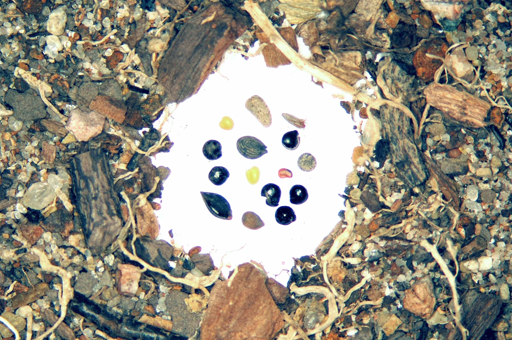
Important properties
- Seed density: number of seeds per unit area or soil volume.
- Species richness: number of species represented.
- Relative abundance: proportion contributed by each species.
- Viability: capacity to remain alive and germinate under suitable conditions.
- Persistence: ability to remain viable through time.
- Burial depth: vertical position in litter or soil.
- Spatial distribution: patchy or aggregated arrangement across microsites.
Seed banks are dynamic reservoirs. Seeds enter through seed rain and leave through germination, predation, decay, mortality, transport or loss of viability.
3. How seed banks form
Seed-bank formation begins with reproduction by adult plants. Flowers produce fruits and seeds; dispersal agents transport seeds; and seed rain deposits them on the ground. Burial may then occur through litter accumulation, cracking, soil movement, flooding, animal activity, earthworm action or cultivation.
- Flowering and fruit development.
- Seed maturation and release.
- Primary dispersal by wind, water, animals, gravity or humans.
- Seed rain onto litter or bare soil.
- Burial or incorporation into soil.
- Dormancy, germination, predation, decay or death.
Seed dispersal and spatial ecology
Dispersal affects both seed quantity and seed location. Wind may transport light seeds across open spaces. Water can deposit seeds in floodplains and depressions. Animals may carry seeds externally or deposit them in dung. Gravity often concentrates heavy seeds beneath parent plants. Human activities can move seeds through crops, contaminated soil, vehicles and construction.
4. Seed-bank types
| Feature | Transient seed bank | Persistent seed bank |
|---|---|---|
| Duration | Relatively short, often seasonal | Survives multiple unfavorable periods |
| Dormancy | Often short or seasonal | Often prolonged or delayed |
| Regeneration | Recent seed production supports replacement | Older seeds support delayed regeneration |
| Population meaning | Short-term memory | Long-term population memory |
Transient and persistent are ecological categories, not identical fixed properties of every species. Seed traits, soil environment and disturbance history influence persistence. Research on persistent banks emphasizes their role in population survival, naturalisation and invasiveness. [source]
5. Seed-bank composition versus above-ground vegetation
The two compartments may differ because they are controlled by different processes. Above-ground vegetation reflects current germination, establishment, survival, growth and competition. The seed bank reflects past seed input, burial, dormancy, longevity, predation and mortality.
| Process | Seed-bank consequence | Vegetation consequence |
|---|---|---|
| Long dormancy | Species remains below ground | Species may be temporarily absent above ground |
| High adult competition | Seeds may remain viable | Seedlings may be suppressed |
| Seed predation | Viable density declines | Future recruitment may decline |
| Disturbance | Seeds may be exposed or buried | Existing plants may be removed |
6. Seed-bank dynamics
Seed-bank dynamics is the study of gains, losses and transformations within the bank. A simple conceptual balance is:
Main processes
- Input: newly produced or externally dispersed seeds enter.
- Germination: viable seeds leave the bank to begin development.
- Mortality: seeds lose viability because of aging, stress or damage.
- Predation: insects, rodents, birds and other animals consume seeds.
- Decay: microorganisms and soil processes destroy seed tissues.
- Secondary dispersal: seeds move after initial deposition.
7. Viability, longevity and dormancy
Viability means that a seed is alive and capable of germination under suitable conditions. Longevity describes how long this capacity is retained. Dormancy is a reversible condition in which a viable seed does not germinate immediately.
Dormancy is not death. It is also not permanent inability to germinate. Dormancy may be released by moisture, temperature change, light, seasonal chilling, fire-related cues, smoke or physical damage to the seed coat. Because environmental conditions vary unpredictably, delayed germination can spread reproductive risk across time.
Seed ecology texts emphasize that persistence and dormancy should not be treated as exact synonyms. Dormancy may prevent immediate germination, but a dormant seed can still die; persistence concerns continued survival in the environment.
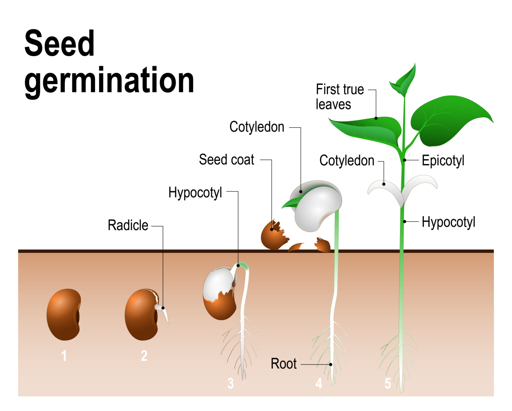
8. Germination, emergence, establishment and recruitment
| Stage | Definition | Typical risks |
|---|---|---|
| Germination | Embryo resumes growth and seed development begins. | Desiccation, unsuitable temperature, pathogens |
| Emergence | Seedling becomes visible above the soil. | Crusting, burial, darkness, herbivory |
| Establishment | Seedling survives and persists at the microsite. | Drought, shade, competition, grazing |
| Recruitment | New individual enters the population under the study definition. | Juvenile mortality, disease, disturbance |
Germination does not guarantee recruitment. The strongest bottleneck may occur before emergence, during early seedling survival or later during juvenile development.
9. Recruitment limitation
Seed limitation
Seed limitation occurs when too few viable seeds reach suitable microsites. A restored area may have fertile soil, appropriate moisture and good light but receive little seed rain because parent plants or dispersal agents are absent.
Establishment limitation
Establishment limitation occurs when seeds arrive but fail to become established. Drought, salinity, competition, insufficient light, poor soil, pathogens, herbivory and temperature stress can create this bottleneck.
| Diagnostic feature | Seed limitation | Establishment limitation |
|---|---|---|
| Seed arrival | Low or inadequate | High or adequate |
| Added seed response | Recruitment may increase | Recruitment may remain low |
| Management focus | Improve seed supply | Improve microsites and survival |
Seed and establishment limitation can occur together. Seed-addition experiments should measure the full pathway from germination to later survival.
10. Safe sites and environmental filtering
A safe site is a microsite where a seed can receive the resources and protection needed for germination and early survival. Safe sites may occur beneath litter gaps, near nurse plants, in canopy openings, beside soil particles that reduce evaporation or in exposed wetland mud after water recedes.
Environmental filtering acts sequentially. Soil moisture and temperature filter germination. Light and oxygen filter emergence. Competition, pathogens and herbivory filter seedling survival. Later drought, shade, disease and disturbance filter juvenile development.
11. Seed banks and population dynamics
Seed banks create a temporal connection between generations. A plant population may survive an unfavorable year because not all seeds germinate at once. In annual plants, the seed bank can be a major life stage. In perennial plants, it may supplement vegetative survival, clonal growth and adult reproduction.
Population structure includes seeds, seedlings, juveniles, mature plants and reproductive adults. Persistently low recruitment can produce an aging population, but population decline is not inevitable because survival, growth, reproduction and immigration also matter. Population ecologists therefore study transition rates among stages.
12. Succession and disturbance
Ecological succession is change in community composition through time. Seed banks can contribute early colonists after disturbance and preserve species that appear later when conditions become favorable. They influence succession but do not determine it alone. External seed dispersal, vegetative regrowth, competition, herbivory, soil development and climate also contribute.
Disturbance effects
- Fire: removes litter, changes light and temperature, and may provide heat or smoke cues.
- Flooding: transports seeds, alters oxygen and changes sediment depth.
- Grazing: changes seed production, litter and microsites.
- Cultivation: mixes soil and exposes buried seeds.
- Construction: removes soil, changes drainage and introduces external seeds.
13. Ecosystem examples
Grasslands
Moderate disturbance can create open microsites, while heavy grazing can reduce seed production, compact soil and increase erosion. Recruitment depends on both seed input and establishment conditions.
Forests
Canopy gaps increase light for some species but may also increase heat and evaporation. Shade-tolerant species may recruit in closed forest, whereas light-demanding species may require gaps. Browsing, drought and root competition continue after germination.
Wetlands
Water level changes determine oxygen, sediment exposure and germination opportunities. Receding water may expose suitable mud; prolonged flooding may inhibit oxygen-sensitive stages.
Deserts
Rainfall pulses are unpredictable. Dormancy and staggered germination prevent all seeds from depending on a single rainfall event. Fast drying can cause severe establishment limitation.
Fire-prone ecosystems
Some plants recruit after fire through heat- or smoke-sensitive germination, while others depend on surviving adults or incoming seed. Fire intensity and post-fire rainfall are critical.
14. Conservation and restoration
Seed-bank knowledge helps managers decide whether natural regeneration is realistic. Natural regeneration may be sufficient when viable native seeds remain, disturbance has created safe sites and competing weeds are controlled. Intervention may be necessary when the bank is depleted, isolated, dominated by invasive species or unable to provide the required species.
- Protect native seed sources and dispersal corridors.
- Sample soil before earthworks or restoration.
- Use direct seeding when seed limitation is diagnosed.
- Use nursery seedlings when establishment conditions are severe.
- Control invasive plants before they replenish persistent banks.
- Monitor recruitment over several seasons.
15. Invasive plants and weed ecology
Persistent seed banks can make management difficult because emergence may continue after adult plants are removed. Soil disturbance can expose buried seeds and create favorable germination sites. Effective management reduces new seed input, minimizes unnecessary soil disturbance, controls repeated emergence and continues long-term monitoring.
16. Climate change and recruitment
Climate change may alter seed production, seed longevity, dormancy release, germination timing, drought exposure, disturbance frequency and seedling survival. A shift in rainfall may cause germination to occur before reliable moisture is available. Warmer temperatures may change dormancy release or increase soil drying. These outcomes are species- and site-specific, so measured evidence should be separated from predictions.
17. How to study seed banks and recruitment
- Define the study area, microsites and soil-depth intervals.
- Collect replicated soil samples and measure sample volume.
- Use germination assays, physical extraction or both.
- Identify seedlings and estimate viability.
- Measure seed rain and above-ground vegetation separately.
- Record germination, emergence, establishment and survival over time.
- Use seed addition or microsite treatments to diagnose limitations.
- Analyze population stage transitions rather than counting emergence alone.
18. Key takeaways for BS Botany
- A seed bank is a hidden reservoir of viable seeds.
- A soil seed bank includes seeds in litter and soil.
- Seed rain is the input of dispersed seeds.
- Persistence is continued viability through time.
- Transient banks support short-term regeneration.
- Persistent banks support delayed regeneration.
- Dormancy is not death.
- Germination is not recruitment.
- Establishment is the survival of a seedling at its microsite.
- Seed limitation concerns arrival.
- Establishment limitation concerns post-arrival survival.
- Environmental filters act sequentially.
- Seed banks influence population structure and succession.
- Disturbance can activate or destroy seed banks.
- Restoration requires both seed supply and suitable microsites.
19. Examination revision
Important definitions
Seed bank; soil seed bank; seed rain; seed viability; seed longevity; seed persistence; transient seed bank; persistent seed bank; seed dormancy; germination; emergence; seedling establishment; recruitment; seed limitation; establishment limitation; safe site; environmental filtering; seed-bank dynamics.
Short questions
- What is a soil seed bank?
- Differentiate viability and persistence.
- Define seed rain.
- What is seed dormancy?
- List major seed-bank losses.
- Differentiate germination and emergence.
- Why is germination not recruitment?
- Define seed limitation.
- Define establishment limitation.
- What is a safe site?
Conceptual questions
- Why can seed-bank composition differ from above-ground vegetation?
- How can disturbance promote and suppress recruitment simultaneously?
- Why can a large seed bank produce few recruits?
- How does dormancy contribute to population persistence?
- How would you diagnose seed limitation experimentally?
- Why do canopy gaps affect species differently?
- How can seed banks influence succession?
- Why must restoration monitor later seedling survival?
Long questions
- Explain the complete pathway from seed production to population regeneration.
- Discuss seed-bank dynamics and factors affecting persistence.
- Compare transient and persistent seed banks.
- Explain recruitment bottlenecks and environmental filtering.
- Discuss seed banks in conservation, restoration and invasive-plant management.
20. References and textbook foundation
- Baskin, C. C., & Baskin, J. M. (2014). Seeds: Ecology, Biogeography, and Evolution of Dormancy and Germination. Academic Press.
- Fenner, M., & Thompson, K. (2005). The Ecology of Seeds. Cambridge University Press.
- Gallagher, R. S. (ed.) (2014). Seeds: The Ecology of Regeneration in Plant Communities, 3rd ed. CABI.
- Harper, J. L. (1977). Population Biology of Plants. Academic Press.
- Leck, M. A., Parker, V. T., & Simpson, R. L. (eds.) (1989). Ecology of Soil Seed Banks. Academic Press.
- Silvertown, J., & Charlesworth, D. (2001). Introduction to Plant Population Biology, 4th ed. Blackwell.
- Grime, J. P. (2001). Plant Strategies, Vegetation Processes, and Ecosystem Properties. Wiley.
- Gioria et al. (2021). Persistent soil seed banks and invasiveness. Open article.
- Soil seed-bank persistence across time and burial depth. Open article.


.jpg)





0 Comments