Biology Class 12 Chapter 22 Important Questions Solved

1) Difference between Genotype and Phenotype
Genotype: Genetic makeup / alleles present in an individual (e.g., TT, Tt, tt). It cannot be seen. Phenotype: External / observable characters (e.g., Tall or Dwarf plant). It can be seen and is influenced by genotype + environment.
2) Difference between Gene and Allele
Gene: Segment of DNA that controls one character (basic unit of heredity). Allele: Different alternative forms of the same gene located at the same locus on homologous chromosomes (e.g., T and t are alleles of height gene).
3) Difference between Dominant and Recessive Allele
Dominant allele: Expresses itself even in heterozygous condition (written in capital letter, e.g., T). Recessive allele: Expresses only in homozygous condition (written in small letter, e.g., t). Dominant masks the recessive.
4) Define Law of Segregation
Law of Segregation (Mendel’s First Law): During gamete formation, the two alleles of a gene separate from each other so that each gamete receives only one allele. It is also called Law of Purity of Gametes. (Occurs in Anaphase-I of meiosis).
5) Define Law of Independent Assortment
Law of Independent Assortment (Mendel’s Second Law): Alleles of different genes assort independently during gamete formation. It explains 9:3:3:1 ratio in dihybrid cross. (True only when genes are on different chromosomes).
6) Difference between Codominance and Incomplete Dominance
| Point | Codominance | Incomplete Dominance |
|---|---|---|
| Heterozygote | Both alleles express fully & equally | Blending / intermediate phenotype |
| Example | ABO blood group (IAIB = AB blood) | Snapdragon flower (Rr = Pink) |
7) What are Multiple Alleles? Give examples.
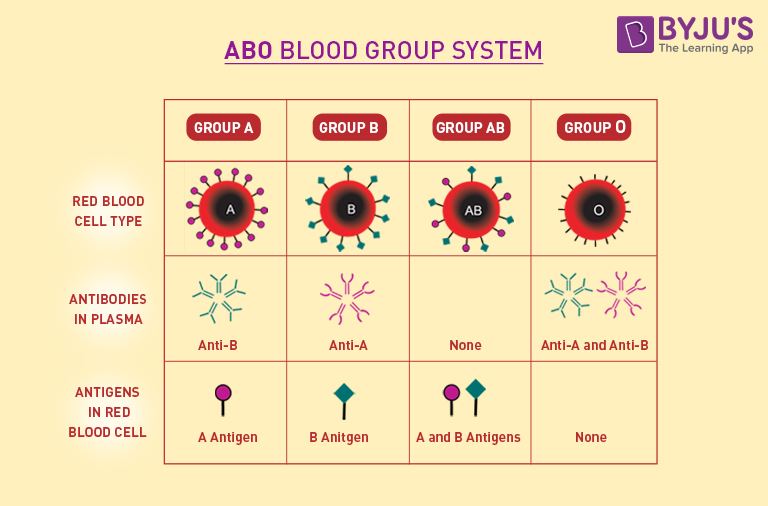
Multiple alleles: When more than two alternative forms of a gene are present in a population at the same locus. Example: ABO blood group system in humans – three alleles IA, IB and i (only two present in any individual).
8) What is Erythroblastosis Fetalis? How is it treated?
Erythroblastosis Fetalis: Haemolytic disease of newborn caused by Rh incompatibility. Rh– mother carrying Rh+ fetus produces anti-Rh antibodies that destroy fetal RBCs in second or later pregnancies. Treatment: Inject RhoGAM (anti-Rh globulin) to Rh– mother within 72 hours after first delivery to prevent antibody formation.
9) Define Epistasis and Pleiotropy
Epistasis: One gene masks or suppresses the expression of another non-allelic gene. Example: Coat colour in Labrador dogs.
Pleiotropy: A single gene controls or affects many phenotypic characters. Example: Sickle cell anaemia gene or Phenylketonuria (PKU) gene.
Boss Tips for Exam:
- Write differences in 2-column table (gets full marks).
- Always give one example after every definition.
- These 9 short questions cover 90% of Chapter 22 short portion.
- Total marks usually 18–20 from these.
Revise 3 times today — you will write all in 8–10 minutes in exam.
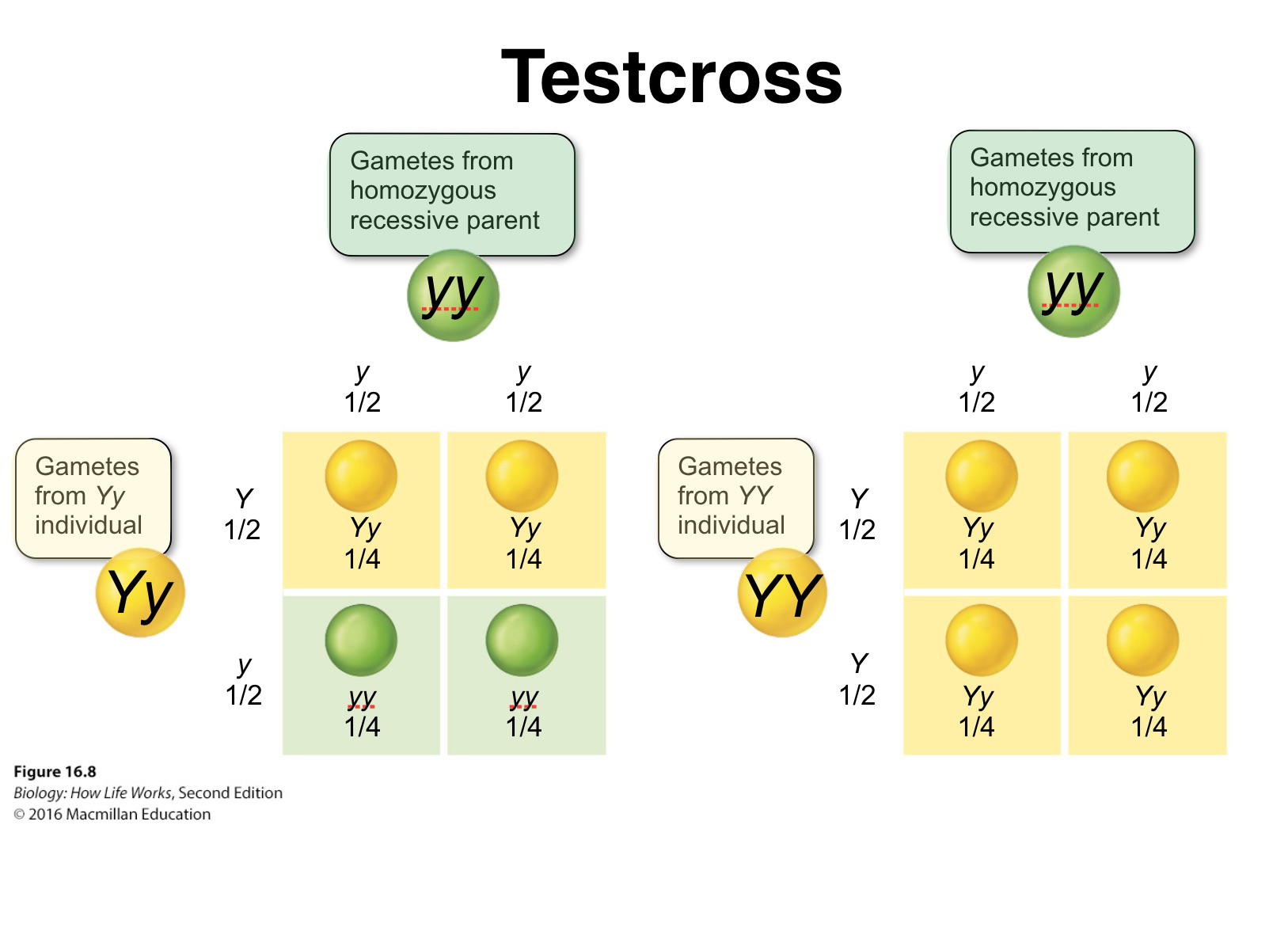
Test Cross Long Question Note – Class 12 Biology (RTS/HED/Punjab Board Exam Pattern) (7–8 Marks wala question – full length, with diagrams, definition, example, Punnett square, significance)
Definition
A test cross is a cross between an individual showing a dominant phenotype (whose genotype is unknown – it may be homozygous dominant or heterozygous) and an individual that is homozygous recessive for the same trait.
The purpose is to determine the exact genotype of the dominant individual. It was first used by Gregor Johann Mendel in his pea plant experiments.

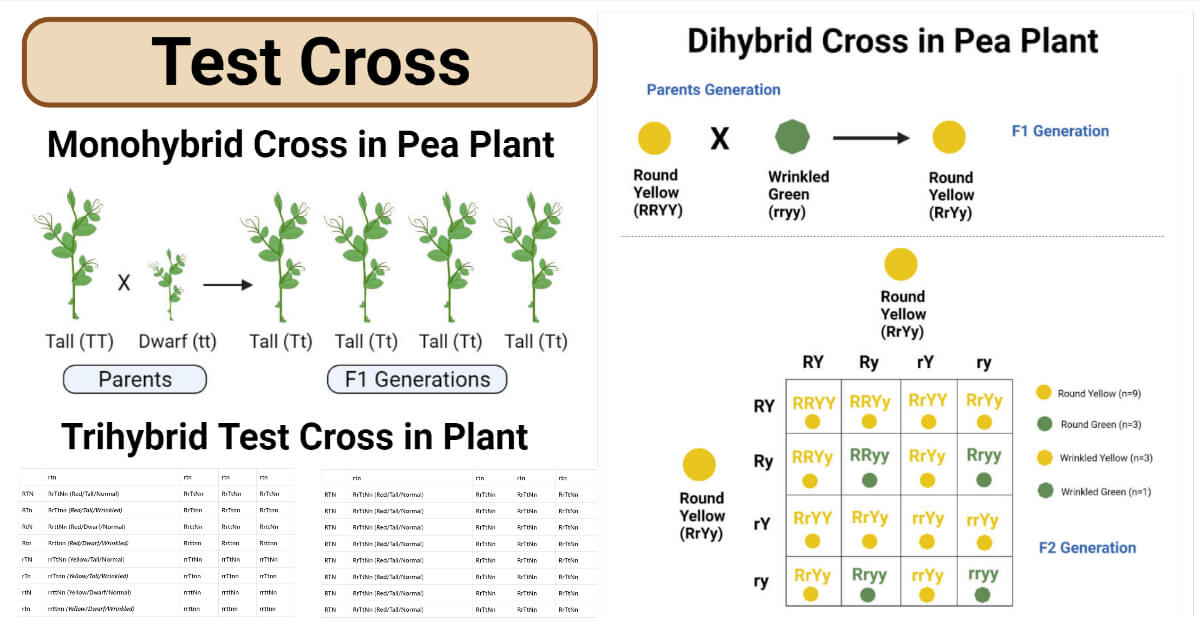
Monohybrid Test Cross (Most Important for Exams)
Example: In pea plant, tallness (T) is dominant over dwarfness (t).
We have a tall plant (phenotype Tall) but we don’t know whether its genotype is TT or Tt. We cross it with a dwarf plant (tt).
Case 1: If unknown tall plant is Homozygous Dominant (TT)
Gametes:
- Tall plant → only T
- Dwarf plant → only t
Punnett Square:
| T | T | |
|---|---|---|
| t | Tt | Tt |
| t | Tt | Tt |
Result:
- All offspring = Tall (Tt)
- Phenotypic ratio = 100% Tall
- Genotypic ratio = 100% Tt
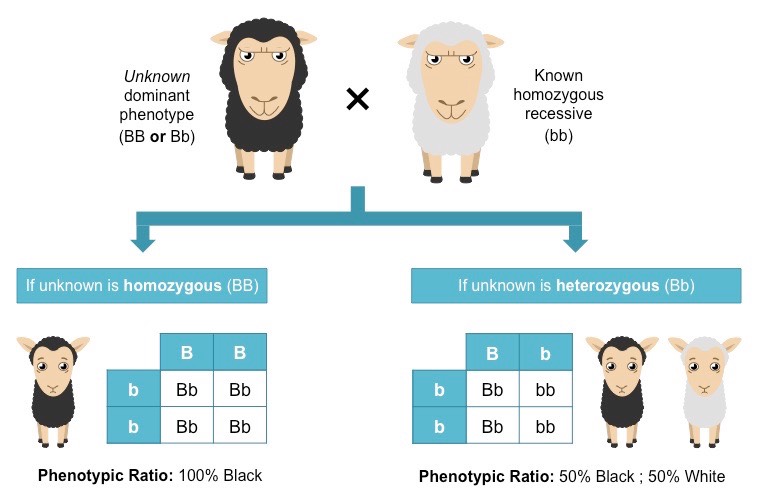
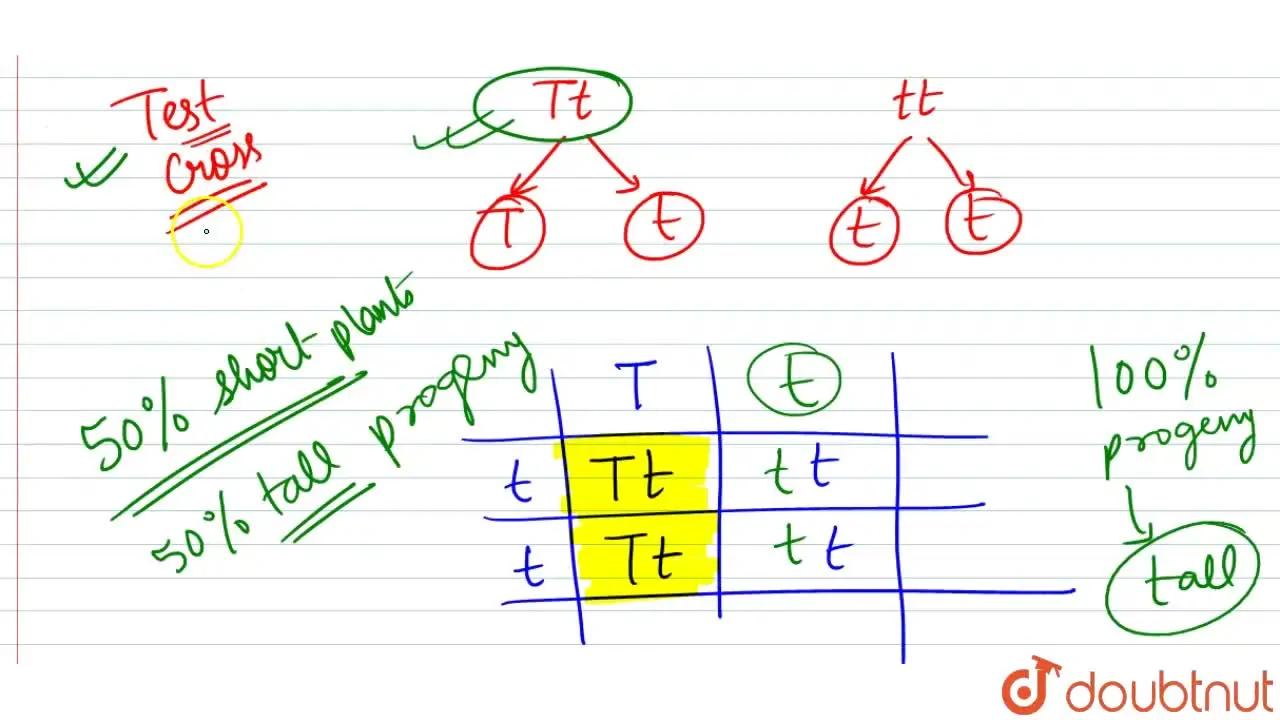
Case 2: If unknown tall plant is Heterozygous (Tt)
Gametes:
- Tall plant → T and t (50% each)
- Dwarf plant → only t
Punnett Square:
| T | t | |
|---|---|---|
| t | Tt | tt |
| t | Tt | tt |
Result:
- 50% Tall (Tt)
- 50% Dwarf (tt)
- Phenotypic ratio = 1 : 1 (Tall : Dwarf)
- Genotypic ratio = 1 : 1 (Tt : tt)
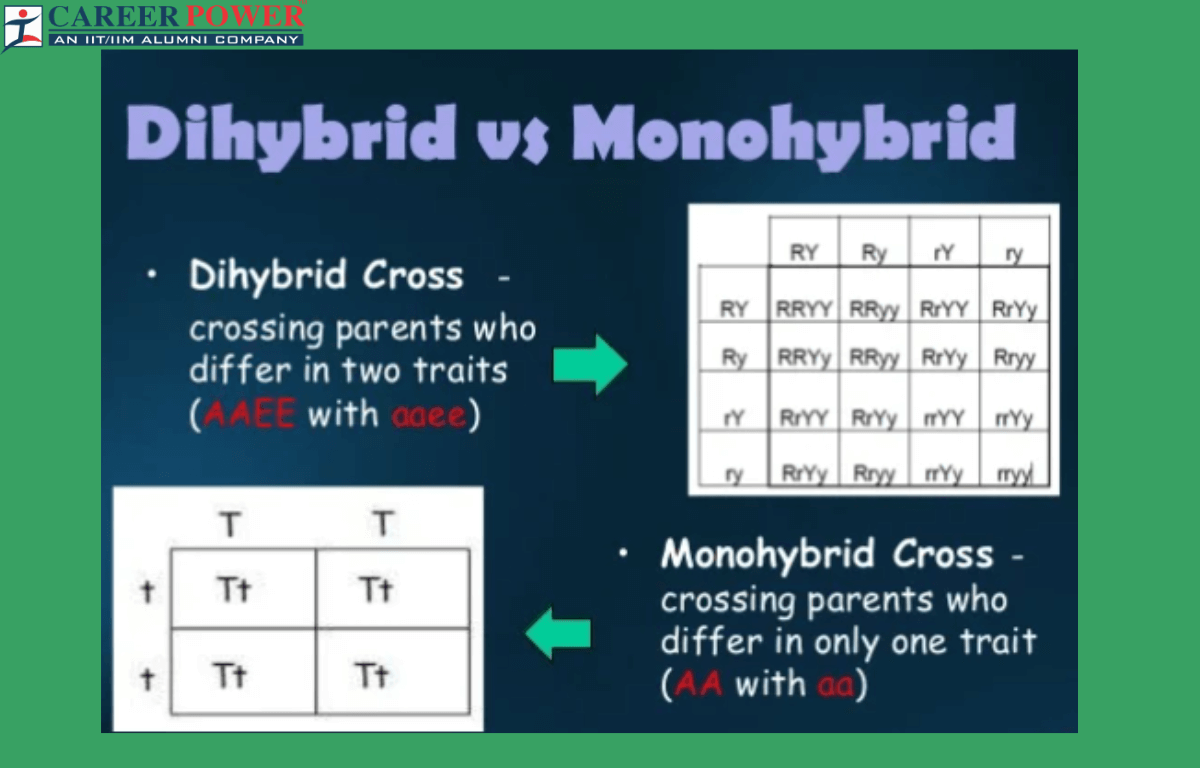
Dihybrid Test Cross (Also Important)
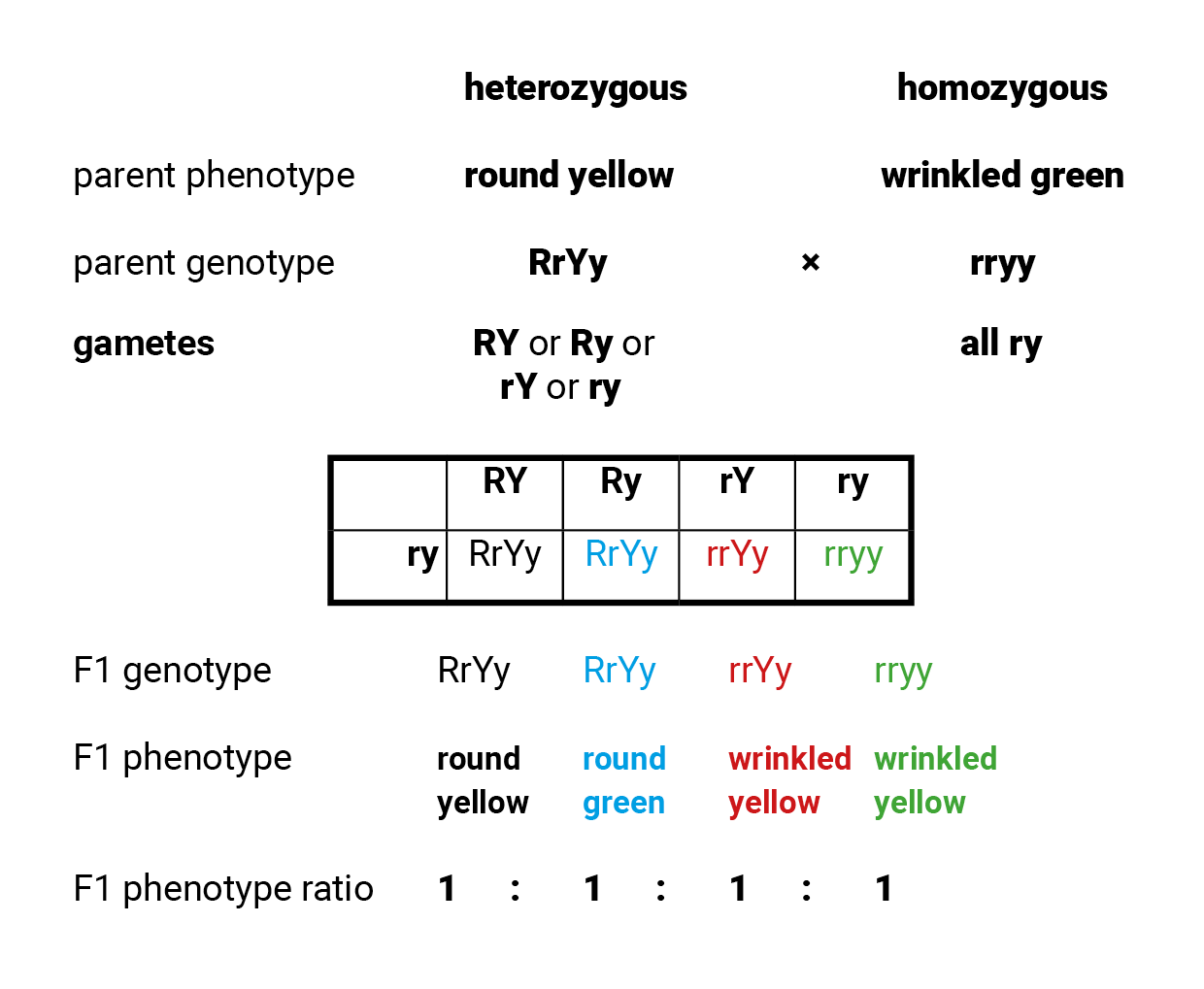
Round Yellow (RrYy) × Wrinkled Green (rryy) If the Round Yellow is heterozygous, offspring ratio = 1 : 1 : 1 : 1 (Round Yellow : Round Green : Wrinkled Yellow : Wrinkled Green)
Significance of Test Cross (Very Important – Always Write These Points)
- To determine unknown genotype of an organism showing dominant phenotype.
- It is the only way to distinguish between homozygous dominant and heterozygous individuals.
- If all offspring show dominant trait → parent is homozygous dominant.
- If 1:1 ratio appears → parent is heterozygous.
- It is used to verify Mendel’s Law of Segregation.
- Helps in plant and animal breeding to produce pure lines.
- Used in modern genetics for linkage studies and gene mapping.
Key Line for Exam: “Test cross is a back cross with homozygous recessive parent and is used to find the genotype of dominant phenotype.”
Summary Table (Draw in Exam – Full Marks
| Genotype of Dominant Parent | Crossed with | Offspring Phenotypic Ratio | Genotype of Unknown |
|---|---|---|---|
| TT (Homozygous) | tt | 100% Tall | Homozygous Dominant |
| Tt (Heterozygous) | tt | 1 Tall : 1 Dwarf | Heterozygous |
Exam Tips (Boss Level):
- Always start with definition + Mendel name.
- Draw both Punnett squares (TT × tt and Tt × tt).
- Label gametes clearly.
- Write significance in 5–6 points.
- End with “This confirms Law of Segregation”.
- This question comes almost every year as 8-mark long question.
Revise these diagrams 2 times — you will get full 8/8 marks easily!
2) Explain Rh blood group system.
Rh Blood Group System Long Note for Class 12 Biology (Important Exam Question – RTS/HED/Punjab Board/NCERT Pattern) (7–8 Marks question – always comes with Erythroblastosis fetalis)
Definition & Discovery The Rh blood group system is the second most important blood grouping system after ABO. It is named after Rhesus monkey (Macaca mulatta) in which it was first discovered by Karl Landsteiner and Alexander S. Wiener in 1940.
It is based on the presence or absence of Rh antigen (also called Rh factor or D antigen) on the surface of Red Blood Cells (RBCs).
- Rh Positive (Rh⁺): RBCs have Rh (D) antigen → about 80–85% population.
- Rh Negative (Rh⁻): RBCs lack Rh (D) antigen → about 15–20% population.
Unlike ABO system, Rh⁻ persons do not have natural anti-Rh antibodies in their plasma. They produce anti-Rh antibodies only when exposed to Rh⁺ blood (e.g., transfusion or pregnancy).

Inheritance of Rh Factor (Very Important) Rh factor is controlled by a single gene with two alleles:
- R = Dominant allele (produces Rh antigen)
- r = Recessive allele (no Rh antigen)
Possible genotypes:
- RR or Rr → Rh Positive
- rr → Rh Negative
Punnett Square Example (Rh⁺ father Rr × Rh⁻ mother rr) Father gametes: R and r Mother gametes: only r
| R | r | |
|---|---|---|
| r | Rr (Rh⁺) | rr (Rh⁻) |
50% Rh⁺ and 50% Rh⁻ children.

Clinical Importance
- Blood Transfusion: Rh⁻ person should receive only Rh⁻ blood. If Rh⁺ blood is given to Rh⁻ person, anti-Rh antibodies are formed → agglutination and haemolysis.
- Pregnancy: Most dangerous when mother is Rh⁻ and father/fetus is Rh⁺ → Erythroblastosis Fetalis (Haemolytic Disease of the Newborn).
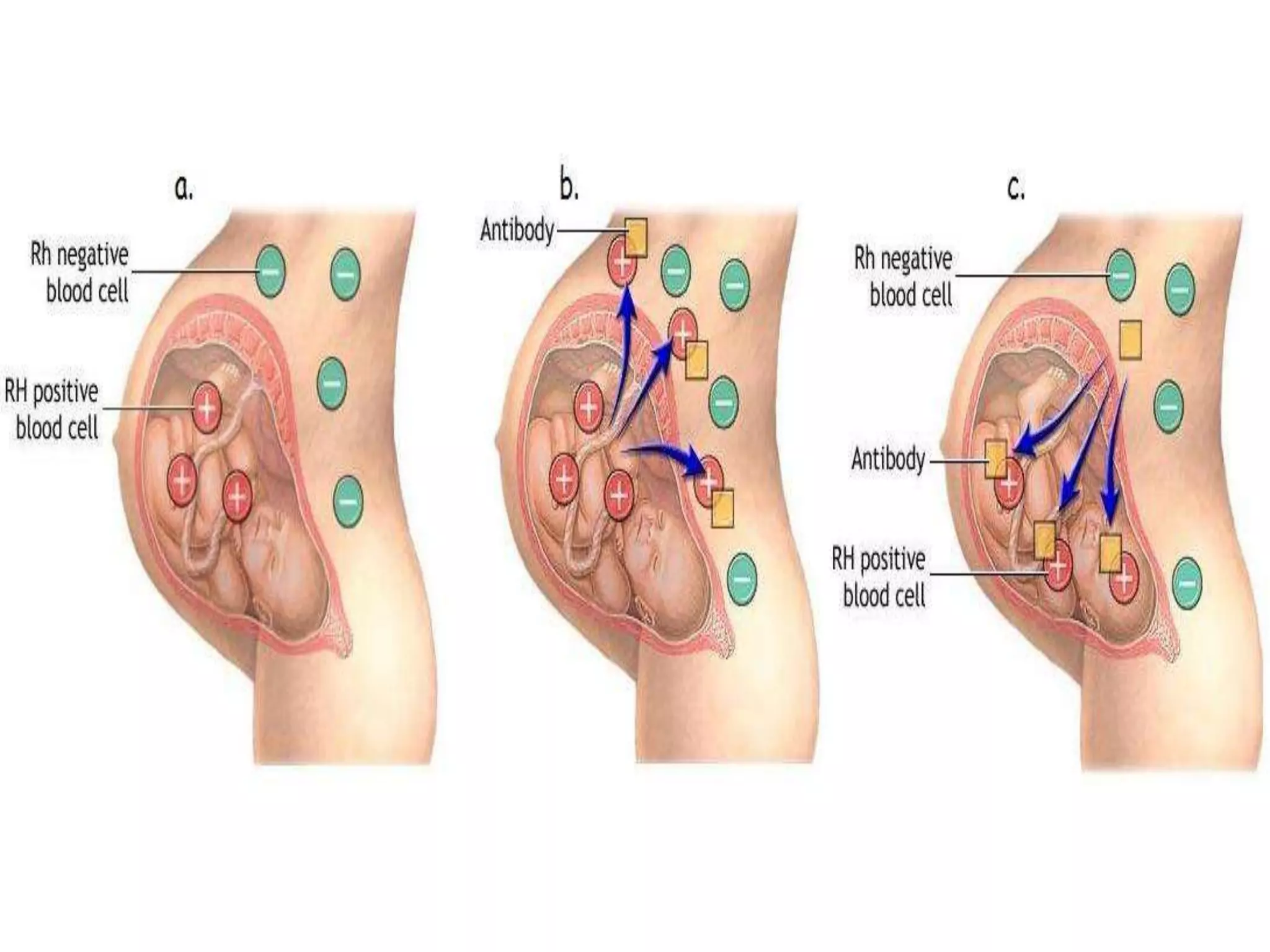
Erythroblastosis Fetalis (Mechanism – Draw this diagram in exam)
- First pregnancy (Rh⁻ mother + Rh⁺ fetus): Usually normal because placental barrier prevents mixing of blood.
- At delivery: Some fetal Rh⁺ RBCs enter mother’s blood → mother’s immune system produces anti-Rh antibodies (IgG).
- Second or later pregnancy (Rh⁺ fetus): Mother’s anti-Rh IgG antibodies cross placenta → destroy fetal RBCs → severe anaemia, jaundice, heart failure, still birth or death of newborn.
Symptoms in baby: Severe anaemia, jaundice, enlarged liver/spleen, kernicterus (brain damage), erythroblastosis (immature RBCs in blood).


Prevention & Treatment
- RhoGAM (anti-Rh immunoglobulin) is injected into Rh⁻ mother within 72 hours after first delivery, miscarriage or abortion.
- RhoGAM destroys any fetal Rh⁺ RBCs in mother’s blood before her immune system can produce antibodies.
- In severe cases: Exchange transfusion of baby’s blood (replace with Rh⁻ blood).
Summary Table (Draw in Exam)
| Feature | Rh Positive (Rh⁺) | Rh Negative (Rh⁻) |
|---|---|---|
| Rh (D) antigen on RBC | Present | Absent |
| Natural antibodies | Absent | Absent (produced only on exposure) |
| Safe transfusion | Can receive Rh⁺ or Rh⁻ | Only Rh⁻ |
| % in population | 80–85% | 15–20% |
| Problem in pregnancy | No problem if mother Rh⁺ | Causes Erythroblastosis fetalis if fetus Rh⁺ |
Key Lines for Full Marks
- “Rh system was discovered in Rhesus monkey.”
- “Rh⁻ mother + Rh⁺ fetus → Erythroblastosis fetalis in second pregnancy.”
- “RhoGAM prevents sensitisation of mother.”
- “Rh factor is inherited as dominant trait.”
This note is 100% according to Class 12 Biology + Punjab Board/RTS pattern. Draw 2–3 diagrams + table = guaranteed 8/8 marks.
- Density-Dependent and Density-Independent Factors: Mechanisms Influencing Population Dynamics
- MDCAT Past Papers with Most Repeated MCQs (2025 Preparation)
- Exploring the Types and Physiological Mechanisms of Seed Germination in Plants


0 Comments