Ecosystem – Class 12 Biology Notes
Introduction
Ecosystem is the interaction of living organisms with each other and with their physical environment. These notes are designed for FSc Class 12 students preparing for RTS. Short and long questions are explained in a simple, student-friendly manner with diagram placeholders.
Keywords ,Ecosystem Class 12, FSc Biology notes, RTS Biology notes, short questions, long questions, food chain, succession, ecological interactions
Short Questions (Quick Revision)
-
Define ecosystem.
A: An ecosystem is a system of living organisms interacting with each other and their physical environment. -
Define biosphere and niche.
A:
- Biosphere: The part of Earth where life exists.
- Niche: The role or position of an organism in its ecosystem.
-
Difference between autecology and synecology.
| Feature | Autecology | Synecology |
|---|---|---|
| Focus | Individual species | Community of species |
| Study | Individual interactions | Interactions among species |
-
Components of ecosystem.
-
Biotic: Producers, consumers, decomposers
-
Abiotic: Water, air, soil, sunlight
-
Define food chain and food web.
-
Food chain: Linear sequence of energy transfer between organisms.
-
Food web: Interconnected food chains in an ecosystem.
-
Difference between primary and secondary succession.
| Feature | Primary succession | Secondary succession |
|---|---|---|
| Starting point | Bare land, no soil | Previously occupied land |
| Time | Long duration | Short duration |
-
Define commensalism with example.
A: Interaction where one organism benefits and the other is unaffected.
Example: Epiphytic plants growing on trees. -
Define grazing. Give effects of overgrazing.
A: Grazing is feeding on grass by herbivores.
Effects of overgrazing: Soil erosion, loss of vegetation, desertification. -
Difference between nitrification and denitrification.
| Feature | Nitrification | Denitrification |
|---|---|---|
| Process | Ammonia → Nitrates | Nitrates → Nitrogen gas |
| Purpose | Soil fertility | Release N₂ to atmosphere |
-
Difference between gross primary production (GPP) and net primary production (NPP).
| Feature | GPP | NPP |
|---|---|---|
| Definition | Total energy produced by photosynthesis | Energy available after respiration |
| Formula | GPP = NPP + Respiration | NPP = GPP − Respiration |
🌿 FSc Class 12 Biology – Chapter 25: Ecosystem | Long Questions Detailed Version (RTS)
Long Questions (Detailed Explanation – 4 Marks)
Q1: Explain food chain and food web with examples.
A:
1. Food Chain – Definition
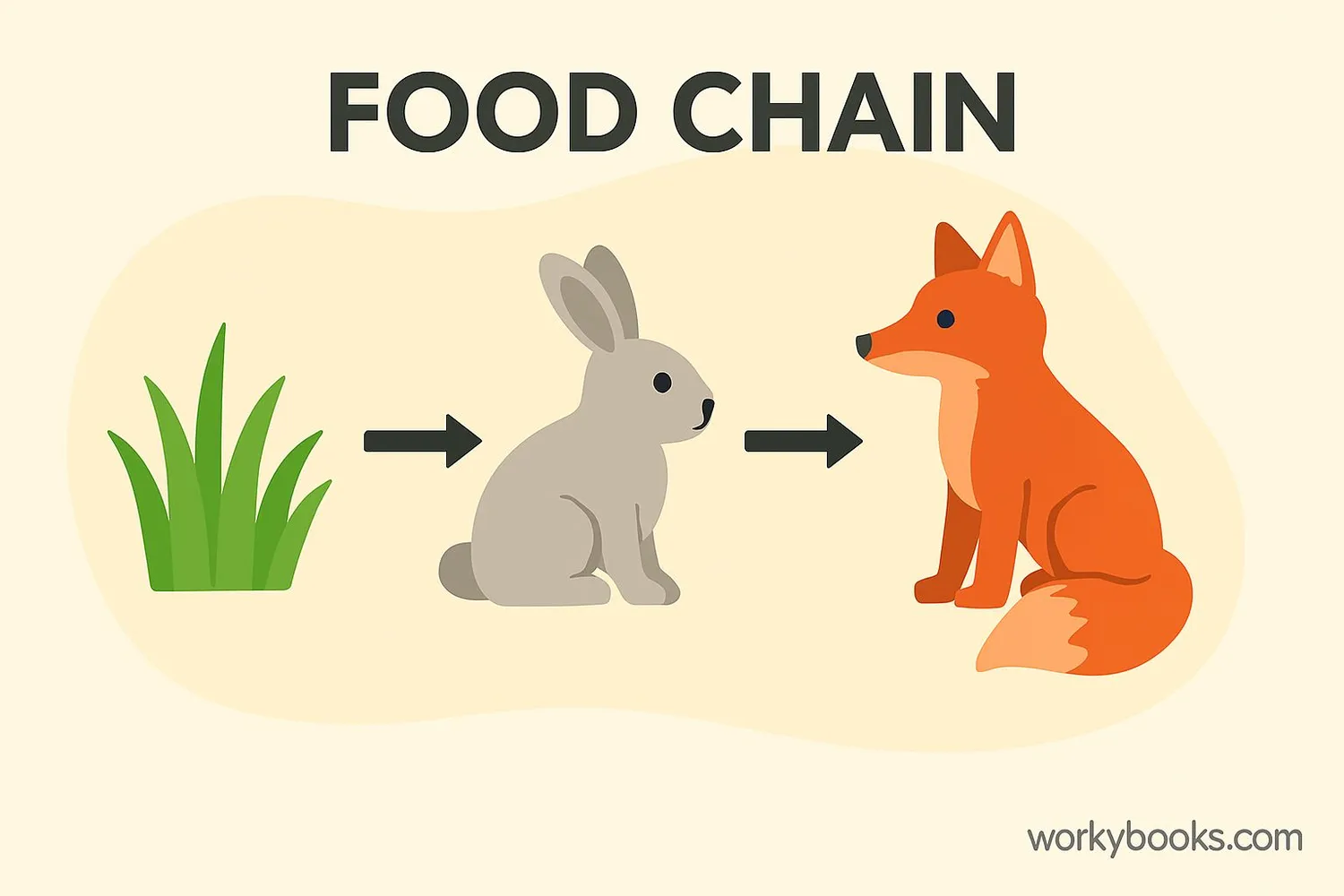
A food chain is a linear sequence of organisms in an ecosystem through which food (energy and nutrients) is transferred from one organism to another. It shows who eats whom in a straight line.
- Starts with producers (autotrophs – green plants or algae that make food by photosynthesis).
- Followed by consumers (heterotrophs).
- Ends with decomposers (bacteria and fungi that break down dead matter).
Key Features:
- Unidirectional flow of energy.
- Each step is called a trophic level.
- Energy decreases at every level (only 10% energy is transferred – 10% Law).
2. Types of Food Chain
- Grazing Food Chain (Predator food chain) Starts with green plants → herbivores → carnivores Example: Grass → Rabbit → Fox
- Detritus Food Chain Starts with dead organic matter (detritus) → decomposers → detritivores Example: Dead leaves → Earthworm → Frog → Snake
3. Example of Food Chain
Grassland Ecosystem (Simple Food Chain):
Grass (Producer) ↓ Grasshopper (Primary consumer – Herbivore) ↓ Frog (Secondary consumer – Carnivore) ↓ Snake (Tertiary consumer) ↓ Eagle (Quaternary consumer / Top carnivore)
Another Common Example: Plants → Deer → Tiger

4. Food Web – Definition
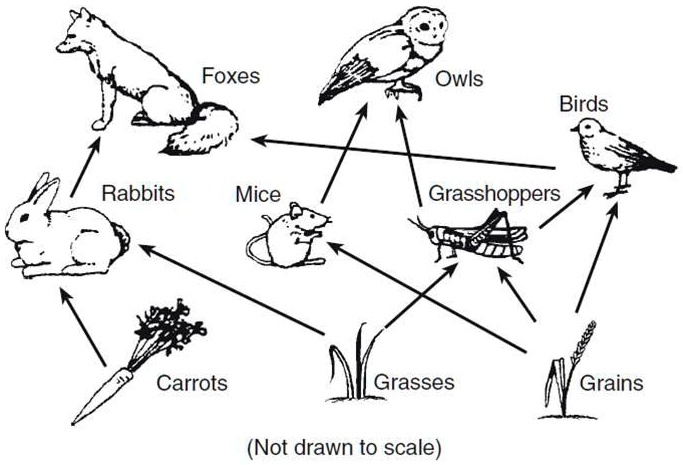
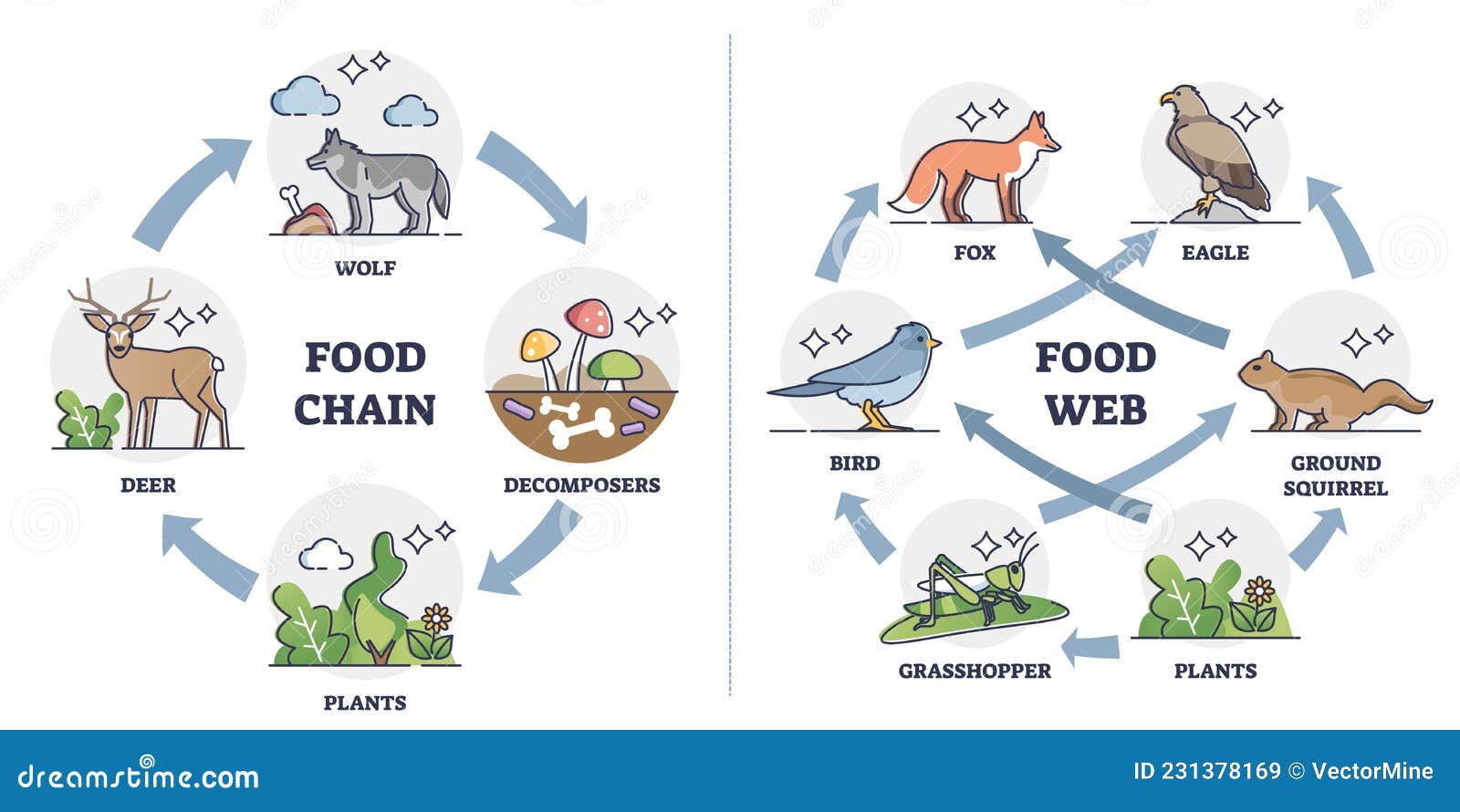
A food web is a network of many interconnected food chains in an ecosystem. It shows complex feeding relationships – one organism can be eaten by many, and can eat many others.
- More realistic representation of nature (food chains rarely exist in isolation).
- Provides stability to the ecosystem. If one species is removed, others can still survive through alternative paths.


5. Food Chain vs Food Web (Comparison)
| Feature | Food Chain | Food Web |
|---|---|---|
| Structure | Linear / Straight line | Interconnected / Network |
| Number of pathways | Single | Multiple |
| Stability | Less stable | More stable |
| Realism | Simplified | More realistic |
| Energy flow | Unidirectional | Unidirectional but multiple routes |
| Example | Grass → Rabbit → Fox | Many plants and animals interconnected |
6. Significance / Importance
- Food Chain:
- Helps understand energy flow and trophic levels.
- Shows how energy is lost as heat at each level.
- Food Web:
- Maintains ecological balance.
- Provides alternate food sources.
- Helps in studying the impact of removing a species (e.g., extinction of tigers affects deer population and vegetation).
7. Quick Revision Points for Exams
- Food chain is linear, food web is complex network.
- Always starts with producers.
- 10% energy transfer rule applies in both.
- Decomposers are important in both (they recycle nutrients).
- Food web increases resilience of ecosystem.
Q2: Explain primary and secondary succession with examples.
1. Ecological Succession – Simple Definition
Ecological succession is the gradual and orderly change in the species composition (community) of an area over a period of time, until a stable climax community is reached.
- It is predictable and directional.
- Sere = Complete series of stages in succession.
- Pioneer species = First organisms to colonize.
- Climax community = Final stable community in equilibrium with climate.
2. Types of Ecological Succession
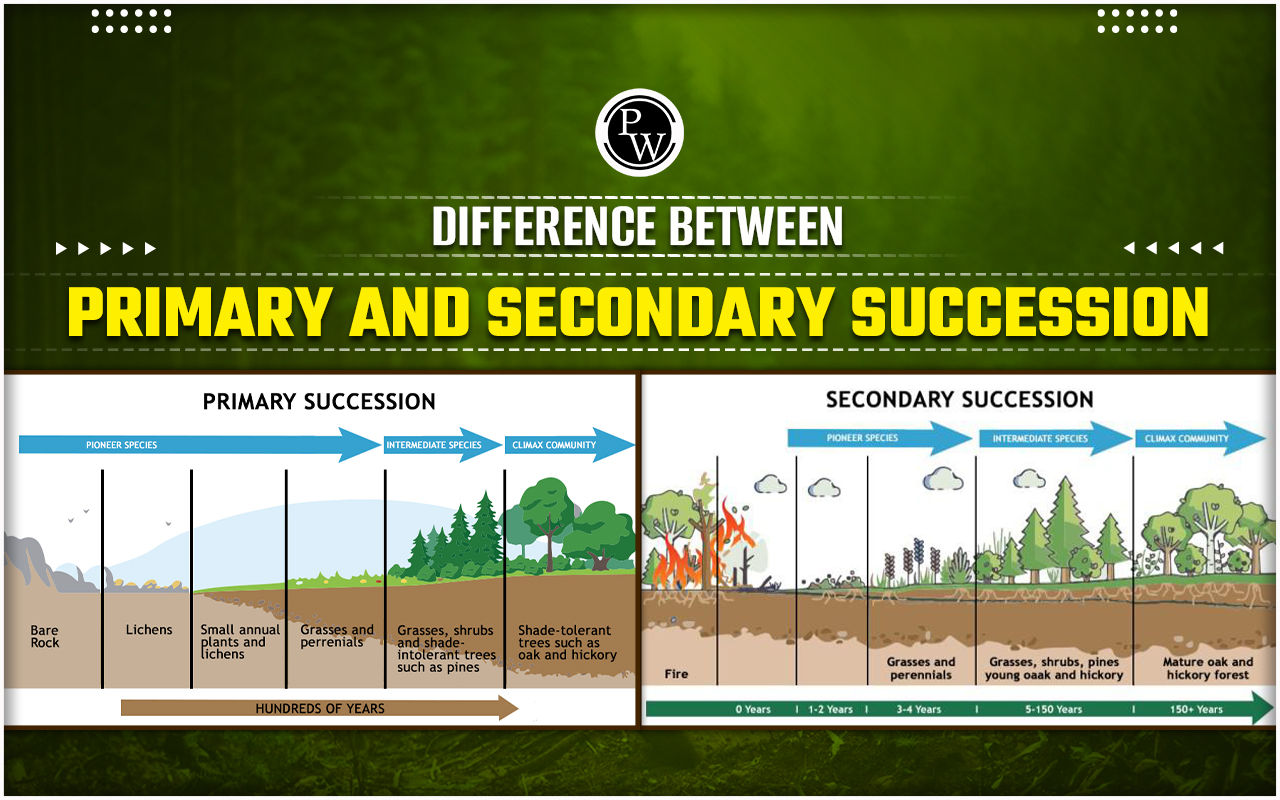
| Feature | Primary Succession | Secondary Succession |
|---|---|---|
| Starting Area | Completely barren, no soil (lifeless) | Area with soil but vegetation destroyed |
| Time Taken | Very slow (hundreds to thousands of years) | Much faster (decades to few hundred years) |
| Soil Presence | Absent (soil forms during process) | Already present |
| Pioneer Species | Lichens, mosses, algae | Grasses, herbs, weeds |
| Seed Bank | Absent | Present (seeds, roots remain) |
| Common Examples | Bare rock, new volcanic island, sand dunes | Burnt forest, abandoned farmland, flood-affected area |
3. Primary Succession – Detailed Explanation
Definition: Succession that begins on a bare, lifeless area where no soil or previous life existed.
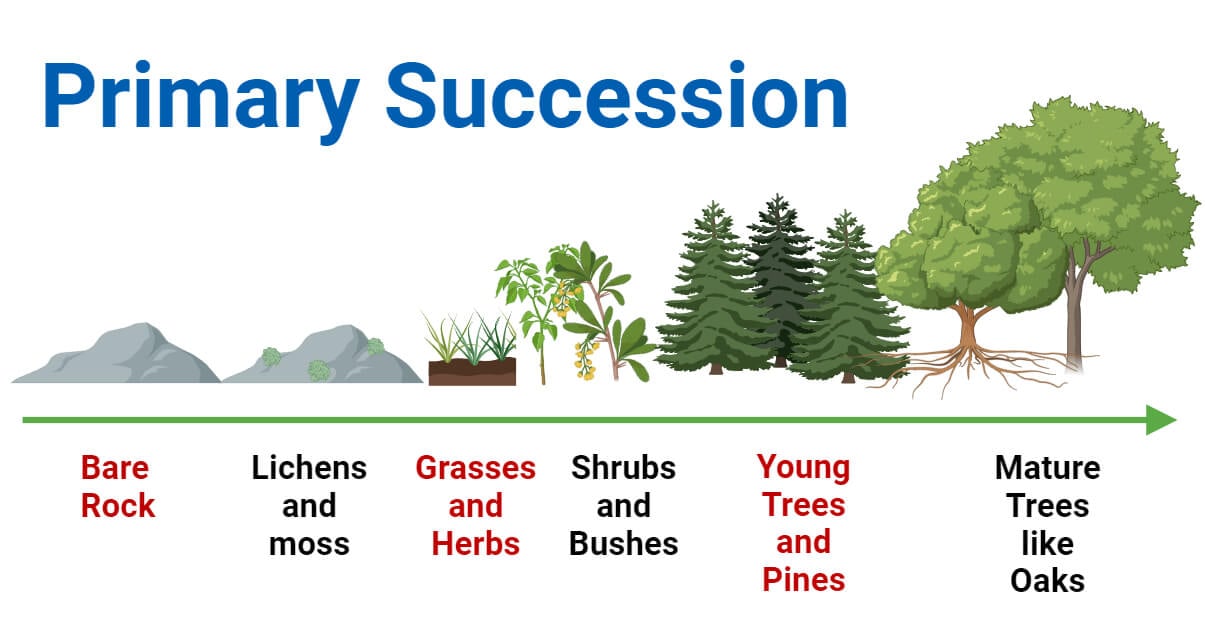
Stages (Xerosere – on bare rock):
- Bare Rock → Lichens & Mosses (Pioneer species)
- Lichens secrete acids → weather rock → thin soil forms.
- Small annual plants & grasses grow as soil thickens.
- Shrubs and bushes appear.
- Young trees (shade-intolerant like pine) → Mature trees (shade-tolerant like oak, hickory).
- Climax Community – Stable forest.
Example:
- Succession on bare rock after glacier retreat.
- New volcanic lava (e.g., Hawaiian islands or Surtsey island).


4. Secondary Succession – Detailed Explanation
Definition: Succession that occurs in an area where soil is already present but the existing community has been disturbed or destroyed by fire, flood, cutting, etc.
Stages:
- Immediately after disturbance → Grasses, herbs, annual weeds (fast-growing pioneers).
- Perennial grasses & shrubs.
- Young trees (pine, etc.).
- Mature forest (climax community).
Example 1: Forest after wildfire Burnt forest → Grasses → Shrubs → Young pine → Oak-hickory forest.
Example 2: Abandoned agricultural field (Old field succession) Weeds → Grasses → Shrubs → Young forest → Climax forest.


5. Key Differences (Most Important for Exams)
- Primary starts without soil → very slow.
- Secondary starts with soil → faster.
- In both, the climax community is usually the same in a given climate.
- Lichens are pioneers only in primary succession.
6. General Steps in Succession (Common to both)
Nudation → Invasion → Competition → Reaction → Stabilization (Climax)
7. Quick Revision Points
- Primary = Pioneer from nothing (bare rock) → Lichens start it.
- Secondary = Starts again after disturbance → Grasses start it.
- Both are autogenic (organisms change the environment).
- Time: Primary >> Secondary.
- Always ends in climax community.
Write a note on nitrogen cycle.
1. Nitrogen Cycle – Definition
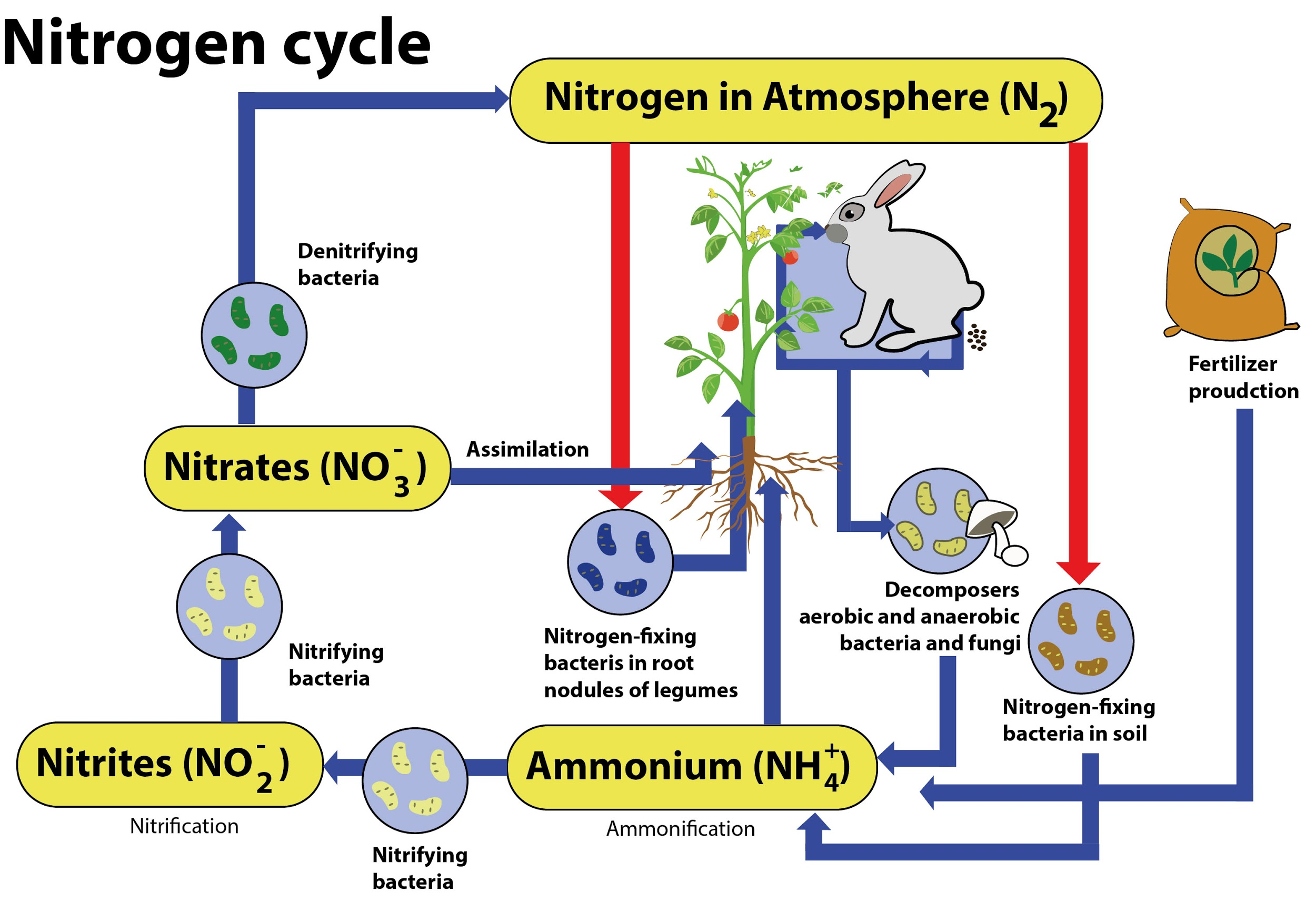
The nitrogen cycle is a biogeochemical cycle that shows the continuous movement of nitrogen between the atmosphere, soil, and living organisms. Nitrogen is essential for synthesis of proteins, DNA, RNA, and chlorophyll, but atmospheric N₂ (78% of air) cannot be used directly by most plants and animals.

2. Main Steps of Nitrogen Cycle
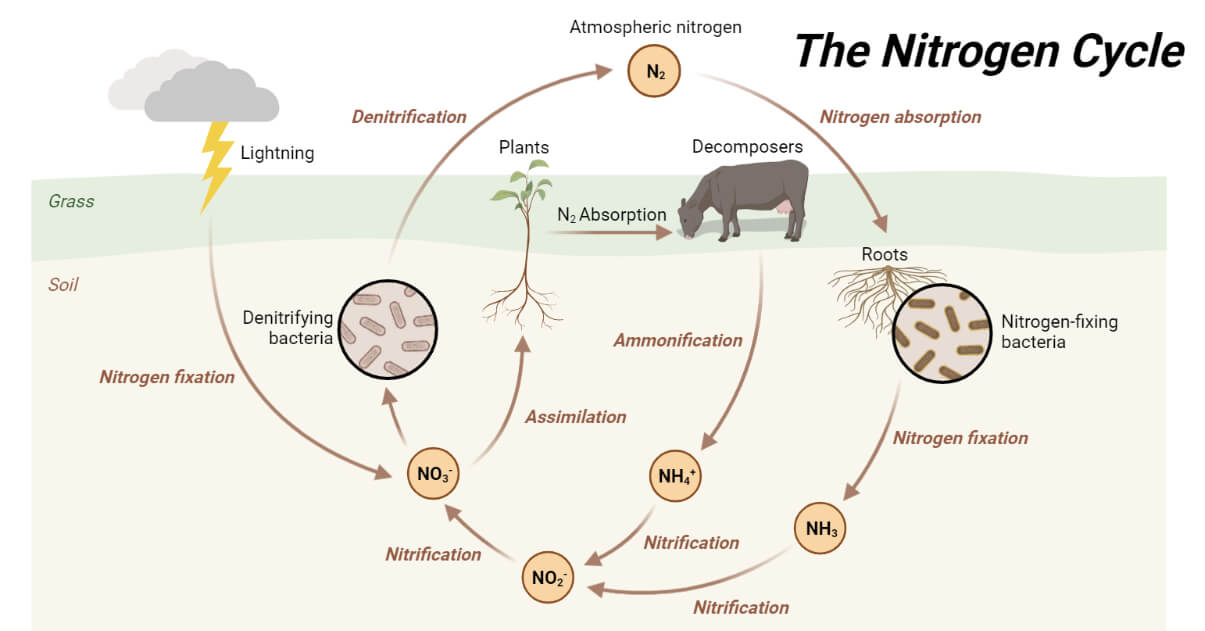
- Nitrogen Fixation
Conversion of atmospheric N₂ into ammonia (NH₃/NH₄⁺).
- Biological: By nitrogen-fixing bacteria
- Symbiotic: Rhizobium (in root nodules of legumes – pea, gram)
- Free-living: Azotobacter, Cyanobacteria
- Atmospheric: Lightning
- Industrial: Fertilizer factories (Haber-Bosch process)
- Biological: By nitrogen-fixing bacteria
- Ammonification Decomposition of dead plants, animals, and excreta by bacteria and fungi → release of ammonia (NH₃) or ammonium ions (NH₄⁺). Decomposers play a major role here.
- Nitrification (Two steps – aerobic process)
- Nitrosomonas bacteria → Ammonia (NH₄⁺) → Nitrite (NO₂⁻)
- Nitrobacter bacteria → Nitrite (NO₂⁻) → Nitrate (NO₃⁻) Plants absorb nitrates easily from soil.
- Assimilation Plants absorb nitrates (NO₃⁻) or ammonium (NH₄⁺) and convert them into plant proteins and organic compounds. Animals obtain nitrogen by eating plants or other animals.
- Denitrification Anaerobic bacteria (Pseudomonas, Thiobacillus) convert nitrates back into atmospheric N₂ gas. This occurs in waterlogged (oxygen-deficient) soils and completes the cycle.
3. Simplified Flow Diagram (for Exam)
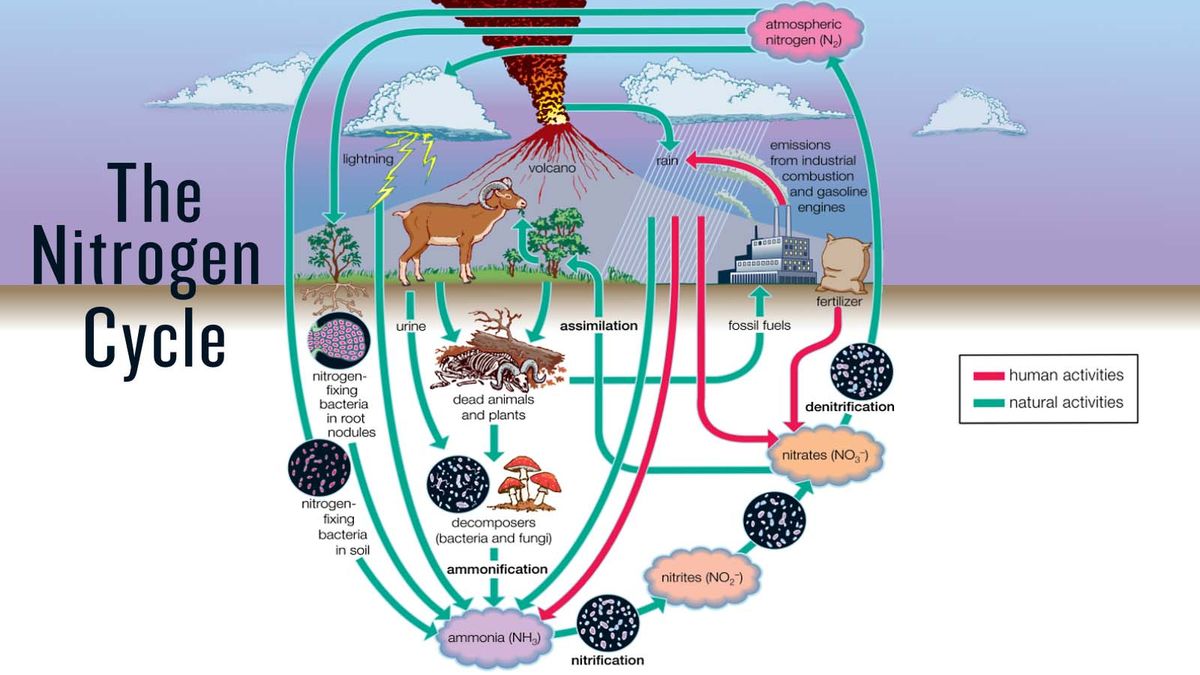
Atmospheric N₂ ↓ Nitrogen Fixation (Rhizobium, Azotobacter, Lightning) Ammonia (NH₃ / NH₄⁺) ↓ Ammonification (Decomposers) ↓ Nitrification (Nitrosomonas → Nitrobacter) Nitrites (NO₂⁻) → Nitrates (NO₃⁻) ↓ Assimilation (Plants → Animals) Organic Nitrogen (Proteins) ↓ Death & Decay → Ammonification ↓ Denitrification (Pseudomonas) Back to Atmospheric N₂


4. Important Microorganisms
| Step | Bacteria Involved |
|---|---|
| Nitrogen Fixation | Rhizobium, Azotobacter, Frankia |
| Ammonification | Bacillus, fungi (decomposers) |
| Nitrification | Nitrosomonas, Nitrobacter |
| Denitrification | Pseudomonas, Thiobacillus |
5. Human Impact
- Excessive fertilizers → eutrophication in lakes/rivers.
- Burning of fossil fuels → acid rain.
- Legume crops (crop rotation) help increase soil nitrogen naturally.
6. Quick Revision for Exams
- Most important step → Biological Nitrogen Fixation by Rhizobium.
- Plants cannot use N₂ gas directly.
- Denitrification causes loss of usable nitrogen from soil.
- The cycle is gaseous and perfect (returns to atmosphere).
- Always label bacteria names in diagrams.


0 Comments