
📌 Quick Overview
This comprehensive article explores the ecological characteristics of species, including responses to water, temperature, light, and nutrients; ecological amplitude and tolerance; vegetation zonation; and resource utilization strategies. Essential for Biology/Botany students and ecology enthusiasts.
Introduction
If you walk through different habitats—from desert to rainforest, from seashore to mountain peak—you'll notice that different plant species occur in different places. Species do not occur randomly in nature. Instead, their distribution is determined by environmental conditions, tolerance limits, and their ability to acquire and use resources.
The ecological characteristics of species describe how organisms interact with their physical environment, what conditions they can tolerate, how they use available resources, and where they can successfully survive, grow, reproduce, and compete. These characteristics determine why certain species are found in specific habitats while others are absent.
💡 Key Idea
Environmental conditions + Species tolerance + Resource utilization = Species distribution
A species can only persist where environmental conditions fall within its tolerance range AND where it can successfully acquire and use the resources it needs for survival and reproduction.
Responses of Species to the Physical Environment
Every species interacts continuously with its physical environment. Each species has particular requirements and tolerance limits for environmental factors such as water, temperature, light, and nutrients. These responses determine where a species can live and how well it performs.
A. Response to Water
Water is essential for plant survival and is a major factor controlling plant distribution. Plants respond to water availability in different ways depending on their adaptations and tolerance limits.
Simple explanation: Plants need water to survive, but different plants need different amounts. Some plants can survive in very dry places, while others need lots of water.
Scientific explanation: Water availability affects turgor pressure, photosynthesis, nutrient transport, cell expansion, stomatal regulation, and reproduction. Plants experience water stress when availability is too low (drought) or too high (waterlogging).

Shows species performance from very low water (drought stress) through optimum water availability to excess water (waterlogging stress). Different plant groups occupy different positions along this gradient.
Plant categories based on water requirements:
- Hydrophytes: Aquatic plants adapted to waterlogged conditions (e.g., water lilies, cattails)
- Mesophytes: Plants requiring moderate water availability (e.g., most crops, garden plants)
- Xerophytes: Plants adapted to dry conditions (e.g., cacti, succulents, desert shrubs)
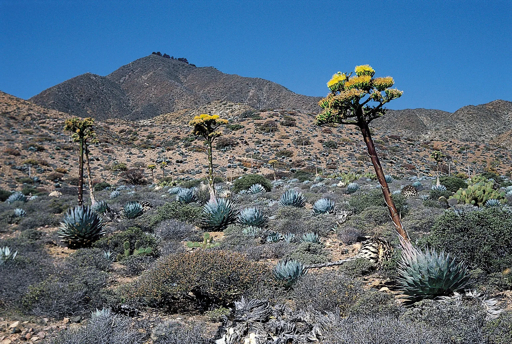
Desert plants exhibit adaptations such as succulence, reduced leaf area, deep roots, and CAM photosynthesis to survive in low-water environments.
🔑 Key Takeaway
Water availability is a primary factor determining plant distribution. Species are adapted to specific water regimes, and their ecological characteristics reflect these adaptations.
B. Response to Temperature
Temperature is a major ecological factor affecting all physiological processes in plants. Each species has minimum, optimum, and maximum temperatures—called cardinal temperatures.
Simple explanation: Every plant has a temperature range where it grows best. Too cold or too hot, and the plant struggles or dies.
Scientific explanation: Temperature affects enzyme activity, membrane fluidity, photosynthesis, respiration, germination, growth, flowering, and reproduction. Extreme temperatures cause cold or heat stress through membrane damage, protein denaturation, and oxidative stress.

Shows minimum, optimum, and maximum temperature ranges with lower and upper stress zones. Species performance peaks at optimum temperatures.
Temperature adaptations:
- Cold tolerance: Alpine and arctic plants tolerate freezing through antifreeze proteins, membrane adjustments, and dormancy
- Heat tolerance: Desert plants tolerate high temperatures through heat-shock proteins, reflective surfaces, and efficient cooling
- Seasonal adaptations: Temperate plants adjust phenology (timing of growth, flowering) to match seasonal temperature patterns
🌡️ Remember
Temperature influences geographical distribution. Tropical species cannot survive freezing, while alpine species cannot tolerate heat. This is why vegetation changes with latitude and altitude.
C. Response to Light
Light is both an energy resource for photosynthesis and an environmental signal regulating development. Light intensity, duration (photoperiod), and quality (wavelength) all affect plant performance.
Simple explanation: Plants need light to make food through photosynthesis. Some plants need lots of light, while others can grow in shade.
Scientific explanation: Light drives photosynthesis, photomorphogenesis, phototropism, and flowering responses. Light compensation point is where photosynthesis equals respiration; light saturation point is where additional light no longer increases photosynthesis.

Photosynthetic rate increases with light intensity up to saturation point. Beyond saturation, additional light may cause photoinhibition.
Plant categories based on light requirements:
- Sun plants (heliophytes): Require high light intensity; have high photosynthetic capacity and thick leaves
- Shade plants (sciophytes): Adapted to low light; have efficient light capture and lower compensation points
- Shade-tolerant plants: Can survive in shade but grow better in moderate light
- Shade-intolerant plants: Require full sun; cannot survive in shade
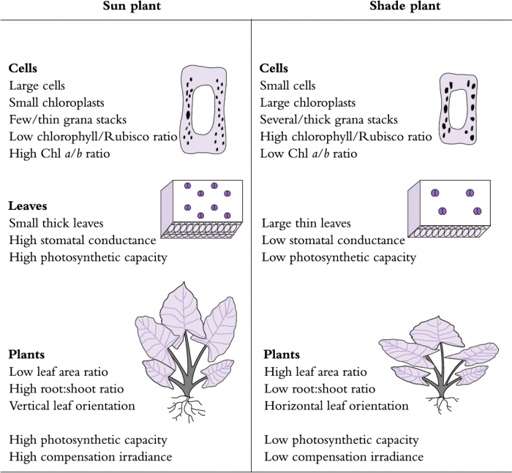
Light decreases from canopy to forest floor, creating distinct zones for sun plants (canopy) and shade plants (understory).
🌳 Exam Tip
Competition for light drives forest structure. Tall trees capture sunlight in the canopy, while shade-tolerant species survive in the understory. This creates vertical zonation of vegetation.
D. Response to Nutrients and Minerals
Mineral nutrients are essential for plant growth and metabolism. Nutrient availability in soil strongly influences which species can dominate an ecosystem.
Simple explanation: Plants need nutrients from soil to grow. Different nutrients do different jobs, and plants can't grow well if any essential nutrient is missing.
Scientific explanation: Macronutrients (N, P, K, Ca, Mg, S) are required in large amounts for structure and metabolism. Micronutrients (Fe, Mn, Zn, Cu, B, Mo, Cl, Ni) are required in small amounts as enzyme cofactors. Nutrient deficiency limits growth; nutrient toxicity can damage plants.

Plant growth increases with nutrient availability up to optimum, beyond which excess causes toxicity. Different species have different nutrient optima.
Nutrient adaptations:
- Nutrient-poor environments: Some plants form mycorrhizal associations, develop cluster roots, or become carnivorous to acquire nutrients
- Nutrient-rich environments: Fast-growing species with high nutrient requirements dominate fertile soils
- Soil pH specialists: Some plants are adapted to acidic soils, others to alkaline soils
🔑 Key Takeaway
Nutrient availability determines ecosystem productivity and species composition. Soil fertility is a major factor in vegetation patterns and agricultural potential.
Comparative Summary: Environmental Factors
Ecological Amplitude of Species
Simple explanation: Ecological amplitude is the range of environmental conditions where a species can survive. Think of it as the species' "comfort zone" for temperature, water, light, nutrients, and other factors.
Scientific definition: Ecological amplitude represents the range of environmental conditions under which a species can survive, grow, and reproduce. It encompasses tolerance limits, optimum ranges, and stress zones for multiple environmental factors.

Bell-shaped curve showing minimum limit, lower stress zone, optimum range, upper stress zone, and maximum limit. Species performance peaks at optimum conditions.
Components of ecological amplitude:
- Tolerance range: Full range from minimum to maximum limits
- Lower tolerance limit: Minimum condition species can tolerate
- Optimum range: Conditions where species performs best
- Upper tolerance limit: Maximum condition species can tolerate
- Stress zones: Areas between optimum and limits where performance declines
- Lethal limits: Conditions beyond which species cannot survive
📊 Exam Tip
Ecological amplitude describes the range of environmental conditions tolerated by a species. The optimum condition is not necessarily the most common condition in nature—species often persist in suboptimal conditions where competition is reduced.
Euryvalent and Stenovalent Species
Simple explanation: Some species can live in many different places (broad tolerance), while others can only live in very specific conditions (narrow tolerance).
Scientific definitions:
- Euryvalent (eurytopic) species: Species capable of tolerating a relatively broad range of environmental conditions. They are generalists with wide ecological amplitude.
- Stenovalent (stenotopic) species: Species capable of tolerating only a relatively narrow range of environmental conditions. They are specialists with narrow ecological amplitude.

Euryvalent species (green) have broad tolerance ranges and can occupy diverse environments. Stenovalent species (red) have narrow tolerance ranges and are restricted to specific conditions.
Vegetation Zonation
Simple explanation: Vegetation zonation is the pattern of different plant communities arranged along environmental gradients, like zones on a mountain or from shoreline to inland.
Scientific explanation: Vegetation zonation occurs because different species have different ecological amplitudes. As environmental conditions change along a gradient (altitude, moisture, temperature, salinity, etc.), species replace each other according to their tolerance ranges and competitive abilities.

Different species occupy different altitudinal zones according to their ecological amplitudes. Species replacement creates distinct vegetation zones from lowland to alpine.
Environmental gradients that produce zonation:
- Altitude: Temperature and atmospheric pressure decrease with elevation
- Moisture: From wet to dry (riparian to desert)
- Temperature: From equator to poles (latitudinal gradient)
- Soil conditions: pH, texture, fertility gradients
- Salinity: From freshwater to marine (estuarine zonation)
- Light availability: From canopy to forest floor
- Flooding: From permanently flooded to dry upland
🌿 Key Takeaway
Vegetation zonation reflects the interaction between environmental gradients and species' ecological amplitudes. Different species occupy different portions of the gradient where their tolerance ranges overlap with environmental conditions.
Capacity of Species to Utilize Available Resources
Species differ not only in their tolerance of environmental conditions but also in their ability to acquire and use available resources. This capacity determines competitive ability and ecological success.
Resource Availability vs Resource Utilization
Resource availability: What resources are physically present in the environment (water, light, nutrients, CO₂, space, soil resources).
Resource utilization: How effectively a species can acquire and use those resources. This depends on root architecture, leaf area, photosynthetic capacity, nutrient uptake systems, and physiological efficiency.
Resource-use efficiency: How efficiently a plant converts available resources into growth, biomass, reproduction, or survival. High efficiency means more output per unit of resource input.
💡 Important Concept
Two species in the same environment may have different success because of differences in resource-use capacity. A species with higher resource-use efficiency can outcompete others even when resources are limited.
Resource Limitation
Simple explanation: Plants need multiple resources, but growth is limited by whichever resource is most scarce. This is like a barrel with staves of different lengths—the water level can only rise to the shortest stave.
Scientific explanation: Liebig's Law of the Minimum states that growth is limited by the scarcest resource (limiting factor), not by total resources available. Multiple resources can simultaneously limit performance, and plants must acquire all essential resources for survival.
Competition for Resources
When multiple species grow together, they compete for:
- Sunlight: Taller plants shade shorter ones
- Soil moisture: Root systems compete for water
- Nitrogen and phosphorus: Essential nutrients often limiting
- Root space: Physical space for root growth
- Other resources: CO₂, micronutrients, mycorrhizal partners
Resource partitioning: Species can coexist by using resources differently—different rooting depths, different growing seasons, different nutrient preferences. This reduces direct competition.
🌱 Example
Two plant species growing together may compete for sunlight, soil moisture, and nitrogen. The taller species captures more light, but the shade-tolerant species can survive beneath it by using light more efficiently. Meanwhile, one species may have deeper roots accessing water the other cannot reach. These differences allow coexistence.
How Environmental Responses, Ecological Amplitude, and Resource Use Work Together
The ecological characteristics of species emerge from the integration of environmental responses, tolerance ranges, and resource utilization strategies. These factors work together to determine where species can occur and how successful they are.
Conceptual Flow: From Environment to Distribution
Real-World Examples
Example 1: Desert Plants
Environmental condition: Extreme water limitation, high temperature, high light
Species response: Water deficit stress, heat stress, photoinhibition risk
Adaptation/Resource strategy: Succulence, reduced leaf area, CAM photosynthesis, deep roots, reflective surfaces
Distribution pattern: Restricted to arid environments; low diversity but high specialization
Example 2: Aquatic Plants (Hydrophytes)
Environmental condition: Waterlogged soil, oxygen limitation in roots
Species response: Anaerobic stress, reduced root respiration
Adaptation/Resource strategy: Aerenchyma for internal aeration, reduced mechanical tissue, thin cuticle
Distribution pattern: Restricted to wetlands, ponds, and aquatic habitats
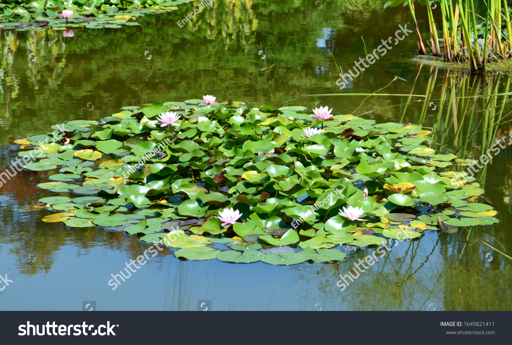
Water lilies exhibit adaptations for aquatic life including aerenchyma, floating leaves, and reduced mechanical tissue.
Example 3: Mangrove Vegetation
Environmental condition: Saline water, waterlogged soil, tidal flooding
Species response: Salt stress, oxygen limitation
Adaptation/Resource strategy: Salt exclusion, salt excretion, pneumatophores (aerial roots), viviparous seeds
Distribution pattern: Zonation along salinity and tidal gradients in coastal areas
Example 4: Alpine Vegetation
Environmental condition: Low temperature, short growing season, high light, wind exposure
Species response: Cold stress, limited growing period
Adaptation/Resource strategy: Low growth forms, cold-tolerant enzymes, protective pigments, rapid life cycles
Distribution pattern: Restricted to high elevations above treeline; distinct alpine meadows
Example 5: Mangrove and Salt-Tolerant Plants
Environmental condition: High salinity, waterlogging, anaerobic soil
Species response: Osmotic stress, ion toxicity, oxygen limitation
Adaptation/Resource strategy: Salt glands, succulent leaves, pneumatophores, selective ion uptake
Distribution pattern: Coastal wetlands, estuaries, salt marshes; zonation according to salinity tolerance
FAQ Section
Internal Linking Opportunities
Suggested anchor text → Suggested related article:
- plant distribution → Factors affecting plant geographical distribution
- climatic factors → Climate and vegetation relationships
- edaphic factors → Soil properties and plant growth
- plant adaptations → Morphological and physiological adaptations
- ecological niche → Niche theory and species coexistence
- population ecology → Plant population dynamics
- plant communities → Community ecology and succession
- vegetation → Major vegetation types and biomes
- limiting factors → Liebig's Law and nutrient limitation
- plant-water relations → Water uptake and transpiration
- mineral nutrition → Essential nutrients and deficiency symptoms
- photosynthesis → C3, C4, and CAM pathways
- biomes → Terrestrial biomes and climate
References / Further Reading
- Shelford VE. 1913. Animal Communities in Temperate America. Chicago: University of Chicago Press.
- Liebig J von. 1840. Die Chemie in ihrer Anwendung auf Agricultur und Physiologie.
- Varsity Tutors. "Ecological Tolerance." https://www.varsitytutors.com/practice/lessons/ap-environmental-science/ecological-tolerance
- Springer Nature. "Plant hormesis and Shelford's tolerance law curve." https://link.springer.com/article/10.1007/s11676-021-01312-0
- PubMed. "Nutrient limitation on terrestrial plant growth." https://pubmed.ncbi.nlm.nih.gov/22458659/
- Wikipedia. "Liebig's law of the minimum." https://en.wikipedia.org/wiki/Liebig's_law_of_the_minimum
- LibreTexts. "Environmental Responses." https://bio.libretexts.org/Bookshelves/Botany
- NC State Extension. "Soils and Plant Nutrients." https://content.ces.ncsu.edu/extension-gardener-handbook/1-soils-and-plant-nutrients
- Britannica. "Xerophyte." https://www.britannica.com/plant/xerophyte
Featured Image Information
📸 Featured Image Concept
Image concept: Composite showing vegetation zonation on a mountainside with different ecological zones (lowland forest, montane forest, alpine meadow) illustrating environmental gradients and species distribution.
Filename: ecological-characteristics-species-vegetation-zonation.jpg
Alt text: Vegetation zonation along mountain altitude gradient showing ecological characteristics of species and environmental tolerance zones
Caption: Vegetation zonation reflects species' ecological characteristics, including environmental tolerance, resource utilization, and competitive abilities along altitudinal gradients.
Dimensions: 1200 × 630 pixels (1.91:1 aspect ratio for social media sharing)
🎯 Final Takeaway
The ecological characteristics of species—environmental responses, tolerance ranges, ecological amplitude, and resource utilization strategies—work together to determine where species can occur and how successful they are. Understanding these characteristics is fundamental to ecology, conservation, and predicting responses to environmental change.


.jpg)





0 Comments