
Photophosphorylation: Complete Guide with Diagrams

Introduction
Every green leaf contains a microscopic energy factory. When sunlight strikes chlorophyll, plants do not store that light directly. Instead, they convert light energy into chemical energy in the form of ATP and NADPH. This process is called photophosphorylation.
Photophosphorylation is one of the most important parts of photosynthesis because it powers the Calvin cycle, supports sugar formation, and explains how light energy becomes usable biological energy. For students, this topic is especially important because exam questions often ask about cyclic photophosphorylation, non-cyclic photophosphorylation, the Z-scheme, ATP synthase, photolysis of water, and differences between both pathways.
Featured Snippet Answer
Photophosphorylation is the light-driven formation of ATP from ADP and inorganic phosphate during photosynthesis. It occurs in the thylakoid membrane of chloroplasts, where light-excited electrons move through electron carriers, create a proton gradient, and drive ATP synthase to produce ATP. It may be cyclic or non-cyclic.
Quick Summary Table
| Feature | Photophosphorylation |
|---|---|
| Meaning | Formation of ATP using light energy |
| Site | Thylakoid membrane of chloroplast |
| Main input | Light, ADP, inorganic phosphate |
| Main product | ATP |
| Linked process | Light-dependent reaction of photosynthesis |
| Types | Cyclic and non-cyclic photophosphorylation |
| Key enzyme | ATP synthase |
Table of Contents
- What is photophosphorylation?
- Site of photophosphorylation
- Importance of photophosphorylation
- Main components involved
- Mechanism of photophosphorylation
- Non-cyclic photophosphorylation
- Cyclic photophosphorylation
- Difference between cyclic and non-cyclic photophosphorylation
- Z-scheme of electron transport
- Role of ATP synthase
- Exam questions and MCQs
- FAQs
What Is Photophosphorylation?
Photophosphorylation is the process in which light energy is used to add a phosphate group to ADP, forming ATP. The word can be divided into two parts:
- Photo means light.
- Phosphorylation means addition of phosphate.
So, photophosphorylation means phosphate addition using light energy. In plants, it occurs during the light-dependent reactions of photosynthesis.
Site of Photophosphorylation
Photophosphorylation occurs in the chloroplast, specifically in the thylakoid membrane. The thylakoid membrane contains photosystems, electron carriers, and ATP synthase.
| Chloroplast Part | Role |
|---|---|
| Outer membrane | Protects the chloroplast |
| Inner membrane | Controls movement of substances |
| Stroma | Site of Calvin cycle |
| Thylakoid membrane | Site of light reactions and photophosphorylation |
| Thylakoid lumen | Area where protons accumulate |
| Grana | Stacks of thylakoids |
Why Photophosphorylation Is Important
Photophosphorylation is important because ATP is required for the Calvin cycle. Without ATP and NADPH from the light reactions, plants cannot efficiently convert carbon dioxide into carbohydrates.
Sunlight → ATP and NADPH → Calvin Cycle → Sugar Formation
Main Components of Photophosphorylation
1. Chlorophyll
Chlorophyll absorbs light energy. When chlorophyll receives photons, electrons become excited and move to a higher energy level.
2. Photosystem II
Photosystem II is also called PSII. Its reaction center is P680 because it absorbs light best at about 680 nm.
3. Photosystem I
Photosystem I is also called PSI. Its reaction center is P700 because it absorbs light best at about 700 nm.
4. Electron Transport Chain
The electron transport chain transfers electrons through carriers such as plastoquinone, cytochrome b6f, plastocyanin, ferredoxin, and NADP reductase.
5. ATP Synthase
ATP synthase uses the proton gradient to produce ATP from ADP and inorganic phosphate.
6. Water
In non-cyclic photophosphorylation, water is split to replace electrons lost from Photosystem II. This process releases oxygen.
Mechanism of Photophosphorylation
Photophosphorylation works through four main steps:
Step 1: Light Absorption
Chlorophyll molecules in photosystems absorb light energy.
Step 2: Electron Excitation
Light energy excites electrons. These high-energy electrons leave the reaction center.
Step 3: Electron Transport and Proton Gradient
Electrons pass through electron carriers. During this movement, protons accumulate inside the thylakoid lumen. This creates a proton gradient.
Step 4: ATP Formation
Protons move back to the stroma through ATP synthase. This proton flow provides energy to convert ADP and inorganic phosphate into ATP.
ADP + Pi → ATP
Types of Photophosphorylation
There are two main types of photophosphorylation:
- Cyclic photophosphorylation
- Non-cyclic photophosphorylation
Non-Cyclic Photophosphorylation
Non-cyclic photophosphorylation is the light-driven formation of ATP in which electrons move from water to NADP+ through Photosystem II and Photosystem I. The electrons do not return to the original photosystem.
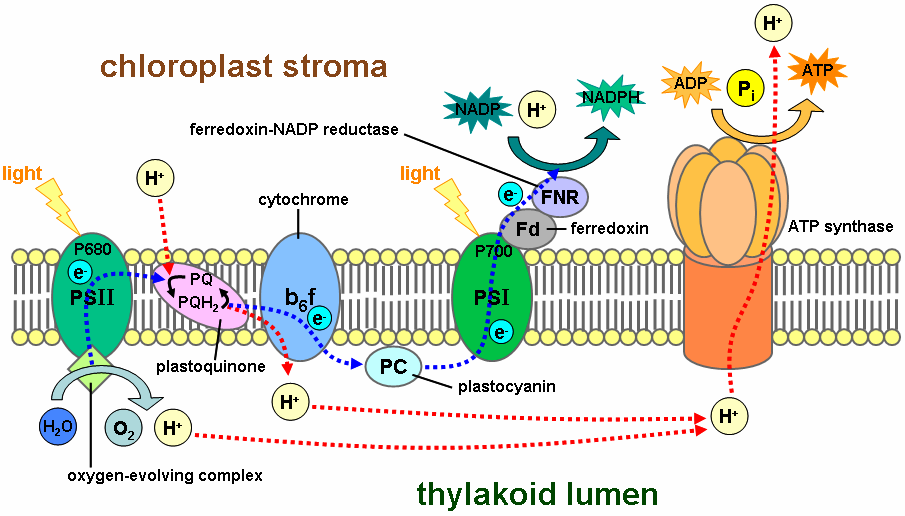
Products of Non-Cyclic Photophosphorylation
- ATP
- NADPH
- Oxygen
Steps of Non-Cyclic Photophosphorylation
- Light hits Photosystem II.
- Electrons in P680 become excited.
- Water splits to replace lost electrons.
- Electrons move through plastoquinone, cytochrome b6f, and plastocyanin.
- A proton gradient forms inside the thylakoid lumen.
- ATP synthase produces ATP.
- Electrons reach Photosystem I.
- Photosystem I transfers electrons to ferredoxin.
- NADP+ is reduced to NADPH.
2H2O → 4H+ + 4e- + O2
Cyclic Photophosphorylation
Cyclic photophosphorylation is the light-driven formation of ATP in which electrons from Photosystem I return back to Photosystem I through electron carriers.

Products of Cyclic Photophosphorylation
- ATP only
Cyclic photophosphorylation does not produce NADPH and does not release oxygen because water is not split.
Steps of Cyclic Photophosphorylation
- Light excites Photosystem I.
- Electrons from P700 move to ferredoxin.
- Electrons return through electron carriers.
- The electron flow helps create a proton gradient.
- ATP synthase produces ATP.
- Electrons return to Photosystem I.
Difference Between Cyclic and Non-Cyclic Photophosphorylation
| Feature | Cyclic Photophosphorylation | Non-Cyclic Photophosphorylation |
|---|---|---|
| Photosystem involved | PSI only | PSII and PSI |
| Electron path | Electrons return to PSI | Electrons do not return |
| ATP production | Yes | Yes |
| NADPH production | No | Yes |
| Oxygen release | No | Yes |
| Water splitting | No | Yes |
| Main purpose | Extra ATP production | ATP, NADPH, and oxygen formation |
| Final electron acceptor | PSI again | NADP+ |
Z-Scheme of Photophosphorylation
The Z-scheme explains the movement of electrons in non-cyclic photophosphorylation. It is called the Z-scheme because the energy level of electrons rises and falls in a pattern that looks like the letter Z.
Water → PSII → Plastoquinone → Cytochrome b6f → Plastocyanin → PSI → Ferredoxin → NADP+ → NADPH
Role of ATP Synthase in Photophosphorylation
ATP synthase is the enzyme that actually produces ATP. It works like a molecular turbine. When protons move from the thylakoid lumen back into the stroma, ATP synthase uses that energy to join ADP and inorganic phosphate.
Why Plants Need Cyclic Photophosphorylation
The Calvin cycle needs both ATP and NADPH, but sometimes the plant needs more ATP than NADPH. Cyclic photophosphorylation helps balance this energy demand by producing extra ATP without producing NADPH or oxygen.
Common Mistakes Students Make
| Mistake | Correct Concept |
|---|---|
| Thinking photophosphorylation makes glucose directly | It makes ATP; glucose is formed later in the Calvin cycle |
| Confusing PSI and PSII order | PSII works before PSI in non-cyclic flow |
| Thinking cyclic photophosphorylation releases oxygen | It does not release oxygen |
| Thinking NADPH forms in cyclic flow | NADPH forms only in non-cyclic flow |
| Forgetting water splitting | Water splits in non-cyclic photophosphorylation |
Keyword Loophole for Students and Teachers
Many articles explain only the basic definition of photophosphorylation. A better learning approach is to explain the topic with diagrams, ATP synthase mechanism, Z-scheme, comparison table, and exam questions. That is why the keyword photophosphorylation mechanism with diagram is more useful than only the broad keyword photophosphorylation.
Diagram Suggestions for Your Notes
| Diagram | Best Placement | Alt Text |
|---|---|---|
| Chloroplast structure | Site of photophosphorylation | Chloroplast diagram showing thylakoid membrane |
| Non-cyclic photophosphorylation | Non-cyclic section | Non-cyclic photophosphorylation diagram with PSII and PSI |
| Cyclic photophosphorylation | Cyclic section | Cyclic photophosphorylation diagram showing PSI electron cycle |
| Z-scheme | Z-scheme section | Z-scheme of photosynthetic electron transport |
Exam Importance of Photophosphorylation
Photophosphorylation is important in exams because it connects photosynthesis, chloroplast structure, electron transport, ATP synthesis, NADPH formation, oxygen evolution, and the Calvin cycle.
Important Short Questions
- Define photophosphorylation.
- Where does photophosphorylation occur?
- What are the two types of photophosphorylation?
- What is cyclic photophosphorylation?
- What is non-cyclic photophosphorylation?
- Why is water split in non-cyclic photophosphorylation?
- What is the role of ATP synthase?
- What is the Z-scheme?
- Why does cyclic photophosphorylation produce only ATP?
- Name the final electron acceptor in non-cyclic photophosphorylation.
Important Long Questions
- Explain the mechanism of non-cyclic photophosphorylation with a diagram.
- Compare cyclic and non-cyclic photophosphorylation.
- Describe the role of photosystems in photophosphorylation.
- Explain the Z-scheme of electron transport.
- Describe how ATP synthase produces ATP during light reactions.
MCQs on Photophosphorylation
- Photophosphorylation occurs in:
A. Mitochondrial matrix
B. Chloroplast stroma
C. Thylakoid membrane
D. Nucleus
Answer: C - The main product of cyclic photophosphorylation is:
A. Oxygen
B. NADPH
C. ATP
D. Glucose
Answer: C - Non-cyclic photophosphorylation involves:
A. PSI only
B. PSII only
C. Both PSII and PSI
D. Ribosomes
Answer: C - The reaction center of Photosystem II is:
A. P700
B. P680
C. NADP
D. ATP synthase
Answer: B - The reaction center of Photosystem I is:
A. P700
B. P680
C. PQ
D. PC
Answer: A - Oxygen is released during:
A. Cyclic photophosphorylation
B. Non-cyclic photophosphorylation
C. Glycolysis
D. Calvin cycle only
Answer: B - Final electron acceptor in non-cyclic photophosphorylation is:
A. Water
B. Oxygen
C. NADP+
D. ATP
Answer: C - ATP synthase uses energy from:
A. Glucose breakdown
B. Proton gradient
C. DNA replication
D. Ribosome movement
Answer: B - Cyclic photophosphorylation does not produce:
A. ATP
B. Proton gradient
C. NADPH
D. Electron flow
Answer: C - The Z-scheme represents:
A. Sugar breakdown
B. Electron flow in photosynthesis
C. Protein synthesis
D. DNA replication
Answer: B
FAQs About Photophosphorylation
1. What is photophosphorylation in simple words?
Photophosphorylation is the process by which plants use light energy to make ATP during photosynthesis.
2. Where does photophosphorylation occur?
It occurs in the thylakoid membrane of chloroplasts.
3. What are the two types of photophosphorylation?
The two types are cyclic photophosphorylation and non-cyclic photophosphorylation.
4. What is cyclic photophosphorylation?
Cyclic photophosphorylation is a pathway in which electrons from Photosystem I return back to Photosystem I and produce ATP only.
5. What is non-cyclic photophosphorylation?
Non-cyclic photophosphorylation is a pathway in which electrons move from water through PSII and PSI to NADP+, producing ATP, NADPH, and oxygen.
6. Why is it called non-cyclic photophosphorylation?
It is called non-cyclic because electrons do not return to their original photosystem.
7. Why is it called cyclic photophosphorylation?
It is called cyclic because electrons return back to Photosystem I.
8. Which photosystem is used in cyclic photophosphorylation?
Only Photosystem I is used in cyclic photophosphorylation.
9. Which photosystems are used in non-cyclic photophosphorylation?
Both Photosystem II and Photosystem I are used in non-cyclic photophosphorylation.
10. Does cyclic photophosphorylation produce oxygen?
No, cyclic photophosphorylation does not produce oxygen because water is not split.
11. Does non-cyclic photophosphorylation produce oxygen?
Yes, oxygen is produced when water is split during non-cyclic photophosphorylation.
12. What is the role of ATP synthase?
ATP synthase produces ATP by using the energy of protons moving down their concentration gradient.
13. What is the Z-scheme?
The Z-scheme is a model showing the energy changes and electron movement through PSII and PSI during non-cyclic photophosphorylation.
14. Why do plants need cyclic photophosphorylation?
Plants use cyclic photophosphorylation to make extra ATP when ATP demand is higher than NADPH demand.
15. What is the final electron acceptor in non-cyclic photophosphorylation?
The final electron acceptor is NADP+.
16. Is photophosphorylation part of the light reaction?
Yes, photophosphorylation occurs during the light-dependent reactions of photosynthesis.
17. What is photolysis of water?
Photolysis is the splitting of water using light energy. It provides electrons and releases oxygen.
18. What is the difference between photophosphorylation and oxidative phosphorylation?
Photophosphorylation uses light energy in chloroplasts, while oxidative phosphorylation uses energy from respiration in mitochondria.
Final Words
Photophosphorylation is the central energy-conversion process of the light-dependent reactions of photosynthesis. It allows plants to transform sunlight into ATP through electron transport, proton gradient formation, and ATP synthase activity. Non-cyclic photophosphorylation produces ATP, NADPH, and oxygen, while cyclic photophosphorylation produces extra ATP only.
Final line: To understand photosynthesis deeply, students must understand photophosphorylation because it is the bridge between sunlight and biological energy.
Image Credits and Attributions
- Chloroplast structure diagram: Kelvinsong, Wikimedia Commons.
- Thylakoid membrane light reaction diagram: Tameeria, Wikimedia Commons, Public Domain.
- Cyclic photophosphorylation diagram: Meimeit21, Wikimedia Commons, CC BY-SA 4.0.
Hashtags: #Photophosphorylation #Photosynthesis #BiologyNotes #PlantPhysiology #Chloroplast #LightReaction #ATP #PreachBio
Internal Link Suggestions for preachbio.com
- Photosynthesis in higher plants
- Light reaction of photosynthesis
- Chloroplast structure and function
- Calvin cycle
- Electron transport chain
- Plant physiology notes
- ATP synthase mechanism
External Authority Source Suggestions
- Khan Academy: Light-dependent reactions
- Britannica: Photosynthesis
- NCBI Bookshelf or PubMed Central: Photosynthetic electron transport
- Nature Education: Photosynthetic cells
Quality Check
| Checkpoint | Verdict |
|---|---|
| Useful for students? | Yes |
| Clickable title? | Yes |
| Realistic ranking angle? | Yes, especially diagram and mechanism keywords |
| Keyword naturally used? | Yes |
| Search intent satisfied? | Yes |
| Suitable for USA/UK audience? | Yes |
| Trustworthy? | Yes, with standard biology explanation and image attribution |


.jpg)





0 Comments