
💧 Molecular Structure and Properties of Water
Comprehensive Analysis of H₂O's Unique Characteristics
Water, a seemingly simple molecule, holds profound significance in chemistry, biology, and environmental science. Its molecular structure (H₂O) belies the complexity of its behavior and unique physico-chemical properties that make it essential for sustaining life on Earth.
1. Molecular Structure
Chemical Composition
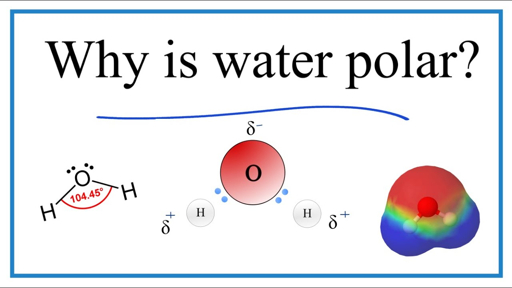
Water consists of two hydrogen atoms covalently bonded to one oxygen atom. The oxygen atom has 6 valence electrons and forms two single covalent bonds with hydrogen atoms, leaving two lone pairs of electrons. This creates a bent or V-shaped molecular geometry with a bond angle of 104.5°, which is less than the ideal tetrahedral angle (109.5°) due to lone pair repulsion.
Polarity
The oxygen atom is significantly more electronegative (3.44 on Pauling scale) than hydrogen (2.20), causing unequal electron sharing. This creates a dipole with partial negative charge (δ⁻) near the oxygen and partial positive charges (δ⁺) near the hydrogens. The dipole moment is 1.85 Debye, making water highly polar.
2. Hydrogen Bonding
Intermolecular Forces
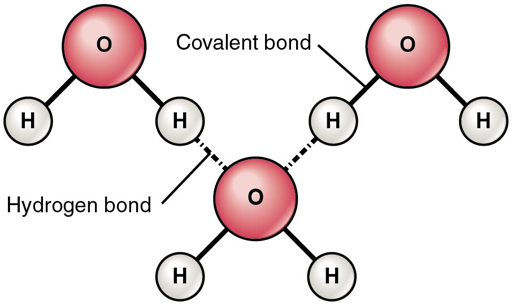
Hydrogen bonds form between the partially positive hydrogen of one water molecule and the partially negative oxygen of another. Each hydrogen bond has a strength of approximately 20 kJ/mol—much weaker than covalent bonds (~460 kJ/mol) but stronger than van der Waals forces. In liquid water at room temperature, each molecule forms an average of 3.4 hydrogen bonds, while in ice, each molecule forms exactly 4 hydrogen bonds in a tetrahedral arrangement.
Unique Properties from H-Bonding
Hydrogen bonding is responsible for water's anomalous properties:
- High surface tension (72.8 mN/m at 20°C): Strong cohesive forces at surface
- Cohesion: Water molecules stick together, enabling water columns in plants
- Adhesion: Water sticks to other surfaces, enabling capillary action
- High specific heat (4.184 J/g·°C): Resists temperature changes
- High heat of vaporization (2260 J/g): Requires much energy to evaporate
3. States of Matter
Solid (Ice)
In the solid state, water molecules form a hexagonal lattice structure (ice Ih), with each molecule hydrogen-bonded to four others in a tetrahedral arrangement. This open, crystalline structure creates large empty spaces, making ice less dense than liquid water. Molecules vibrate in fixed positions but cannot translate or rotate freely.
Liquid
In the liquid state, water molecules are in constant motion with moderate kinetic energy. Hydrogen bonds are dynamic—continuously breaking and reforming on a picosecond (10⁻¹² s) timescale. This allows fluidity while maintaining cohesion. The average number of hydrogen bonds per molecule is ~3.4, fewer than in ice but more than in vapor.
Gas (Vapor)
In the gaseous state, water molecules have high kinetic energy and are widely separated. Hydrogen bonds are essentially broken, and molecules move independently with minimal intermolecular interactions. Water vapor behaves nearly as an ideal gas under normal conditions.
| Property | Solid (Ice) | Liquid | Gas (Vapor) |
|---|---|---|---|
| Molecular arrangement | Hexagonal lattice, fixed | Dynamic, moving | Widely separated |
| Hydrogen bonds | 4 per molecule (stable) | ~3.4 per molecule | Broken/minimal |
| Density | 0.917 g/cm³ | 1.000 g/cm³ (at 4°C) | ~0.0006 g/cm³ |
| Molecular motion | Vibration only | Translational + rotational | Free, rapid movement |
4. Density Anomalies
Maximum Density at 4°C
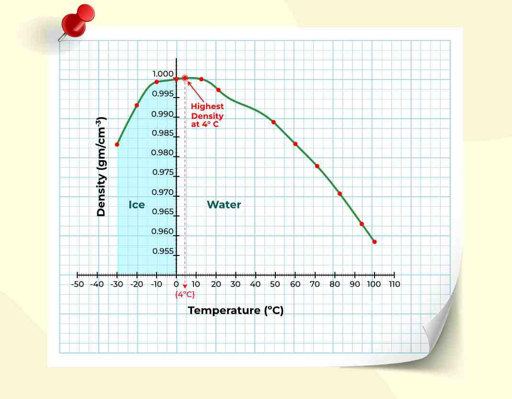
Unlike most substances, water reaches its maximum density at 4°C (not at freezing point). This results from two competing effects: (1) Thermal contraction—as temperature decreases, molecules move slower and pack more closely (increasing density); (2) Hydrogen bond expansion—as temperature approaches 0°C, hydrogen bonds begin organizing into the open hexagonal ice structure (decreasing density). At 4°C, these effects balance perfectly, giving water its maximum density of 1.000 g/cm³.
Expansion upon Freezing
Water expands by approximately 9% when it freezes due to the arrangement of molecules in a hexagonal lattice. In liquid water, molecules are randomly arranged and relatively close together. Upon freezing, molecules organize into an open hexagonal structure with larger spacing between them. This decreases density from 1.000 g/cm³ (liquid at 4°C) to 0.917 g/cm³ (ice at 0°C), causing ice to float.
5. High Heat Capacity
Specific Heat Capacity
Water has an unusually high specific heat capacity of 4.184 J/g·°C (1 cal/g·°C), meaning it requires 4.184 joules of energy to raise the temperature of 1 gram of water by 1°C. This is among the highest of all common substances, exceeded only by ammonia and hydrogen gas.
Why So High?
The high heat capacity results from hydrogen bonding. When heat is added to water, much of the energy goes into breaking hydrogen bonds rather than increasing molecular kinetic energy (temperature). This "energy sink" effect buffers temperature changes, requiring substantial heat input to raise water temperature.
Thermal Properties
- Specific heat: 4.184 J/g·°C (liquid water)
- Heat of vaporization: 2260 J/g (energy to convert liquid to gas)
- Heat of fusion: 334 J/g (energy to melt ice)
- Thermal conductivity: 0.6 W/m·K (moderate)
Biological & Environmental Significance
- Temperature regulation: Organisms resist temperature fluctuations
- Evaporative cooling: Sweating removes large amounts of heat
- Climate moderation: Oceans absorb solar heat, reducing temperature extremes
- Cellular stability: Maintains stable internal environment for enzymes
6. Universal Solvent
Why Water Dissolves Substances
Water's polarity enables it to dissolve more substances than any other liquid, earning it the title "universal solvent." The partial charges on water molecules attract ions and polar molecules through electrostatic interactions. Water molecules surround dissolved particles in a process called hydration or solvation, forming a hydration shell that stabilizes the dissolved species.
Mechanism of Dissolution
When ionic compounds dissolve, water molecules orient themselves around ions: oxygen (δ⁻) faces cations (+), while hydrogens (δ⁺) face anions (−). The energy released from hydration (solvation energy) overcomes the ionic bonds holding the crystal together. For polar molecules, water forms hydrogen bonds with polar functional groups (−OH, −NH₂, −COOH), enabling dissolution.
What Water Dissolves
- ✓ Ionic compounds: Salts (NaCl, KCl), minerals, electrolytes
- ✓ Polar molecules: Sugars (glucose, sucrose), alcohols, amino acids
- ✗ Nonpolar molecules: Fats, oils, hydrocarbons (hydrophobic effect)
7. Surface Tension
Mechanism of Surface Tension
Water molecules in the bulk experience balanced forces from neighbors on all sides. However, surface molecules only have neighbors below and beside them, creating a net inward force. This causes the surface to contract, minimizing surface area and behaving like a stretched elastic membrane. Water has a surface tension of 72.8 mN/m at 20°C—higher than most liquids.
Manifestations
- Water droplets: Form spherical shapes (minimum surface area for given volume). Raindrops, dew drops, and water beads on waxy surfaces are round due to surface tension.
- Capillary action: Water rises in narrow tubes against gravity. Adhesion pulls water up tube walls, while cohesion pulls water molecules together. Critical for water transport in plant xylem and water movement in soil.
- Insect locomotion: Water striders and other insects walk on water surface without breaking through, supported by surface tension.
- Lung function: Pulmonary surfactant reduces surface tension in alveoli, preventing lung collapse during exhalation.
8. pH and Ionization
Autoionization of Water
Water undergoes autoionization (self-ionization), where one water molecule donates a proton to another:
2H₂O ⇌ H₃O⁺ + OH⁻
Or simplified as:
H₂O ⇌ H⁺ + OH⁻
Ion Product (Kw)
The equilibrium constant for water ionization is Kw = [H⁺][OH⁻] = 1.0 × 10⁻¹⁴ at 25°C. In pure water, [H⁺] = [OH⁻] = 1.0 × 10⁻⁷ M, giving a pH of 7.0 (neutral). Temperature affects Kw; at higher temperatures, ionization increases and pH decreases slightly.
Acid-Base Properties
Water is amphoteric—it can act as both acid (proton donor) and base (proton acceptor):
- As a base: H₂O + H⁺ → H₃O⁺ (accepts proton)
- As an acid: H₂O → H⁺ + OH⁻ (donates proton)
- Buffering: Resists drastic pH changes in biological systems
Biological Importance
Most enzymes function optimally at pH 6.5-7.5. Water's buffering capacity maintains stable pH in cells and blood. The pH scale (0-14) measures hydrogen ion concentration: pH = −log[H⁺].
9. Transparency & Light Absorption
Visible Light Transmission
Water is transparent to visible light (400-700 nm), allowing sunlight to penetrate aquatic environments. Blue-green light (450-550 nm) penetrates deepest, while red light (620-750 nm) is absorbed within the first few meters. In clear ocean water, light can reach depths of ~200 meters (photic zone).
Selective Absorption
Water selectively absorbs different wavelengths:
- Blue light (450-495 nm): Least absorbed, penetrates deepest, ocean appears blue
- Green light (495-570 nm): Moderately absorbed, important for photosynthesis
- Red light (620-750 nm): Strongly absorbed, filtered out in first few meters
- UV radiation: Absorbed, protecting aquatic life from damage
Environmental Implications
- Photosynthesis: Light availability determines depth distribution of aquatic plants and algae
- Color spectrum: Influences color perception and camouflage in aquatic environments
- Thermal stratification: Absorption of infrared radiation heats surface layers
- UV protection: Water absorbs harmful UV-B and UV-C, protecting DNA from damage
10. Chemical Reactivity
Hydrolysis Reactions
Water participates in hydrolysis reactions, breaking down complex molecules by adding water across bonds:
- Carbohydrates: Starch + H₂O → Glucose (digestion)
- Proteins: Protein + H₂O → Amino acids (proteolysis)
- Lipids: Triglyceride + H₂O → Glycerol + Fatty acids (lipolysis)
- Nucleic acids: DNA/RNA + H₂O → Nucleotides
A-B + H₂O → A-H + B-OH
Ionization of Salts
Water dissolves and ionizes salts into constituent ions:
- Dissociation: NaCl(s) → Na⁺(aq) + Cl⁻(aq)
- Hydration: Ions surrounded by water molecules
- Conductivity: Ionic solutions conduct electricity (electrolytes)
Other Chemical Reactions
- Hydration reactions: Water adds to double bonds (e.g., ethene + H₂O → ethanol)
- Condensation reactions: Reverse of hydrolysis, water removed (e.g., amino acids → protein + H₂O)
- Redox reactions: Photosynthesis oxidizes water: 2H₂O → O₂ + 4H⁺ + 4e⁻
- Weathering: Water chemically weathers rocks through hydrolysis and dissolution
FAQs
- What is the molecular structure of water, and why is it polar?
Water has molecular formula H₂O with bent geometry (104.5° bond angle). Oxygen is more electronegative than hydrogen, creating partial negative charge (δ⁻) near oxygen and partial positive charges (δ⁺) near hydrogens. The bent shape prevents charge cancellation, making water polar. - How does hydrogen bonding contribute to water's unique properties?
Hydrogen bonds (20 kJ/mol) between water molecules create high cohesion, surface tension (72.8 mN/m), high specific heat (4.184 J/g·°C), and solvent abilities. Each molecule forms up to 4 H-bonds in ice, ~3.4 in liquid. - Why does water have maximum density at 4°C, and how does it impact aquatic ecosystems?
Competing effects of thermal contraction (increases density) and H-bond organization (decreases density) balance at 4°C. Ice floats (density 0.917 g/cm³), insulating water below and preventing complete freezing, allowing aquatic life to survive winter. - What is the significance of water's high specific heat capacity?
High specific heat (4.184 J/g·°C) allows water to absorb large amounts of heat with minimal temperature change. This regulates organism body temperature, moderates global climate (oceans), and maintains stable cellular environments. - How does water act as a solvent, and why is it called 'universal solvent'?
Water's polarity enables it to dissolve ionic compounds and polar molecules through hydration. It dissolves more substances than any other liquid, facilitating biochemical reactions, nutrient transport, and waste removal in living systems. - What role does water play in biological systems?
Water is the medium for all metabolic reactions, transports nutrients and wastes, maintains cell turgor, regulates temperature, participates in hydrolysis reactions, and provides structural support. Cells are 70-80% water.


.jpg)





0 Comments