Solve the strand-direction problem first, then understand how RNA is made and processed.
1. Transcription: copy information without copying the whole chromosome
Transcription is the synthesis of an RNA molecule using a DNA strand as a template. It is the first step of gene expression. In a protein-coding gene, the RNA message provides information that can later be used in translation. (Transcription makes RNA; translation uses an mRNA message to assemble a polypeptide. They are connected processes, not two names for the same reaction.)
A useful analogy is making a working copy of one instruction from a reference file. The original DNA remains, and the RNA is a new molecule with its own sugar–phosphate backbone. The analogy has a limit: the RNA sequence is produced through complementary base pairing, not by physically peeling away part of the DNA strand.
2. Template versus coding strand: the distinction that solves sequence questions
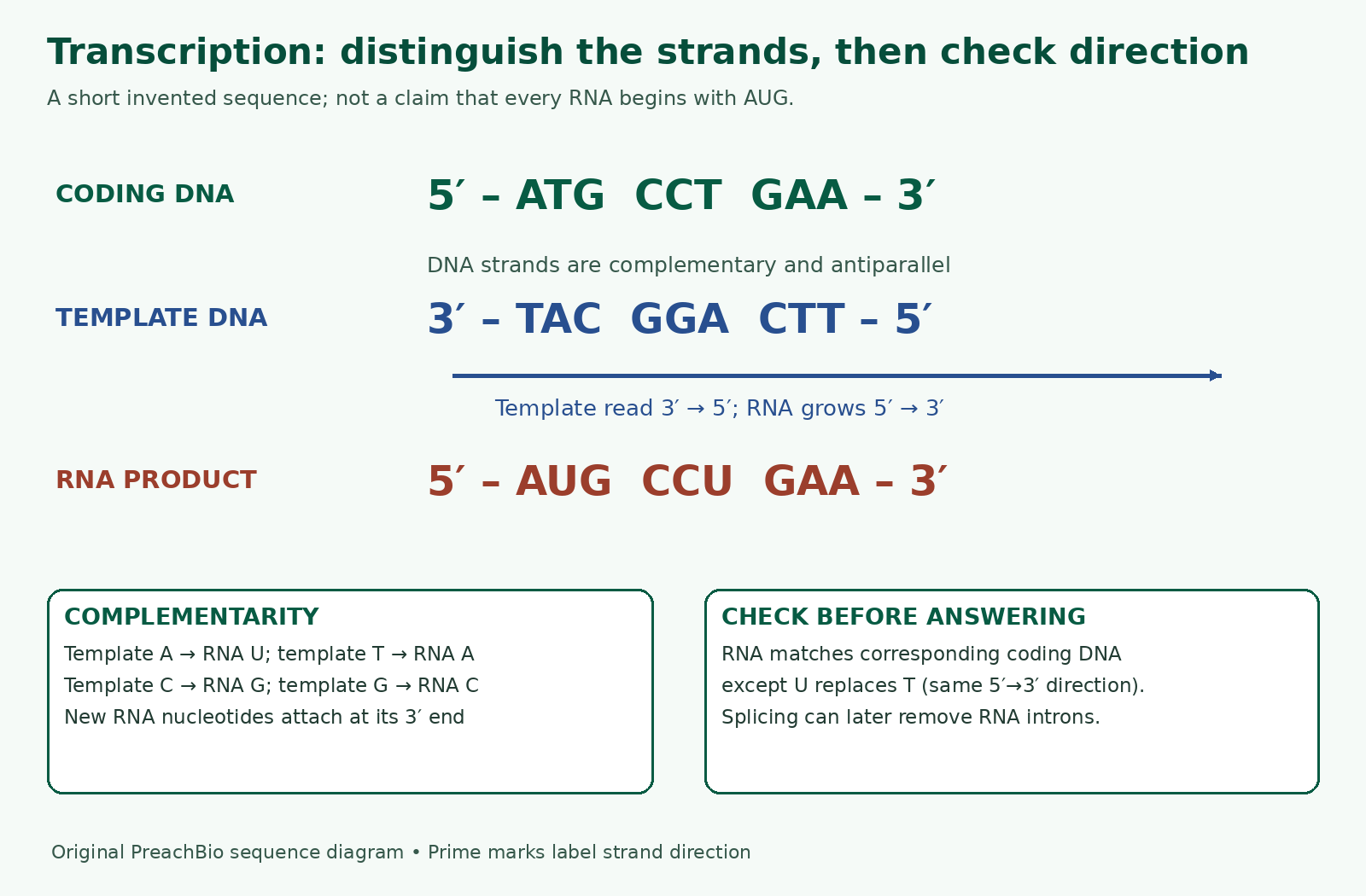
For a particular transcription unit, RNA polymerase reads one DNA strand, called the template or antisense strand. The RNA sequence is complementary and antiparallel to it. The other DNA strand is the coding or sense strand; over the corresponding transcribed region, it has the same sequence as the RNA when both are written 5′→3′, except DNA contains T where RNA contains U.
The words 'template' and 'coding' describe the roles of the strands for that particular gene. Do not assume that one entire chromosome strand is always the template for every gene. Also distinguish a primary transcript from a mature, spliced RNA: removal of introns changes which parts remain together in the mature molecule.
3. Read DNA 3′→5′, build RNA 5′→3′
RNA polymerase adds each incoming ribonucleotide to the 3′ end of the growing RNA. Consequently RNA grows 5′→3′ while the template is read 3′→5′. The prime marks refer to carbon positions in the nucleotide sugar. (The two direction labels describe different strands; they are not contradictory descriptions of one strand.)
The pairing rules are template A → RNA U, template T → RNA A, template G → RNA C, and template C → RNA G. RNA uses ribose and uracil; DNA uses deoxyribose and thymine. These chemical distinctions are why 'replace every T with U' works for the coding strand but is not the full rule for a template strand.
4. Worked example: identify the strand before changing any bases
Suppose the template segment is 3′–TAC GGA CTT–5′. Read left to right and pair each base to obtain RNA 5′–AUG CCU GAA–3′. The corresponding coding segment is 5′–ATG CCT GAA–3′. Check that RNA matches the coding sequence except for U replacing T.
Now suppose a template is supplied as 5′–AGT CCA–3′. If the answer must be written 5′→3′, first take the complementary antiparallel RNA, 3′–UCA GGU–5′, then reverse its written order to give 5′–UGG ACU–3′. (Changing T to U without checking orientation would give the wrong message.) These are short invented sequence segments, not claims that every transcript begins with AUG.
5. What RNA polymerase needs
Transcription requires a DNA template, RNA polymerase and ribonucleoside triphosphates: ATP, GTP, CTP and UTP. Their bases pair with the template, and the enzyme forms phosphodiester bonds in the new RNA backbone. When a nucleotide is incorporated, pyrophosphate is released; the associated chemistry helps drive chain growth.
RNA polymerase can begin RNA synthesis without a pre-existing primer. (Do not import the primer requirement of DNA replication into transcription.) A new RNA strand is assembled; the DNA template is neither converted into RNA nor permanently consumed by the process.
6. Initiation: find the promoter, then open a local region
A promoter is a DNA region recognised by the transcription machinery to position it for initiation. The transcription start site is the point where RNA synthesis actually begins. Upstream positions are labelled with negative numbers relative to that start site; the first transcribed position is +1. Promoter recognition and the start of the RNA chain are related but distinct events.
In the bacterial model used in the syllabus, sigma (σ) factor helps RNA polymerase recognise promoter sequences. Local DNA unwinding exposes the template and forms a transcription bubble. (Only a short region opens at a time; the whole chromosome does not unzip.) Sigma's tight initiation role is reduced as the enzyme proceeds into productive elongation.
7. Promoter examples: remember the context as well as the letters
The bacterial consensus examples are TTGACA near −35 and TATAAT near −10. The eukaryotic examples given in the syllabus are a TATA box, illustrated by TATAAA near −25, and a CAAT-box example GGCCAATCT near −70. 'Near' matters: these are teaching reference positions, not a rule that every promoter has exactly these bases at an identical distance.
A consensus sequence represents a commonly observed pattern. Not every bacterial promoter has a perfect match, and not every eukaryotic gene has a TATA box. The bacterial sigma factor should not be carried over as the eukaryotic recognition mechanism; eukaryotic transcription uses associated transcription factors. (Learn the distinction without adding advanced factor pathways to this lesson.)
8. Polymerase roles: keep the simplified model in its proper place
The syllabus introduces bacterial α, β, β′ and σ components: two α subunits support assembly and regulatory interactions; β and β′ form major parts of the catalytic and nucleic-acid-binding machinery; σ contributes promoter recognition. The important functional contrast is promoter recognition during initiation versus RNA-chain synthesis by the core enzyme.
An accuracy clarification is useful here: the common bacterial core is described more completely as α₂ββ′ω, with an additional small omega subunit; adding σ gives the holoenzyme. (The simplified five-component school diagram omits ω. Do not interpret that diagram as an exhaustive account of every bacterial polymerase.) Eukaryotic nuclear RNA polymerases have a different organisation.
At school level, RNA polymerase I is associated with production of most major rRNA, polymerase II with pre-mRNA, and polymerase III with tRNA. (Polymerase III also makes 5S rRNA; therefore 'all rRNA is made by polymerase I' is too absolute.) These qualifications clarify the textbook categories rather than introduce a separate topic.
9. Elongation: a moving bubble and a growing RNA strand
During elongation, RNA polymerase moves along the template, selecting complementary ribonucleotides and extending RNA at its 3′ end. A short RNA–DNA hybrid exists inside the transcription complex. As the enzyme advances, the new RNA separates and the DNA strands rejoin behind it. The transcription bubble therefore moves rather than remaining fixed at the promoter.
Do not confuse the temporary hydrogen bonding between RNA and template bases with the covalent bonds holding the RNA chain together. Base pairing selects which nucleotide fits; phosphodiester bonds connect successive nucleotides within the new RNA strand. (One answers 'which base next?'; the other answers 'what makes a continuous chain?'.)
10. Termination: stop transcription, not translation
In the bacterial hairpin model illustrated in the syllabus, a transcribed sequence produces a GC-rich RNA hairpin followed by a U-rich region. The hairpin favours polymerase pausing, while the weak RNA–DNA interactions in the U-rich region help destabilise the complex. The RNA is released and transcription ends. This is one bacterial termination mechanism, not a universal mechanism for all genes and organisms.
A transcription terminator is not the same as a translation stop codon. UAA, UAG and UGA are read by the translation machinery as signals to end polypeptide synthesis; they are not, by themselves, commands for RNA polymerase to stop. (A transcript can include a translation stop codon and additional RNA sequence beyond it.) This distinction prevents an otherwise common confusion between the two stages of gene expression.
11. Why the eukaryotic primary transcript needs processing
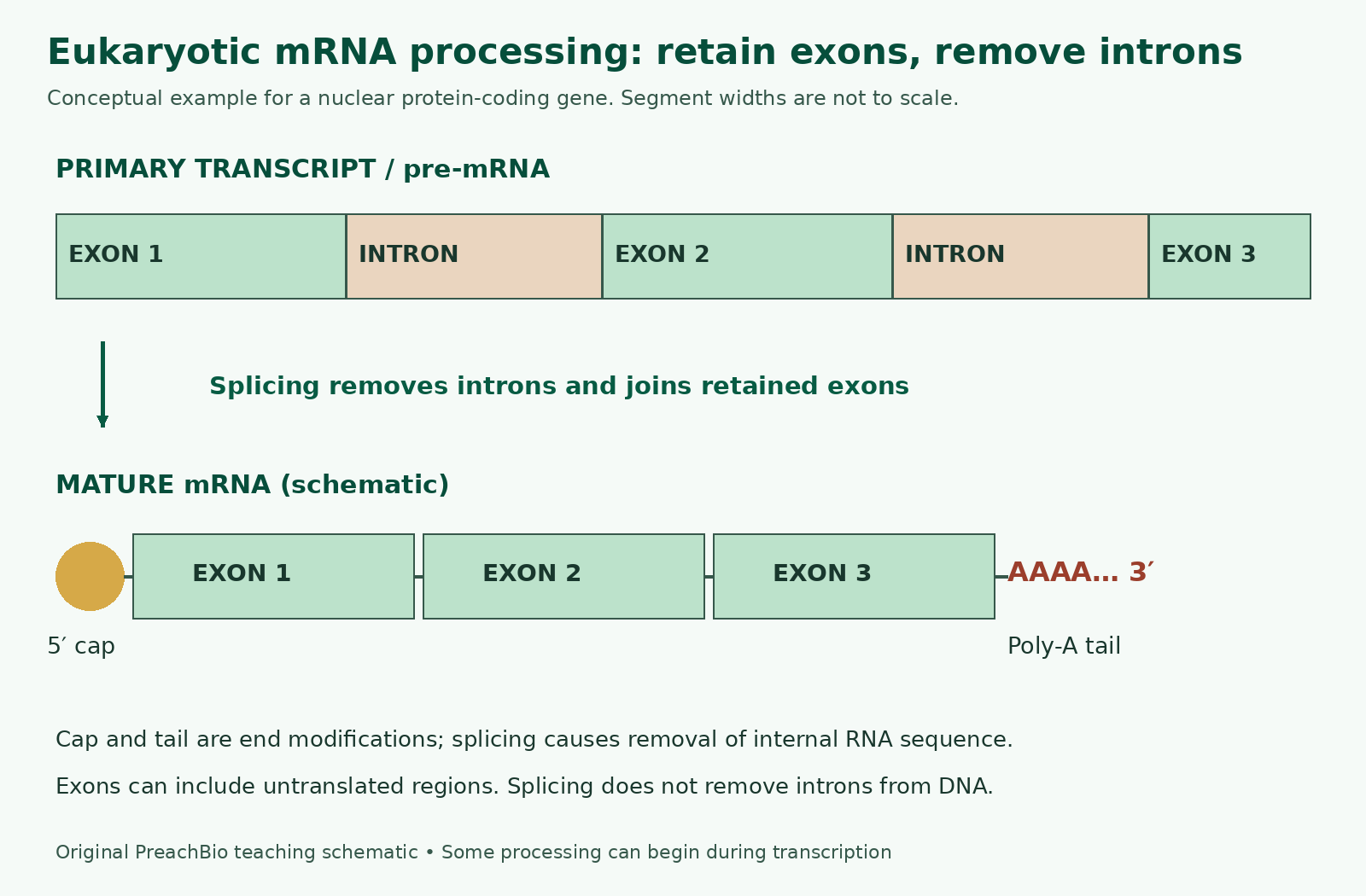
For a typical nuclear protein-coding gene in a eukaryote, transcription produces a primary RNA transcript or pre-mRNA in the nucleus. Processing prepares a mature mRNA for export and translation in the cytoplasm. The syllabus groups the key changes as addition of a 5′ cap, addition of a 3′ poly-A tail and splicing.
The label 'post-transcriptional modifications' is convenient for study, but some processing begins while transcription is still occurring. (Do not assume that the entire chain must always be finished before any processing starts.) Bacteria lack a membrane-bound nucleus, so transcription and translation can be coupled; their typical mRNA pathway does not require this nuclear export step.
12. 5′ cap and 3′ poly-A tail: protect the message
The 5′ cap includes a modified guanine nucleotide, 7-methylguanosine, joined through an unusual 5′–5′ linkage. It helps protect the RNA and supports its handling and use by the cell. Do not confuse the cap with a start codon: a cap is an end modification, whereas a start codon is part of the sequence later read during translation.
For most eukaryotic mRNAs, the 3′ end is processed and a chain of adenine-containing ribonucleotides is added as a poly-A tail. It contributes to stability, export and efficient use of the message. The textbook's approximately 250 A residues is a representative example; tail lengths vary. (The tail is added during processing rather than simply copied from a long run of T bases in the DNA template.)
13. Splicing: remove introns and join exons
An intron is a segment transcribed into the primary RNA that is removed during splicing. Exons are segments retained in the mature RNA. In the simple protein-coding model, joining retained exons produces a continuous message for later translation. (Retained does not mean every exon base becomes an amino acid: mature mRNA also includes untranslated regions.)
The mature RNA can be shorter than the primary transcript because introns have been removed. Cap and tail addition do not cause that shortening; they add material. An invented example makes the distinction clear: a 1,200-nucleotide primary transcript loses 400 nucleotides of introns, leaving 800 nucleotides of retained transcript before counting newly added end modifications. Removing RNA introns does not mean deleting those sequences from the cell's DNA.
Transcription versus translation: quick comparison
| Feature | Transcription | Translation |
|---|---|---|
| Information used | DNA template | mRNA message |
| Product | RNA | Polypeptide |
| Main machinery | RNA polymerase and associated factors | Ribosome and associated factors |
| Typical eukaryotic location for a nuclear gene | Nucleus | Cytoplasmic ribosomes |
| Ending signal | Transcription termination mechanism | Translation stop codon |
14. Write a mechanism answer in a logical order
Begin with the definition, name the template and coding strands, and state the opposite template-reading and RNA-synthesis directions. Then explain initiation at a promoter, elongation by complementary nucleotide addition and termination with RNA release. If the question concerns eukaryotic mRNA, add cap, tail and splicing with the purpose of each change.
Before submitting a sequence answer, check four things: which strand was supplied, the direction in which it was written, complementary pairing if it was the template, and U rather than T in RNA. Before submitting a long answer, check that you have not made a stop codon terminate transcription or made a ribosome manufacture RNA. Those two errors mix up the jobs of different molecular machines.
20 MCQs with explained answers
Attempt each question before opening its explanation. All questions are original practice for this lesson.
1. What is the direct product of transcription?
- A new lipid bilayer
- A polypeptide
- RNA
- A duplicated whole chromosome
Show answer and explanation
C. RNA — RNA polymerase assembles an RNA chain using a DNA template.
2. Which DNA strand is read for a particular transcription unit?
- Both strands copied into one RNA simultaneously
- Coding strand in place of template
- Neither strand
- Template strand
Show answer and explanation
D. Template strand — The RNA is complementary to the template for that gene.
3. In which direction does RNA grow?
- 5′→3′
- Both directions from each nucleotide
- Only towards a chromosome centromere
- 3′→5′
Show answer and explanation
A. 5′→3′ — New nucleotides are added to the growing 3′ end.
4. In which direction is the template read during RNA synthesis?
- Only from a DNA 5′ cap
- Without any strand direction
- 5′→3′
- 3′→5′
Show answer and explanation
D. 3′→5′ — Template and new RNA are antiparallel.
5. Template 3′–TAC–5′ gives which RNA segment?
- 5′–ATG–3′
- 5′–UAC–3′
- 5′–TAC–3′
- 5′–AUG–3′
Show answer and explanation
D. 5′–AUG–3′ — RNA bases pair A with template T, U with A and G with C.
6. Which sequence matches RNA apart from T/U in the corresponding unspliced region?
- Template DNA written 3′→5′ without complementation
- An unrelated promoter sequence
- Coding DNA written 5′→3′
- Both DNA strands written in the same direction
Show answer and explanation
C. Coding DNA written 5′→3′ — Coding DNA and corresponding RNA have the same base order except thymine/uracil.
7. Which enzyme synthesises RNA in transcription?
- An AV-node enzyme
- RNA polymerase
- A ribosomal peptidyl transferase
- DNA ligase alone
Show answer and explanation
B. RNA polymerase — RNA polymerase catalyses RNA-chain synthesis.
8. Does RNA polymerase need a pre-existing primer to begin transcription?
- No
- Yes, always a protein primer
- Only if uracil is present
- Yes, always an RNA primer
Show answer and explanation
A. No — It can initiate an RNA chain de novo.
9. What is a promoter?
- A DNA region recognised for transcription initiation
- A mature protein signal peptide
- A translation stop codon
- The RNA poly-A tail
Show answer and explanation
A. A DNA region recognised for transcription initiation — Promoters help position transcription machinery.
10. What does −35 mean in the bacterial promoter example?
- The 35th phosphate of the mature tail
- Thirty-five seconds after initiation
- Thirty-five amino acids after a stop codon
- Upstream of the transcription start site
Show answer and explanation
D. Upstream of the transcription start site — Negative positions refer to upstream DNA coordinates relative to +1.
11. Which bacterial −10 consensus is used in the syllabus?
- UGA
- AAAAAAAA
- AUG
- TATAAT
Show answer and explanation
D. TATAAT — TATAAT is the classic bacterial −10 consensus example.
12. What is sigma factor's central initiation role?
- Adding the eukaryotic poly-A tail
- RNA-intron removal
- Promoter recognition
- Translating amino acids
Show answer and explanation
C. Promoter recognition — Sigma helps the bacterial enzyme recognise appropriate initiation sites.
13. Which substrates are used for RNA-chain growth?
- Ribonucleoside triphosphates
- Amino acids alone
- Fatty acids
- Deoxyribonucleotides only
Show answer and explanation
A. Ribonucleoside triphosphates — ATP, GTP, CTP and UTP provide ribonucleotides for RNA synthesis.
14. Which bonds join successive RNA nucleotides in the backbone?
- Phosphodiester bonds
- Disulphide bonds
- Peptide bonds
- Only hydrogen bonds
Show answer and explanation
A. Phosphodiester bonds — Hydrogen bonding selects complementary bases, while phosphodiester bonds make the chain.
15. In the hairpin termination model, the hairpin forms in:
- The DNA phosphate backbone being cut
- A polypeptide chain
- A valve leaflet
- The newly made RNA
Show answer and explanation
D. The newly made RNA — RNA can fold through complementary intramolecular base pairing.
16. Which statement distinguishes a terminator from a stop codon?
- A stop codon ends translation; a terminator acts in transcription
- A terminator is an amino acid
- Both always halt RNA polymerase directly
- Stop codons are 5′ caps
Show answer and explanation
A. A stop codon ends translation; a terminator acts in transcription — The two signals belong to different molecular processes.
17. What is added at the typical eukaryotic mRNA 5′ end?
- A long thymine tail
- A DNA centromere
- A modified guanine cap
- An amino-acid primer
Show answer and explanation
C. A modified guanine cap — The 5′ cap includes 7-methylguanosine.
18. What does poly-A describe?
- The bacterial −10 sequence
- A chain of alanine amino acids
- A DNA sequence removed with every intron
- A chain of adenine-containing RNA nucleotides
Show answer and explanation
D. A chain of adenine-containing RNA nucleotides — The tail is an RNA-end modification rich in A residues.
19. What does splicing remove from pre-mRNA?
- All exons
- All uracil bases
- The DNA template from the chromosome
- Introns
Show answer and explanation
D. Introns — Introns are excised and retained exons are joined.
20. Which eukaryotic nuclear polymerase makes pre-mRNA?
- A ribosome
- RNA polymerase II
- RNA polymerase I only
- DNA polymerase III
Show answer and explanation
B. RNA polymerase II — Polymerase II transcribes nuclear protein-coding genes.
Interactive quiz: 20 different questions
This is a separate question set. Choose one answer for each question, then check your score. No login, timer or personal information is needed; answers are processed in this page.
Quiz answer key and explanations — open after attempting
1: D. 5′–AUG CCU–3′ — Use the coding sequence in the same direction, substituting U for T.
2: C. 5′–CCU GAA–3′ — Complement the supplied 3′→5′ template to obtain 5′→3′ RNA.
3: B. 5′–UGG ACU–3′ — Take the RNA complement antiparallel to the template, then reverse its written order.
4: A. U — RNA uses uracil opposite template adenine.
5: D. G — Complementary base pairing selects guanine opposite cytosine.
6: C. The RNA must also be complementary and antiparallel — The shortcut applies to the corresponding coding sequence, not directly to the template.
7: C. Promoter positions machinery; +1 is the first transcribed position — Recognition elements and the actual initiation nucleotide are distinct.
8: B. TTGACA near −35 and TATAAT near −10 — These are bacterial promoter consensus examples, not universal exact sequences.
9: B. It is a promoter example, not present in every gene — Promoter architecture varies among eukaryotic genes.
10: C. The separated DNA strands rejoin — The bubble is local and transient.
11: C. To the growing RNA 3′ end — 3′-end addition determines 5′→3′ RNA growth.
12: C. Base pairing selects a nucleotide; phosphodiester bonding links it — Complementarity and covalent polymerisation have different roles.
13: B. GC-rich RNA hairpin followed by a U-rich region — Pausing and weak RNA–DNA interactions help destabilise the transcription complex.
14: A. There is no nuclear envelope separating the two processes — The lack of nuclear compartmentalisation allows coupling.
15: C. 800 nt — Subtract removed RNA sequence: 1,200 − 400 = 800.
16: A. Intron removal — Splicing removes internal RNA segments; capping and tailing add material.
17: B. The intron-containing DNA sequence — RNA processing does not delete introns from the original DNA.
18: A. They are retained RNA segments and may include untranslated regions — Retention in mature RNA does not imply translation of every retained base.
19: D. Polymerase III also makes 5S rRNA — Most major rRNA is associated with polymerase I, but 5S is a polymerase III product.
20: A. The cap is an end modification; AUG is a sequence used in translation — An RNA-end modification is not a translated triplet signal.
Student FAQs
What is transcription in biology?
It is RNA synthesis directed by a DNA template. For a protein-coding gene, it produces the RNA message used later in translation.
Which DNA strand is copied during transcription?
The template strand for that gene is read. The coding strand matches the corresponding RNA sequence, apart from T in DNA and U in RNA.
Why is RNA made 5′ to 3′?
RNA polymerase extends the chain by adding nucleotides to its 3′ end, while reading the template in the opposite direction.
Does transcription need a primer?
No. RNA polymerase can start a new RNA chain without a pre-existing primer.
Is the promoter the same as a start codon?
No. A promoter helps position transcription machinery on DNA. A start codon is an mRNA sequence used during initiation of translation.
Does a stop codon stop transcription?
No. Translation stop codons terminate polypeptide synthesis. Transcription termination depends on signals and mechanisms acting on RNA polymerase.
Why is mature mRNA shorter than the primary transcript?
Splicing removes introns. Cap and poly-A-tail addition are separate modifications that add material rather than explain the shortening.
Are introns removed from DNA?
Not during ordinary RNA splicing. They are removed from the RNA transcript; the DNA sequence remains.
What is the difference between transcription and translation?
Transcription synthesises RNA from DNA; translation uses mRNA information to assemble a polypeptide at a ribosome.
Does every exon code for amino acids?
No. Exons are retained in mature RNA and can contain untranslated regions as well as protein-coding sequence.
Continue studying
- Three-domain classification — recall the distinction between bacterial and eukaryotic cell organisation.
- Homeostasis and feedback — related physiology revision at Class 12 level.
- Punjab Biology course resources and official textbook links
Sources, scope and preparation
Prepared for PreachBio on 20 October 2026. Original explanations, invented worked examples, questions and diagrams were developed for this lesson. Punjab textbook headings and section boundaries were checked; supplementary sources were used to clarify scientific wording. This is an independent learning resource, not an official PECTAA publication or medical advice.
- PECTAA official curriculum and textbook directory — follow the edition prescribed by your college.
- Punjab Biology 12, Chapter 19, section 19.5, printed pages 133–136. Public textbook viewer consulted for curriculum scope.
- Molecular Biology of the Cell: From DNA to RNA — transcription and processing concepts.
- Review of bacterial RNA polymerase structure — the omega-subunit clarification.


0 Comments