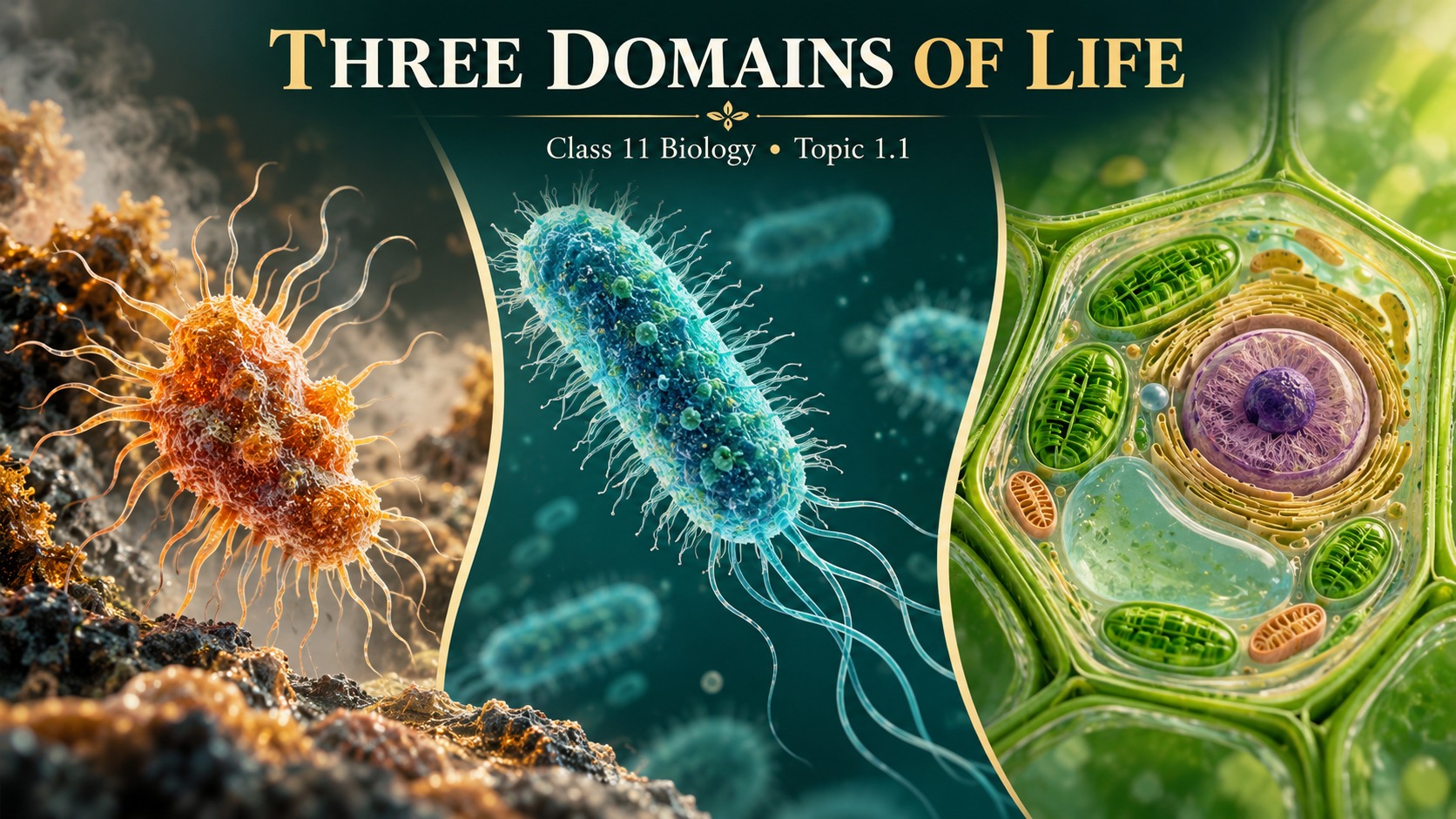
A bacterium and an archaeon can both be tiny cells without a nucleus. That does not make them members of the same domain. The three-domain system uses differences in cellular organisation and molecular features to separate cellular life into Archaea, Bacteria and Eukarya.
1. What is a domain?
A domain is the broadest rank used in this classification model, above kingdom. It groups organisms using fundamental features of their cells and molecular organisation. A domain is not a habitat, a body shape or a feeding method. Organisms with very different appearances can belong to the same domain: a mushroom, a tree and a human all belong to Eukarya.
Keep two questions separate: What type of cell does it have? and Which domain does it belong to? Prokaryotic organisation occurs in both Archaea and Bacteria. Eukaryotic organisation characterises Eukarya. Therefore, the two cell-organisation categories do not correspond to only two domains.
2. Why was Monera separated?
In Whittaker’s five-kingdom model, introduced in 1969, prokaryotic organisms were placed together in Monera. The three-domain system, proposed by Carl Woese and colleagues in 1990, distinguished Archaea from Bacteria. Comparisons of ribosomal RNA and other molecular features showed that a shared lack of a nucleus concealed major differences.
The useful reasoning is similar outward organisation does not necessarily mean the closest evolutionary relationship. In the syllabus model, Archaea share important molecular features with Eukarya. Do not turn a branching diagram into a ladder: living bacteria did not simply change into living archaea and then into present-day humans.
3. Domain Archaea
Archaea have prokaryotic cells: their genetic material is not enclosed in a membrane-bound nucleus, and they lack the membrane-bound organelles typical of eukaryotes. Their cell envelopes and molecular machinery distinguish them from bacteria. Archaeal cell walls lack bacterial peptidoglycan; some contain different wall materials, including proteins or pseudopeptidoglycan.
A central membrane distinction is ether linkage. Archaeal membrane lipids typically contain branched hydrocarbon chains joined to glycerol through ether bonds. Bacterial and eukaryotic membrane lipids are typically ester-linked. For this topic, recognise the contrast rather than memorising a detailed lipid structural formula.
Methanogens produce methane under anaerobic conditions. Other syllabus examples include salt-associated halophilic archaea, heat-associated groups such as Thermococci, and archaea involved in the nitrogen cycle. These examples show diversity within the domain. Not every archaeon lives in an extreme environment, and an organism cannot be classified as archaeal merely because it tolerates heat.
Archaea reproduce asexually, for example by division, budding or fragmentation. They do not carry out mitosis or meiosis. Their biological importance includes nutrient cycling and methane production during anaerobic digestion. Some archaeal enzymes remain functional under demanding conditions and are useful in biotechnology; this does not mean every archaeal enzyme is heat-resistant.
4. Domain Bacteria
Bacteria also have prokaryotic cells. Their DNA is located in a nucleoid region rather than a membrane-bound nucleus. A bacterial chromosome is commonly circular, and additional DNA may occur as plasmids. Treat these as common features, not exception-free rules about every bacterial species.
Most bacterial cell walls contain peptidoglycan. Bacteria generally multiply by binary fission, not mitosis. Their shapes include cocci, bacilli, spirilla and vibrios. Shape is useful for description but is insufficient to distinguish Bacteria from Archaea by itself.
The domain includes photosynthetic organisms, decomposers, nitrogen-fixing organisms and organisms associated with other living things. Some cause disease; many do not. Examples include Escherichia coli, Rhizobium and cyanobacteria. A photosynthetic cyanobacterium is still a bacterium: making food using light does not place it in the plant kingdom.
5. Domain Eukarya
Eukaryotic cells have genetic material enclosed within a membrane-bound nucleus and contain membrane-bound organelles. Animals, plants, fungi and protists are placed in Eukarya in the school classification model. This domain includes unicellular organisms as well as multicellular organisms.
Cell walls are not a universal eukaryotic feature. Plant cell walls contain cellulose, fungal cell walls typically contain chitin, and animal cells lack cell walls. Therefore, both “has a cell wall” and “has no cell wall” are incomplete domain-identification rules without further evidence.
Eukaryotes may reproduce sexually or asexually. Mitosis supports nuclear division in many eukaryotic growth and asexual processes, while meiosis is associated with sexual life cycles. Do not claim that every eukaryote is multicellular or that all eukaryotic reproduction is sexual.
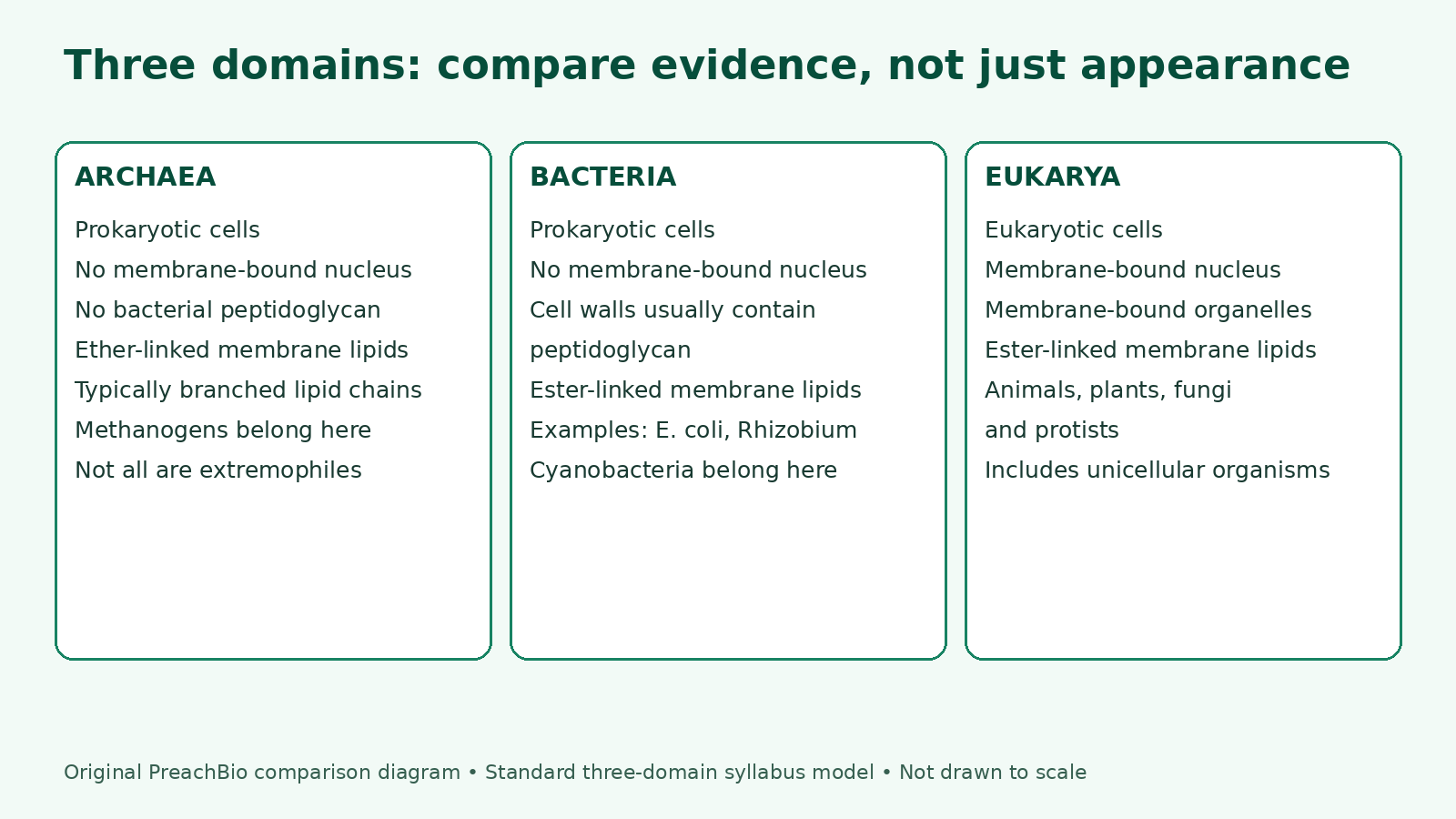
6. Archaea, Bacteria and Eukarya: comparison table
| Feature | Archaea | Bacteria | Eukarya |
|---|---|---|---|
| Cell organisation | Prokaryotic | Prokaryotic | Eukaryotic |
| Membrane-bound nucleus | Absent | Absent | Present in the typical cell |
| Typical membrane linkage | Ether | Ester | Ester |
| Cell wall | No bacterial peptidoglycan | Usually peptidoglycan | Variable: cellulose, chitin or absent |
| Examples | Methanogens, halophilic archaea | E. coli, Rhizobium, cyanobacteria | Plants, animals, fungi, protists |
| Key caution | Not all extremophiles | Not all pathogens | Not all multicellular |
7. Worked identification: justify the answer
Case A: A cell lacks a nucleus. Its membrane lipids are ether-linked, and its wall lacks peptidoglycan. Conclusion: Archaea. Lack of a nucleus alone leaves two possibilities; the membrane and wall evidence narrow the choice.
Case B: A unicellular organism has a nucleus and mitochondria. Conclusion: Eukarya. Being single-celled does not make an organism prokaryotic.
Case C: A photosynthetic cell has no nucleus and a peptidoglycan wall. Conclusion: Bacteria. The cell organisation and wall chemistry are more decisive here than its nutritional mode.
8. Write a strong comparison answer
For an answer comparing Archaea and Bacteria, begin with the shared prokaryotic organisation. Then give paired differences: ether-linked versus ester-linked membrane lipids, and absence versus usual presence of peptidoglycan. Finish with a suitable example. A list of archaeal features followed by an unrelated list of bacterial shapes is a weaker comparison.
Revision check: Can you explain why a yeast cell belongs with Eukarya, why cyanobacteria are not plants, and why “lives in hot water” is not enough evidence to assign a domain? If you can justify all three, you understand the classification principle rather than only remembering names.
20 MCQs with answers and explanations
Try each question before opening its answer. These questions practise this topic only.
1. Which is a domain in the three-domain system?
- Archaea
- Monera
- Animalia
- Fungi
Show answer and explanation
A. Archaea — Archaea is a domain; Animalia and Fungi are kingdoms in the school model.
2. Which pair has prokaryotic cell organisation?
- Archaea and plants
- Bacteria and Eukarya
- Fungi and Bacteria
- Archaea and Bacteria
Show answer and explanation
D. Archaea and Bacteria — Both Archaea and Bacteria lack a membrane-bound nucleus.
3. A domain is placed at which level relative to kingdom?
- Below kingdom
- Above kingdom
- Below species
- At the same rank as genus
Show answer and explanation
B. Above kingdom — Domain is the broader rank above kingdom.
4. Which feature most directly identifies a typical eukaryotic cell?
- Binary fission
- A membrane-bound nucleus
- A cell wall
- Small size
Show answer and explanation
B. A membrane-bound nucleus — The membrane-bound nucleus distinguishes eukaryotic organisation.
5. Typical archaeal membrane lipids have which linkage?
- Glycosidic
- Peptide
- Ester only
- Ether
Show answer and explanation
D. Ether — Ether-linked membrane lipids are a major archaeal distinction.
6. Which wall material is characteristic of most bacteria?
- Peptidoglycan
- Lignin
- Chitin
- Cellulose
Show answer and explanation
A. Peptidoglycan — Peptidoglycan is the usual bacterial wall polymer.
7. Methanogens are classified in which domain?
- A fourth cellular domain
- Archaea
- Eukarya
- Bacteria
Show answer and explanation
B. Archaea — Methanogens are methane-producing archaea.
8. A unicellular organism has a nucleus and mitochondria. Its domain is:
- Bacteria
- Archaea
- Eukarya
- Monera
Show answer and explanation
C. Eukarya — Unicellular eukaryotes exist; a nucleus and mitochondria support Eukarya.
9. Cyanobacteria belong to:
- Bacteria
- Fungi
- Plantae
- Archaea
Show answer and explanation
A. Bacteria — Photosynthesis does not override their prokaryotic bacterial organisation.
10. Which statement about archaea is accurate?
- All divide by mitosis
- Not all live in extreme habitats
- All cause human disease
- All have chloroplasts
Show answer and explanation
B. Not all live in extreme habitats — Archaea occur in ordinary habitats as well as extreme ones.
11. Most bacterial cells multiply primarily by:
- Binary fission
- Mitosis
- Fertilisation
- Meiosis
Show answer and explanation
A. Binary fission — Binary fission is the usual bacterial division process.
12. Which group includes both unicellular and multicellular organisms?
- Only Monera
- Eukarya
- Only methanogens
- Only viruses
Show answer and explanation
B. Eukarya — Eukarya includes unicellular protists and yeasts as well as multicellular groups.
13. Which feature alone is insufficient to distinguish Bacteria from Archaea?
- Wall chemistry together with membrane chemistry
- Lack of a nucleus
- Several molecular comparisons
- Typical membrane linkage
Show answer and explanation
B. Lack of a nucleus — Both domains lack a membrane-bound nucleus.
14. A typical fungal cell wall contains:
- Glycogen only
- Peptidoglycan
- Chitin
- Animal collagen
Show answer and explanation
C. Chitin — Chitin is a typical fungal wall component.
15. Whittaker’s five-kingdom model grouped prokaryotes in:
- Protista
- Plantae
- Animalia
- Monera
Show answer and explanation
D. Monera — Monera grouped prokaryotic organisms in that model.
16. The three-domain system was proposed in 1990 by Woese and colleagues using important:
- Only colour patterns
- Body-weight categories
- Molecular evidence
- Weather records
Show answer and explanation
C. Molecular evidence — Molecular comparisons revealed major differences not apparent from cell shape alone.
17. Which statement avoids an overgeneralisation?
- Every bacterium is pathogenic
- Every archaeon is heat-loving
- Every eukaryote is multicellular
- Most bacterial walls contain peptidoglycan
Show answer and explanation
D. Most bacterial walls contain peptidoglycan — The qualified wall statement is accurate; the other claims are false universals.
18. Which organism belongs to Eukarya?
- Yeast
- Rhizobium
- A methanogen
- A cyanobacterium
Show answer and explanation
A. Yeast — Yeast is a fungus with eukaryotic cells.
19. Which pair correctly matches cell wall material?
- Archaea—peptidoglycan; animals—cellulose
- Animals—peptidoglycan; plants—chitin
- Plants—cellulose; fungi—chitin
- Plants—chitin; fungi—cellulose
Show answer and explanation
C. Plants—cellulose; fungi—chitin — Cellulose and chitin are characteristic plant and fungal wall materials, respectively.
20. The strongest domain assignment uses:
- Cell colour alone
- Habitat alone
- Cell size alone
- A combination of cellular and molecular evidence
Show answer and explanation
D. A combination of cellular and molecular evidence — Several relevant features provide a better justification than one superficial feature.
Separate interactive quiz: 20 new questions
This is a different question set from the explained MCQs. Select one answer per question, then submit. No timer, login or personal information is required. Results stay in this page; refreshing clears them.
Quiz answer key and explanations — open after attempting
1: A. Archaea — The combined membrane and wall evidence supports Archaea.
2: D. Eukarya — A nucleus and chloroplasts show eukaryotic organisation.
3: D. Their domains are not established — Shape alone does not establish a domain.
4: D. Cellular evidence places cyanobacteria in Bacteria — Photosynthesis also occurs in prokaryotic bacteria.
5: C. A membrane-bound nucleus — A membrane-bound nucleus is the decisive observation here.
6: A. Fungi — Fungi is a kingdom, not a domain.
7: C. It is shared by Bacteria and Archaea — Further evidence is required to distinguish the two prokaryotic domains.
8: B. Archaea — Methanogenesis is characteristic of methanogenic archaea.
9: D. Archaea—ether; Bacteria—ester — This compares the same feature using the correct typical linkages.
10: B. A membrane-bound nucleus — Single-celled organisms can be eukaryotic.
11: A. Rhizobium — Rhizobium is a bacterial genus.
12: B. Plants and fungi also have cell walls — A wall is not unique to Bacteria; its composition and other traits matter.
13: A. Monera — Monera is the historical prokaryotic grouping.
14: D. They revealed differences hidden by similar appearance — Molecular evidence can distinguish superficially similar organisms.
15: D. Binary fission — Binary fission does not require eukaryotic mitosis.
16: A. Habitat alone is not a sufficient domain test — Some bacteria also tolerate extreme conditions.
17: C. Eukarya — Both have eukaryotic cellular organisation.
18: B. Bacterial peptidoglycan absent — Archaeal walls do not contain bacterial peptidoglycan.
19: B. Domain is above kingdom — Domain is the broadest rank used here.
20: D. Branching relationships from ancestors — Evolutionary relationships are branching, not a ladder of present-day forms.
Questions students ask
What are the three domains of life?
Archaea, Bacteria and Eukarya. Archaea and Bacteria have prokaryotic organisation; Eukarya has eukaryotic organisation.
Are Archaea and Bacteria the same?
No. Both lack a membrane-bound nucleus, but membrane chemistry, cell-wall composition and molecular features distinguish them.
Why is Monera not one of the three domains?
Monera is the historical kingdom that grouped prokaryotes in the five-kingdom model. The three-domain model separates Archaea from Bacteria.
Do all archaea live in extreme conditions?
No. Extreme habitats provide memorable examples, but the domain also includes organisms from non-extreme environments.
Can a single-celled organism belong to Eukarya?
Yes. Yeasts and many protists are unicellular eukaryotes. A nucleus and other cellular evidence matter more than cell number.
Does photosynthesis make cyanobacteria plants?
No. Cyanobacteria have bacterial cellular organisation. Nutritional mode alone does not determine a domain.
Is this the whole Chapter 1?
No. This lesson is Topic 1.1 only. Taxonomic hierarchy and later classification and biodiversity topics require separate study.
Continue studying
- Homeostasis: Class 12 Biology Topic 13.1 — a separate lesson at a different school level.
- Enzyme inhibition: worked explanations and practice — optional concept support, not extra prescribed content for this topic.
- Official Punjab textbook and MDCAT resource links
Sources and scope
Prepared for PreachBio, 20 October 2026. Curriculum scope was checked against the relevant opening textbook section. Explanations, worked cases, diagrams and questions on this page are original teaching material. The cover artwork is newly generated. This page is independent of PECTAA/PCTB and is not an official board publication.
- PECTAA official curriculum and textbook directory — use the edition prescribed by your college.
- Biology 11, Chapter 1, section 1.1, printed pages 1–5. The section ends where 1.2 Taxonomic Hierarchy begins. A publicly accessible textbook copy was consulted to verify the section boundaries.
- Woese, Kandler and Wheelis (1990): the original three-domain proposal. Used for the model’s attribution; advanced phylogenetic debates are outside this lesson.


0 Comments