🌿 Factors Affecting Population Fluctuations
Biotic Potential, Environmental Resistance & Population Dynamics
Introduction: Why populations fluctuate
Population fluctuations are changes in the number, density, age structure, or distribution of individuals in a population over time. A population may increase rapidly, decline, remain relatively stable, or show repeated cycles of increase and decrease.
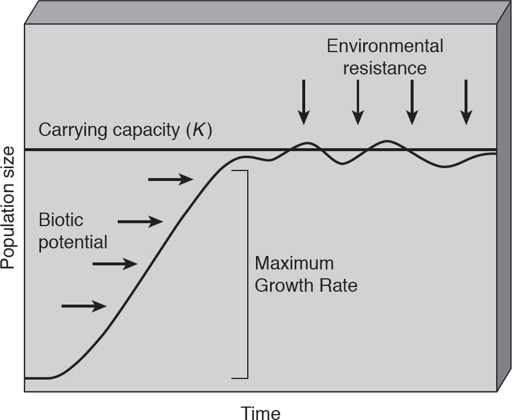
These changes occur because two opposing forces act on every population: the species’ natural capacity to reproduce, called biotic potential, and the environmental factors that limit growth, called environmental resistance.
Population dynamics explains how these forces interact to produce changes in population size, density, age structure, and distribution over time.
1. Biotic potential
Definition
Biotic potential is the maximum possible rate at which a population can increase when resources are abundant and environmental conditions are ideal.
It represents the reproductive capacity of a species. Under ideal conditions, a population could increase very rapidly, but such conditions rarely continue for long in nature.
Factors that increase biotic potential
High reproductive rate
Species that produce many offspring or reproduce frequently have greater potential for rapid population growth.
Early maturity
Individuals that reach reproductive age quickly can produce more generations in a short time.
Long reproductive period
Species whose adults remain reproductive for many years can add offspring repeatedly.
High offspring survival
When many offspring survive to reproductive age, the population can increase rapidly.
Plant example
Many annual weeds produce large numbers of small seeds. Under suitable moisture, light, nutrients, and space, they can establish rapidly and increase in number over a short period.
2. Environmental resistance
Definition
Environmental resistance is the combined effect of all factors that prevent a population from increasing at its full biotic potential. These factors reduce survival, reproduction, growth, or establishment.
Types of environmental resistance
Density-independent factors
These affect individuals regardless of how crowded the population is. Examples include drought, floods, fires, storms, extreme temperatures, and pollution.
Density-dependent factors
These become stronger as population density increases. Examples include competition for resources, disease, predation, parasitism, and waste accumulation.
Important distinction
Density-independent factors affect a population whether it is crowded or sparse. Density-dependent factors change in intensity as population density changes.
3. Relationship between the two forces
Simple relationship
Observed population change = biotic potential − environmental resistanceWhen environmental resistance is low, a population may increase rapidly. As resistance increases, growth slows. If resistance remains high, the population may decline or remain at a lower size.
| Condition | Expected population response |
|---|---|
| High biotic potential, low resistance | Rapid increase in population size. |
| High biotic potential, increasing resistance | Growth slows as resources or space become limiting. |
| Low biotic potential, high resistance | Slow growth, decline, or low population size. |
| Births plus immigration equal deaths plus emigration | Population size remains relatively stable. |
4. Population dynamics
Definition
Population dynamics is the study of how population size, density, age structure, and distribution change over time. It explains why populations grow, decline, fluctuate, or remain stable.
Processes that drive population dynamics
Births and deaths
Births add individuals; deaths remove them. The balance between natality and mortality strongly affects population trend.
Immigration and emigration
Immigration adds individuals to a local population, while emigration removes them. These processes are especially important in fragmented habitats.
Density-dependent regulation
As density rises, competition, disease, and predation may reduce survival or reproduction, helping regulate population size.
Density-independent disturbance
Drought, fire, flooding, storms, and pollution can cause sudden population declines regardless of density.
5. Patterns of population fluctuation
Stable fluctuation
The population remains within a relatively narrow range around an average size. Births and deaths are broadly balanced over time.
Cyclic fluctuation
The population shows repeated increases and decreases over time. These cycles may be linked to seasonal change, resource availability, or interactions with other species.
Irruptive fluctuation
The population increases rapidly, often after favorable conditions or disturbance, and may later decline sharply.
Decline
The population decreases when mortality exceeds births and immigration over time. Causes may include habitat loss, drought, disease, or poor recruitment.
Key takeaways
- Biotic potential is the maximum possible growth rate under ideal conditions.
- Environmental resistance includes all factors that limit population growth.
- Density-independent factors affect populations regardless of density.
- Density-dependent factors become stronger as population density increases.
- Population dynamics explains changes in population size, density, age structure, and distribution.
- Population fluctuations result from the interaction between reproductive capacity and environmental limits.
- Births, deaths, immigration, and emigration are the main direct processes changing local population size.
- Populations may show stable, cyclic, irruptive, or declining patterns.
Interactive quiz: 20 MCQs
Choose one option for each question, then select Submit answers. Your score, correct answers, and explanations will appear below.
Continue studying with Advanced Plant Ecology course guide.
0 Comments
Have a biology question or spotted an error?
Send feedback to PreachBio →