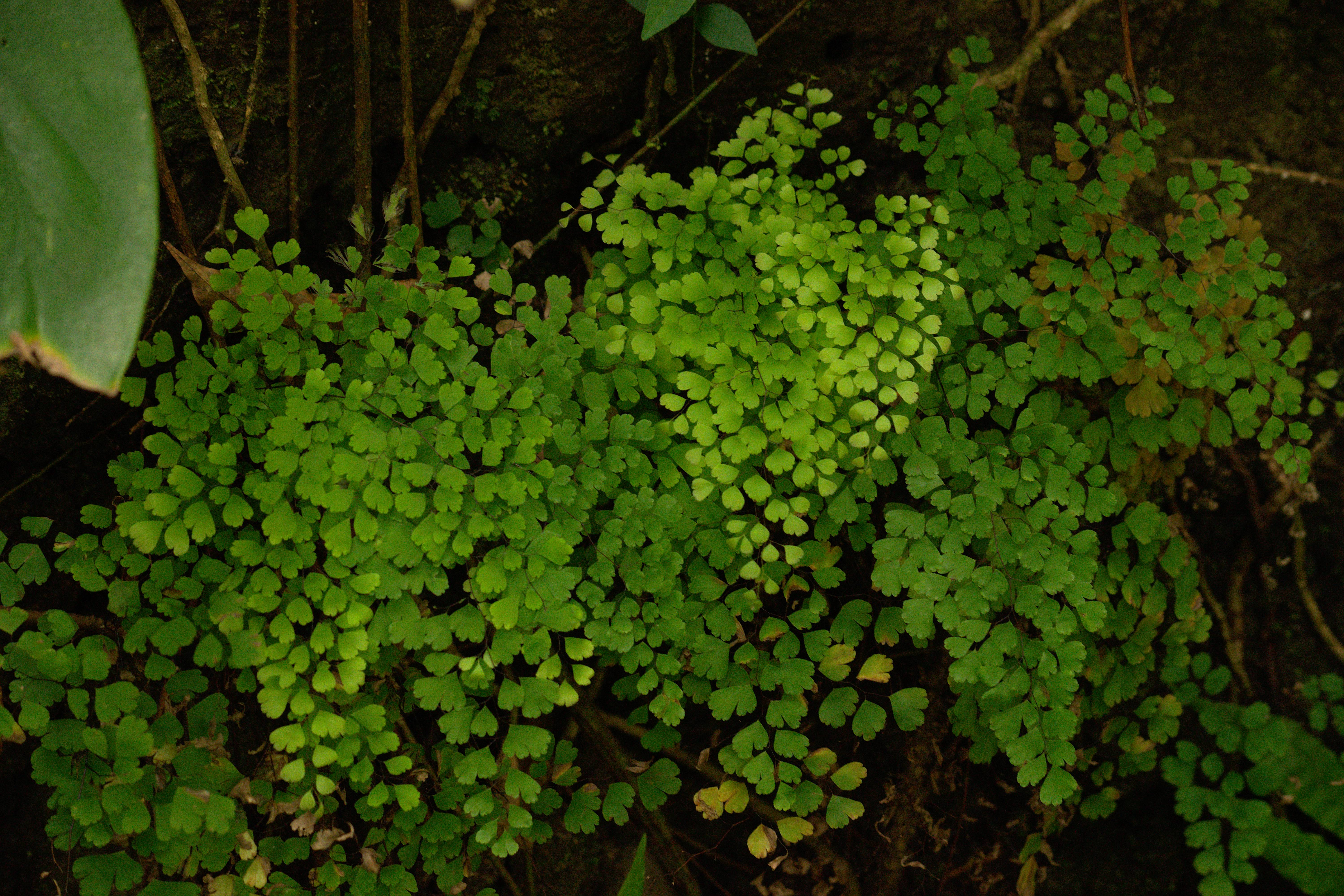
Photo: Wasp32 / Wikimedia Commons · CC BY 4.0. Original photograph; displayed at a responsive size. Tap the photograph to view its full resolution.
BS Botany · Maidenhair fern morphology and reproduction
A maidenhair fern is easy to recognise from its slender dark axes and delicate leaf segments. For a botanical identification, turn over a fertile segment: the defining character of Adiantum is the attachment of its sporangia to the lower surface of a reflexed marginal flap.
These notes use Adiantum capillus-veneris as the main specimen. Its characters are distinguished from those of the wider genus, so that one species description is not mistaken for a rule applying to every maidenhair fern.
1. Classification and habitat
Adiantum, commonly called maidenhair fern, is a genus of seedless vascular plants in the family Pteridaceae. The Greek name adiantos refers to leaves shedding raindrops. This feature does not mean the plant can survive without moisture.
| Rank | Placement |
|---|---|
| Class | Polypodiopsida |
| Subclass | Polypodiidae |
| Order | Polypodiales |
| Family | Pteridaceae |
| Subfamily | Adiantoideae |
| Genus | Adiantum |
| Representative species | Adiantum capillus-veneris L. |
This placement follows Pteridophyte Phylogeny Group, version 2.0.0. Traditional syllabuses may place these ferns under Pteridophyta or Pteropsida; retain those terms when discussing the syllabus, but distinguish them from the classification used here.
Members of the genus occur on soil and rocks in many regions. A. capillus-veneris is especially associated with moist rock faces, calcareous ledges, seepage sites and stream-side habitats. Shade and a continuing water supply are common features of these sites. A plant rooted in a rock crevice still absorbs water through its roots; growing on rock does not mean that it obtains all its water from the air.
The species occurs in both tropical and temperate regions. Its habitat should not be described simply as “tropical rainforest.” Compare the local specimen with a regional flora, because cultivated maidenhair ferns may belong to other species.
2. Structure of the sporophyte
The large fern seen in the photograph is the sporophyte. In the ordinary sexual life cycle it is diploid (2n). It has a stem, true roots and vascular leaves.
Rhizome and roots
In A. capillus-veneris, the stem is a slender creeping rhizome covered with scales. It bears fronds and adventitious roots. The roots provide anchorage and absorb water and dissolved mineral nutrients; they are different organs from the rhizome.
Rhizome growth can spread the plant locally. Across the genus, rhizomes may be short-creeping, long-creeping or suberect. Therefore, “every Adiantum has a horizontal underground stem” is too broad a statement.
Stipe, rachis and blade divisions
A fern leaf is called a frond. The stalk below its blade is the stipe; the main axis within the blade is the rachis. The stipes and smaller axes of A. capillus-veneris are typically glossy and dark brown to almost black.
The blade is divided into primary divisions called pinnae. Where those divisions are subdivided, the smaller units are pinnules. The familiar wedge-shaped to fan-shaped units in this species are the ultimate segments, rather than the entire frond. Blade division varies with position on the frond and among species.
In A. capillus-veneris, the veins repeatedly fork towards the segment margin. Under a hand lens, trace a vein from the narrow base towards the broad outer margin. Do not assume that every species has identical segment shape or venation.
Circinate vernation
A developing frond has its tip coiled inward. This arrangement is circinate vernation, and the young coiled frond is a crozier or fiddlehead. It unrolls as the blade expands. Compare a young crozier with a mature frond to understand development; a mature leaf alone cannot demonstrate the sequence.
What to record in an anatomical section
A rhizome section contains an outer epidermal region, ground tissue and vascular tissue. Xylem conducts water and minerals, while phloem transports organic solutes. In fern stems, the departure of leaf traces can interrupt the vascular cylinder, producing leaf gaps. Overlapping leaf gaps can separate the vascular region into strands called meristeles, an arrangement termed a dictyostele.
Use this terminology to interpret the section actually supplied in class. Record the specimen identity, section level and visible tissues. Do not assign a fixed number of meristeles or an identical stele to every member of the genus without supporting observations.
3. Sori, false indusia and sporangia
A sorus is a group of sporangia; the plural is sori. A sporangium is an individual spore-producing capsule. These two terms describe different structural levels.
In a fertile Adiantum segment, parts of the margin bend back to form protective flaps called false indusia. “False” refers to the origin of the covering from the existing leaf margin. It does not mean that the sorus or spores are false.
The critical character is that the sporangia are attached to the abaxial surface of the reflexed flap itself. Abaxial means the developmentally lower surface. Turning a flap back changes its position, but not its surface identity. Simply writing “sori occur on the underside of the leaf” leaves out the character used to recognise the genus.
Adiantum is leptosporangiate: a sporangium develops from a single superficial initial cell. Typical mature sporangia have a stalk, a capsule and an annulus, a specialised row of cells involved in spore release. Water loss deforms the annulus and opens the capsule; rapid recoil helps disperse the spores. A precise launch speed or universal spore count should not be added without species-specific evidence.
In the ordinary sexual cycle, diploid spore mother cells undergo meiosis, forming haploid spores. Adiantum is homosporous: it produces one spore type rather than separate microspores and megaspores.
4. Life cycle and alternation of generations
The ordinary sexual life cycle alternates between a diploid sporophyte and a haploid gametophyte. Both are multicellular stages, but the leafy sporophyte is the conspicuous, dominant generation.
- Spore formation: the mature sporophyte develops sporangia, where meiosis produces haploid spores.
- Gametophyte development: a spore germinates under suitable conditions and forms a small green gametophyte, also called a prothallus. Development is exosporic, outside the spore wall.
- Sex-organ formation: antheridia produce flagellated sperm, and archegonia contain eggs. Gametes form by mitosis in the haploid generation. Sex expression varies with development and conditions; one spore type does not require every prothallus to bear both organs simultaneously.
- Fertilisation: sperm move through a film of water to an egg. Fusion forms a diploid zygote.
- New sporophyte: the zygote develops into an embryo initially attached to the gametophyte. As roots and fronds develop, the young sporophyte becomes independent.
Sporophyte (2n) → sporangium and meiosis → spore (n) → gametophyte (n) → gametes (n) → fertilisation → zygote (2n) → young sporophyte (2n).
A spore is not a gamete. It can germinate without fusing with another spore; a gamete normally participates in fertilisation. Rhizoids on the gametophyte are also not true roots. Their presence does not make the small prothallus a miniature leafy sporophyte.
This is the standard sexual model. Apogamous fern lineages can form a sporophyte without the usual fertilisation step, so the sexual diagram should not be presented as an exceptionless rule for all ferns. For the standard model, moisture is needed both for gametophyte establishment and for sperm movement.
5. Practical identification and specimen study
Begin with the whole plant, then examine fertile segments under a hand lens or dissecting microscope. The field photograph helps with recognition, but it cannot replace examination of the reproductive structures.
| Observation | What to label or explain |
|---|---|
| Stem and roots | Rhizome with adventitious roots; distinguish stem from root |
| Leaf axes | Stipe below the blade; rachis within it; dark smaller axes |
| Blade divisions | Pinnae, pinnules and ultimate segments where present |
| Young frond | Crozier showing circinate vernation |
| Fertile margin | Reflexed marginal flaps forming false indusia |
| Sporangium attachment | Abaxial surface of the flap itself |
| Prepared gametophyte | Prothallus, rhizoids and visible sex organs |
Record the species name if it is known, whether the specimen is fertile, the magnification and the structures actually visible. Draw the attachment site of the sporangia clearly. If the specimen is sterile, state that the fertile diagnostic character has not been checked.
For a comparison exercise, use Pteris, Adiantum and Marsilea: comparative BS Botany notes. Contrast the two false-indusium arrangements with the sporocarps and heterospory of Marsilea.
6. Revision questions
What is the strongest fertile character of Adiantum?
Sporangia occur on the abaxial surface of reflexed marginal flaps that form the false indusia.
Is the entire frond fan-shaped?
In A. capillus-veneris, it is usually the ultimate segments that are wedge-shaped to fan-shaped. The complete blade is divided into many such units.
Why is the protective flap called a false indusium?
It is formed by the existing leaf margin folding back, rather than by a separate indusial outgrowth. The associated sori are real groups of sporangia.
Where do meiosis and fertilisation occur in the cycle?
Meiosis occurs during spore production in the sporangium. Fertilisation occurs when sperm and egg fuse in an archegonium on the gametophyte.
Does homospory mean that spores are male and female gametes?
No. Homospory means one spore type. Spores produce gametophytes, which subsequently produce sperm and eggs.
What should a long-answer response cover?
Describe classification and habitat, rhizome and roots, frond divisions and vernation, sporangium attachment and false indusia, then the sexual life cycle with ploidy labels. Finish with the practical characters that distinguish the specimen from another fern.
Sources and further reading
- Pteridophyte Phylogeny Group, version 2.0.0: classification.
- Flora of North America: Adiantum: genus morphology and sporangium attachment.
- Flora of China: Adiantum capillus-veneris: representative species and habitat.
- OpenStax Biology 2e: seedless vascular plants: the standard fern life cycle.
- Llorens and colleagues (2016), The fern cavitation catapult: experimental explanation of annulus mechanics in a leptosporangiate fern.


1 Comments
Sir Mohsin is worlds bestest lecturer....... ALLAH pak apko akhrat or duniya mai boht kamyab krah AMEEN 🥹🩷
ReplyDelete