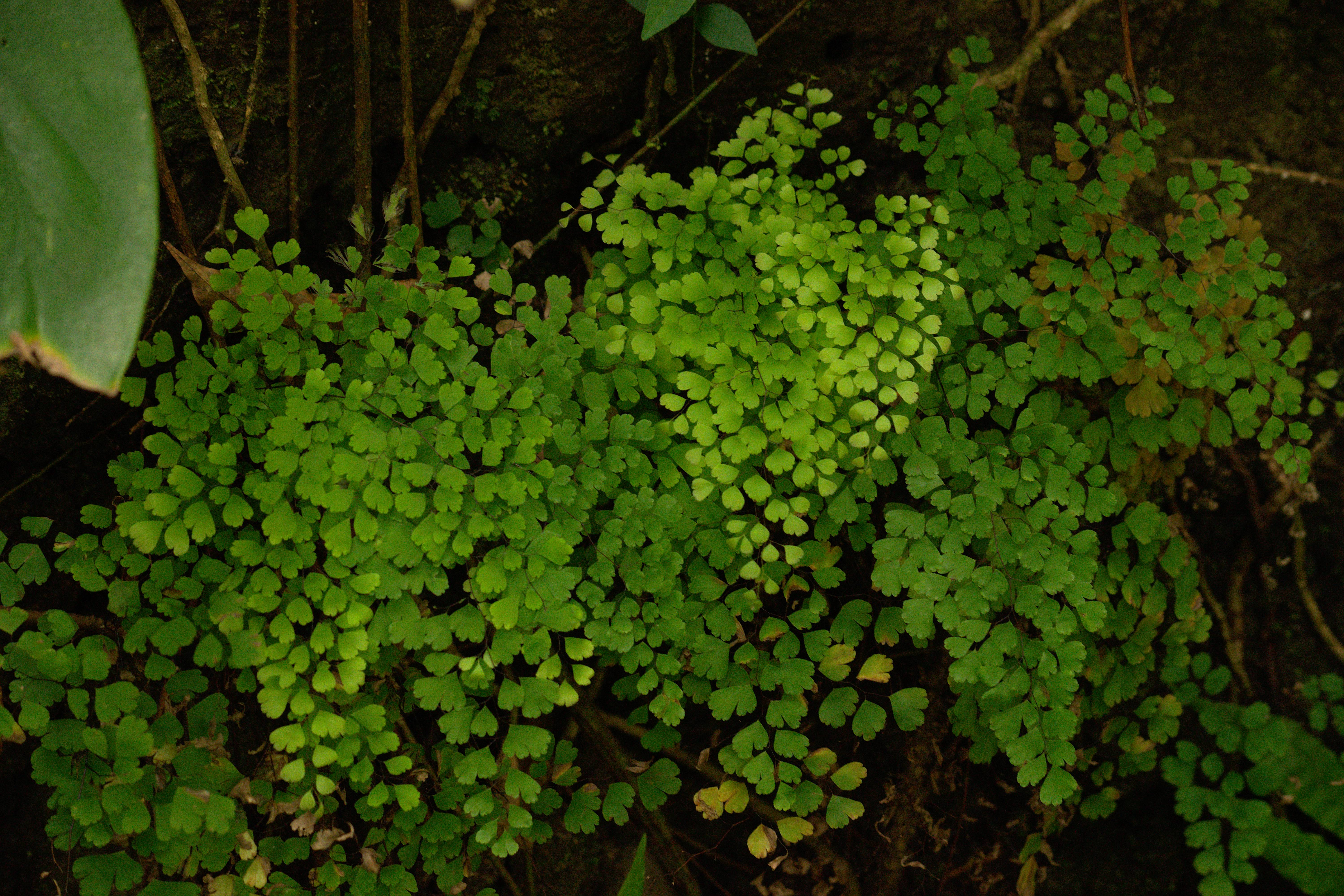
Photo: Wasp32 / Wikimedia Commons · CC BY 4.0. Original photograph; displayed at a responsive size. Tap the photograph to view its full resolution.
A Pteris frond, a delicate maidenhair fern and a four-leaf water clover look quite different. Yet all three are ferns. The useful comparison is not simply their leaf shape: it is where they place their sporangia, how they protect them, and what happens after their spores germinate.
These notes explain the traditional syllabus topic Pteropsida: Pteris, Adiantum and Marsilea. The focus is comparative morphology, circinate vernation, sori and indusia, heterospory, and the adaptations of water-clover ferns.
1. Pteropsida and modern fern classification
Pteropsida is a traditional name used in many teaching schemes for true ferns. It should not be treated as the current formal class name in every classification. The Pteridophyte Phylogeny Group classification displayed as version 2.0.0 places these genera in Polypodiopsida, within the leptosporangiate subclass Polypodiidae.
| Genus | Order | Family | Teaching identity |
|---|---|---|---|
| Pteris | Polypodiales | Pteridaceae | Brake ferns; often conspicuous marginal soral bands |
| Adiantum | Polypodiales | Pteridaceae | Maidenhair ferns; sporangia attached to reflexed marginal flaps |
| Marsilea | Salviniales | Marsileaceae | Heterosporous water-clover ferns with sporocarps |
Marsilea is not a flowering clover. Its four leaflets resemble those of a four-leaf clover, but its reproductive structures are spore-bearing structures, not flowers, fruits or seeds. Classification reference: Pteridophyte Phylogeny Group, version 2.0.0.
2. Essential terms before examining a specimen
- Rhizome: a stem, often creeping at or beneath the substrate. It bears leaves and adventitious roots. A rhizome is not a root.
- Frond: a fern leaf. The stalk below the blade is the stipe; the main axis within a divided blade is the rachis.
- Pinna: a primary division of a frond. In a further-divided pinna, the smaller divisions are pinnules.
- Sporangium: a structure in which spores develop. In the ordinary sexual life cycle, diploid spore mother cells undergo meiosis to produce haploid spores.
- Sorus (plural sori): a group of sporangia.
- Indusium (plural indusia): a protective covering associated with a sorus. Its developmental origin matters when identifying a fern.
- Sporocarp: in Marsilea, a hardened reproductive structure enclosing several sori. It is neither a single sporangium nor a seed.
For Marsilea, remember the nested sequence: sporocarp → sori → sporangia → spores. Confusing these levels is a common source of incorrect diagrams and answers.
3. Comparative vegetative morphology
Pteris: a useful example of a divided fern frond

Photo: Krzysztof Ziarnek, Kenraiz / Wikimedia Commons · CC BY-SA 4.0. Original photograph; displayed at a responsive size. Tap the photograph to view its full resolution.
Pteris vittata has a short, erect rhizome with scales, adventitious roots and clustered fronds. A representative mature blade is once pinnate, with narrow lateral pinnae arranged along the rachis and a terminal pinna. Each pinna has a midvein and lateral veins. This makes it convenient for teaching the difference between a whole frond and one of its divisions.
Do not turn this species description into a rule for the whole genus. Other Pteris species have more deeply divided blades, different rhizome habits, and free or interconnected veins. Use the name of the actual specimen in a practical record. Species description: Flora of China, Pteris vittata.
Adiantum: dark axes and delicate ultimate segments
Look at the real plant: the featured field photograph above shows this maidenhair fern in shaded understory. Compare its small ultimate segments with the pinnate Pteris blade and the four-leaflet Marsilea blade.
In Adiantum capillus-veneris, a slender creeping rhizome bears delicate divided fronds. The stipes and axes are characteristically glossy and dark. The ultimate segments are commonly wedge-shaped to fan-shaped, with veins repeatedly forking towards the margin. The fertile margin is modified into individual reflexed lobes or flaps.
The fan-shaped unit seen in a maidenhair fern is usually an ultimate segment, not the entire frond. Frond division and segment shape vary among species. Moist, shaded rock faces and seepage sites are useful habitats in which to look for this example, subject to local access and conservation rules. Species description: Flora of China, Adiantum capillus-veneris.
Marsilea: a creeping stem and four terminal leaflets

Photo: Vinayaraj / Wikimedia Commons · CC BY-SA 3.0. Original photograph; displayed at a responsive size. Tap the photograph to view its full resolution.
Marsilea has a slender creeping rhizome that spreads through wet soil or mud. Adventitious roots anchor it; roots arise at nodes and, in some species, also along internodes. A long stipe ends in four leaflets arranged as two close pairs, producing the familiar water-clover appearance. The veins branch and reconnect, forming a network.
In standing water the stipe can be long and flexible, with the blade floating at the surface. In shallow water or on exposed wet ground, the leaves may be emergent or terrestrial. Frond dimensions and posture therefore cannot be interpreted without noting the water conditions. Genus description: Royal Botanic Gardens and Domain Trust, PlantNET.
Circinate vernation: what unrolls, and why it matters
Circinate vernation is the coiled arrangement of a developing fern frond: the tip is rolled inward and the frond uncoils as it expands. The young coiled structure is called a crozier or fiddlehead. Coiling keeps delicate expanding tissues compact while the leaf develops.
The young fronds of these three genera show circinate development, even though their mature blades differ. In Marsilea, the young stipe and blade are coiled and the developing leaflets remain folded together before spreading. Later daily leaflet folding is a different phenomenon: it is not another episode of circinate vernation. Compare young and mature leaves rather than trying to infer vernation from an expanded specimen.
Anatomy: read the section rather than memorising one genus-wide stele
A rhizome section shows an outer epidermis, ground tissue and a vascular region containing xylem and phloem. Xylem conducts water and minerals; phloem transports organic solutes. Supporting tissue helps the axes bear the blade, while leaf traces connect the rhizome vascular system to each frond.
In fern stems, leaf-trace departure may leave a leaf gap in the vascular cylinder. Overlapping gaps can divide that cylinder into separate vascular strands called meristeles, producing a dictyostelic arrangement. A solenostele has a vascular cylinder surrounding a pith, with non-overlapping leaf gaps. These are descriptions of an observed arrangement, not interchangeable labels for every fern.
In commonly described Marsilea rhizomes, the stele is an amphiphloic solenostele: phloem occurs both outside and inside the xylem, with a central pith. The cortex can contain conspicuous air spaces. Species, growth conditions and the level of the section affect what is visible; label the tissue actually observed instead of assigning the same anatomy to every specimen. Further study: Bharathidasan University, Pteridophytes and anatomy.
4. Sori, true indusia and false indusia
A true indusium is a distinct protective outgrowth associated with the sorus. A false indusium is formed from the existing leaf margin, which bends back over the fertile region. The two can perform similar protective roles, but arise differently.
Where the sporangia are attached in Pteris
On a fertile Pteris segment, sori generally form elongated bands just inside the margin. Adjacent sori can form a nearly continuous band, sometimes described as a coenosorus. The reflexed margin covers the sporangia as a false indusium. Importantly, the sporangia are attached to the lamina beneath the fold, rather than to the fold itself. The band need not extend across every tip and sinus. Genus reference: Flora of North America, Pteris.
Where the sporangia are attached in Adiantum
In Adiantum, discrete reflexed marginal lobes form the false indusia. Its diagnostic feature is that sporangia are borne on the abaxial surface of the reflexed flap itself. “Abaxial” means the developmentally lower surface; reflexing the flap changes its physical position but not that identity.
For a practical comparison, gently lift a fertile flap under a dissecting microscope and inspect the attachment site. Do not record only “sori on the underside” for both genera: that misses the character that separates their fertile structures. Genus reference: Flora of North America, Adiantum.
Leptosporangia and the annulus
These genera belong to the leptosporangiate fern lineage. In the developmental distinction, a leptosporangium originates from a single superficial initial cell, unlike a eusporangium, which develops from a group of initial cells. Typical fertile Pteris and Adiantum sporangia are stalked and possess an annulus, a row of specialised cells involved in opening the capsule and dispersing spores.
Water loss bends the annulus and opens the sporangium at its weaker dehiscence region. Cavitation then triggers a rapid recoil that helps eject spores. The mechanism has been studied experimentally in other leptosporangiate ferns; exact launch speeds from those experiments should not be assigned to every species. Marsilea sporangia lack this annulus-based catapult. Experimental explanation: the fern cavitation catapult.
5. Marsilea: sporocarps and adaptations to changing water levels
A protective sporocarp encloses the sori
Sporocarps arise on short stalks near the base or lower part of a leaf stipe. Mature sporocarps are hard, often bean-shaped or oval, and contain several sori. Each sorus includes both microsporangia and megasporangia. The microsporangia produce numerous small microspores; a mature megasporangium contains one functional large megaspore.
A sporocarp should not be labelled “one large sporangium.” Nor is its wall simply a false indusium like a folded Pteris margin. Individual internal sori have their own thin indusial coverings. Precise sporocarp shape, hairs, teeth, stalk branching and sorus number vary and are useful in identifying species. Family description: Flora of New Zealand, Marsileaceae.
What happens when a sporocarp opens in water?
After the wall opens and water reaches the contents, a gelatinous supporting structure swells and extends, carrying the sori into the water. This structure is commonly called the sorophore. The released spores then develop their reduced gametophytes. The hard wall must first permit hydration: an intact dormant sporocarp need not germinate immediately just because it has been immersed.
This sequence connects protection during an unfavourable period with reproduction when suitable wet conditions return. Comparative research distinguishes the sorophore from its protective envelope; for this lecture, “sporocarp” means the enclosing wall and its contents. Morphological analysis: Nagalingum, Schneider and Pryer (2006). Reproductive reference: Flora of North America, Marsileaceae.
Four adaptations to explain, not merely list
- Creeping, rooted rhizome: anchors the plant and permits vegetative spread through wet substrate.
- Adjustable leaf form and stipe length: positions the photosynthetic blade appropriately as water level changes. Floating, emergent and terrestrial leaves can differ structurally.
- Aerenchyma: tissue with large internal air spaces provides a pathway for internal gas movement, useful where surrounding mud or water restricts gas exchange.
- Durable sporocarps: protect the reproductive contents during dry or otherwise unfavourable periods. Long persistence is documented in some species; an exact survival time should not be generalised to the whole genus.
A study of Marsilea quadrifolia compared floating, emergent and terrestrial leaves and found differences in features including lower-surface stomatal density and petiole characteristics. This supports describing the plant as amphibious and developmentally flexible, rather than claiming that all its leaves have an identical aquatic anatomy. Primary study: Lin, Lin and Kao (2007), Taiwania.
6. Life cycles: homospory versus heterospory
The ordinary sexual cycle of Pteris and Adiantum
These genera are homosporous: they produce one spore type, not separate microspores and megaspores. In a typical sexual cycle, a haploid spore germinates outside its spore wall to form a small, free-living gametophyte or prothallus. This development is described as exosporic.
The gametophyte bears antheridia that produce sperm and archegonia that contain eggs. Its sex expression can depend on age and conditions; homospory does not mean every gametophyte must simultaneously bear both organs. A film of water allows flagellated sperm to reach an egg. Fertilisation restores the diploid condition, and the resulting embryo develops into the new sporophyte.
Cycle to draw: sporophyte (2n) → sporangium and meiosis → spore (n) → gametophyte (n) → gametes (n) → fertilisation → zygote (2n) → young sporophyte (2n). The spore is not a sperm or an egg. This is the ordinary sexual model; apogamous fern lineages provide exceptions to the fertilisation step.
The heterosporous cycle of Marsilea
Heterospory separates two developmental routes. A microspore produces a reduced male gametophyte; a megaspore produces a reduced female gametophyte. Their development is predominantly endosporic, within the spore wall, although part of the female gametophyte protrudes.
The male gametophyte forms sperm; the female forms an archegonium containing an egg. Fertilisation still requires water for sperm movement. The zygote becomes a sporophyte, which eventually produces new sporocarps. Heterospory therefore does not make Marsilea a seed plant or remove its requirement for water during sexual fertilisation.
The useful evolutionary connection is that separate microspores and megaspores also occur in seed-plant life cycles. However, resemblance in this character does not make Marsilea an ancestor of flowering plants. Background: OpenStax, homospory and heterospory.
7. Comparison table for examinations
| Character | Pteris | Adiantum | Marsilea |
|---|---|---|---|
| Typical setting | Terrestrial habitats; species differ | Often moist shaded ground, rocks or seepage sites | Wet soil, shallow water and seasonal wetlands |
| Representative leaf | Pinnate frond with narrow pinnae in P. vittata | Divided frond with fan-shaped ultimate segments in A. capillus-veneris | Long stipe ending in four leaflets |
| Young leaf | Circinate | Circinate | Circinate; developing leaflets also folded |
| Soral arrangement | Usually elongated intramarginal bands | Fertile reflexed marginal lobes | Several sori enclosed in each sporocarp |
| Spore-bearing attachment | Lamina beneath the reflexed margin | Abaxial surface of the reflexed flap itself | Internal soral receptacles |
| Protection | False indusium: reflexed leaf margin | False indusium: reflexed marginal flap | Sporocarp wall plus coverings of internal sori |
| Annulus | Present in typical sporangia | Present in typical sporangia | Absent |
| Spore types | Homosporous | Homosporous | Heterosporous |
| Gametophyte model | Free-living, exosporic in ordinary sexual cycle | Free-living, exosporic in ordinary sexual cycle | Reduced male and female forms; endosporic development |
| Water for fertilisation | Required in ordinary sexual cycle | Required in ordinary sexual cycle | Required despite heterospory |
8. Practical identification and classroom activities
Begin with the whole specimen, then turn to its reproductive structures. A fertile specimen is much more informative than an attractive sterile leaf.
- Identify stem, roots and leaves. Ask whether a rhizome is a root and whether water clover is a flowering plant.
- Compare the three mature blades and a young crozier. Label stipe, rachis, pinna and pinnule only where appropriate.
- Show fertile Pteris and Adiantum under a hand lens or dissecting microscope. Find the folded margin and establish the attachment site of the sporangia.
- Use a prepared Marsilea sporocarp section or Figure 3. Distinguish the protective sporocarp, internal sori, two sporangium types and their spores.
- Draw the two reproductive routes and complete the comparison table from memory. Finish with the revision questions below.
In a practical notebook, record the specimen name, fertile or sterile condition, blade form, soral position and magnification. Draw what you observe; do not add a universal “64 spores,” fixed chromosome number or identical stele to every specimen without evidence. Use prepared sections when sectioning is not appropriate for the available material.
9. Revision questions with concise answers
Why do both Pteris and Adiantum have “false” indusia?
The covering comes from a reflexed part of the existing leaf margin. The sorus remains an actual cluster of sporangia. A true indusium is a separate protective outgrowth.
What is the best fertile character for separating Pteris from Adiantum?
Inspect sporangium attachment. In Pteris, sporangia lie on the lamina beneath the marginal fold. In Adiantum, they attach to the abaxial surface of the reflexed marginal flap.
Is the Marsilea sporocarp a seed or a sporangium?
Neither. It is a hardened structure containing several sori, each with microsporangia and megasporangia. Seeds enclose embryos with seed-plant protective structures; a sporocarp contains spore-producing structures.
How does heterospory change gametophyte development?
Microspores develop male gametophytes and megaspores develop female gametophytes. In Marsilea, these are reduced and develop predominantly within the spore wall.
Why does Marsilea still need water for sexual reproduction?
Its sperm are motile and must reach the egg in the archegonium through water. Producing two spore types does not replace fertilisation with pollen delivery.
How does circinate vernation differ from daily leaflet folding?
Circinate vernation describes the coiled developing frond as it grows and unrolls. Daily folding changes the position of already developed leaflets.
Long-answer practice: compare the three genera in a logical sequence.
Start with classification and representative habitat. Describe the rhizome and blade, then explain circinate vernation. Compare soral position and indusial origin before discussing homospory, heterospory and gametophytes. Finish by connecting Marsilea structures with changing water conditions. Include labelled diagrams and note species-dependent variation.
Sources and further reading
The botanical descriptions above were checked against specialist floras, the displayed Pteridophyte Phylogeny Group classification and primary research. The diagrams are original teaching schematics, not specimen photographs or exact histological sections.
- Pteridophyte Phylogeny Group classification, version 2.0.0 — current genus, family and order placement.
- Flora of North America: Pteris and Adiantum — diagnostic fertile characters.
- Flora of North America: Marsileaceae — internal sori, sporangia and hydration.
- PlantNET: Marsilea — vegetative and sporocarp variation.
- Lin, C.-H., Lin, B.-L. and Kao, W.-Y. (2007). Leaf characteristics and photosynthetic performance of Marsilea quadrifolia. Taiwania 52: 195–200. DOI: 10.62/tai.2007.52(3).195.
- Llorens and colleagues (2016). The fern cavitation catapult: mechanism and design principles. — measured annulus mechanics.
Continue with the Pteridophytes and Gymnosperms study collection · Browse all PreachBio courses

.jpg)





0 Comments