Course: Molecular Biology · BS Botany learning notes
A DNA copying error creates two problems. The cell must recognise that a base pair is wrong, and it must decide which strand to correct. A G–T mismatch identifies an abnormal pairing, but the pair alone does not reveal whether G or T is the newly introduced error.
DNA mismatch repair (MMR) corrects many base-pair mismatches and small insertion–deletion loops that escape replication proofreading. Its contribution to genetic fidelity depends on directing repair towards the appropriate strand. This is why recognising a mismatch and choosing the repair strand are separate steps.
What does mismatch repair recognise?
During replication, a polymerase may insert an inappropriate nucleotide. In repetitive DNA, the template and nascent strands may also slip out of register, leaving an extra unpaired nucleotide or a small loop. MMR systems recognise many such structures and replace a stretch of the error-containing strand using the other strand as a template.
A mismatch is not automatically a permanent mutation. It is an unresolved disagreement between paired strands. If it escapes repair and another replication round occurs, one descendant DNA molecule can acquire a changed, normally paired sequence. At that point, normal base pairing alone no longer identifies the earlier copying error.
For complementary pairing and strand separation, see DNA denaturation, renaturation and hybridisation. Separating strands is different from cutting the sugar–phosphate backbone.
The repair sequence
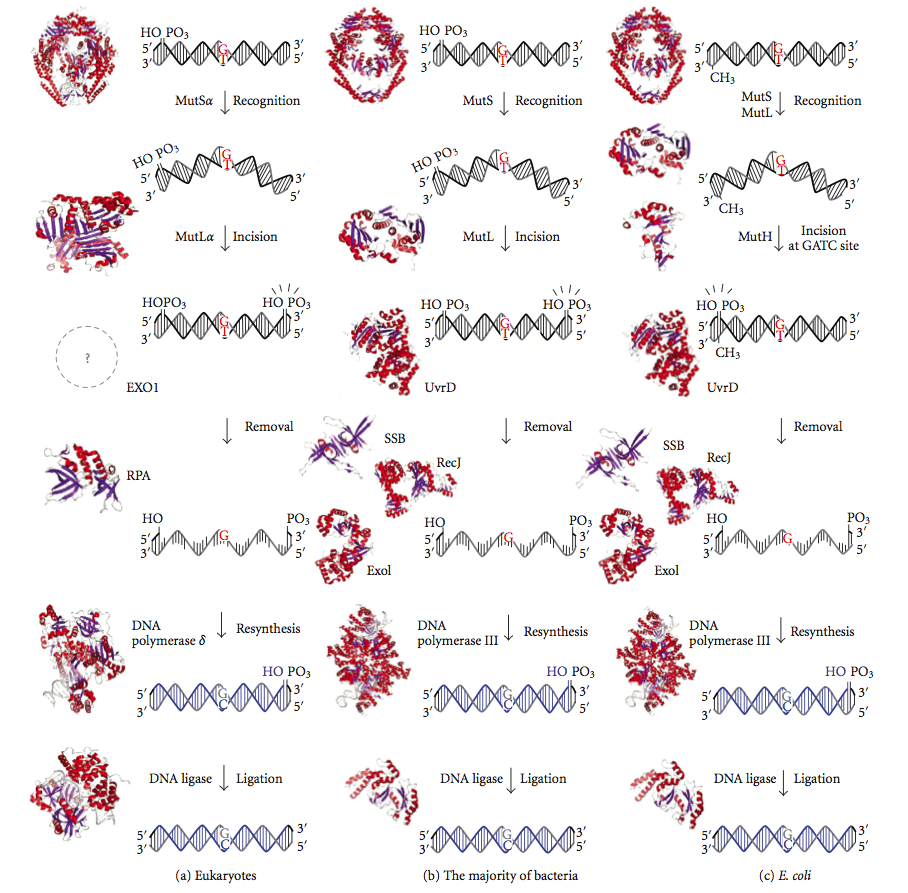
- Mismatch recognition. A mismatch-recognition complex binds an abnormal pairing or a suitable insertion–deletion loop. In the classic bacterial system, MutS performs this recognition role.
- Repair coordination and strand discrimination. Additional proteins connect recognition with the information identifying the strand to be corrected. MutL is a central coordinating factor in the well-studied MutS–MutL pathways.
- Incision and excision. Repair machinery generates or uses strand discontinuities and removes a segment containing the error. The patch is not necessarily only one nucleotide long.
- Repair synthesis. DNA polymerase fills the gap using the retained strand as a template. If the retained base is G, the appropriate newly incorporated partner is C.
- Ligation. DNA ligase seals the remaining nick in the backbone. Correct bases do not by themselves create a covalently continuous strand.
This sequence is a functional framework, not a claim that all organisms use exactly the same proteins. The classic methyl-directed Escherichia coli pathway is especially useful for learning the logic, but it must not be presented as universal.
MutS, MutL and MutH in the classic E. coli system
| Component | Main teaching role | Misconception to avoid |
|---|---|---|
| MutS | Recognises a mismatch and initiates assembly of repair machinery | It does not alone replace the incorrect nucleotide |
| MutL | Coordinates interactions linking recognition to strand-directed repair | It is not simply another name for DNA ligase |
| MutH | Incises the unmethylated strand at a hemimethylated GATC site | The incision site need not be the mismatch itself |
| UvrD and exonuclease activities | Help unwind and remove the error-containing DNA segment | Recognition and excision are different functions |
| DNA polymerase and ligase | Restore sequence and backbone continuity | Polymerase and ligase do not perform the same reaction |
Immediately after replication in this system, an appropriate GATC site can be hemimethylated: the parental strand carries its methylation mark while the newly synthesised strand has not yet acquired it. MutH-dependent repair uses this temporary asymmetry to target the nascent strand. Dam methylase later methylates the new strand, so this strand signal is time-limited.
Notice the distinction between two locations: MutS detects the mismatch, while MutH acts at a suitable GATC site. These sites can be separated along the DNA. Studies of purified proteins and defined DNA substrates established the strand-directed logic; see Paul Modrich’s Nobel lecture.
How eukaryotic mismatch repair differs
Eukaryotes use related proteins, but they do not generally identify new strands through the classic E. coli Dam–MutH mechanism. In human cells, MutSα contains MSH2 and MSH6 and recognises base mismatches and small loops. MutSβ contains MSH2 and MSH3 and has a different, overlapping substrate preference, especially for insertion–deletion loops. MutLα contains MLH1 and PMS2.
Strand discontinuities and replication-associated factors, including proliferating cell nuclear antigen (PCNA), help couple repair to the newly made strand. The detail varies between systems. An exam answer should therefore say “in the classic E. coli pathway” before explaining methylation-directed repair.
The abbreviations identify protein families or complexes, not interchangeable names for a single universal enzyme. Likewise, the absence of MutH in a system does not imply the absence of mismatch repair.
Proofreading, mismatch repair and excision repair
| Process | Typical problem addressed | Useful distinction |
|---|---|---|
| Polymerase proofreading | A wrongly incorporated nucleotide at the growing DNA end | Many replicative polymerases remove it through a 3′→5′ exonuclease activity |
| Mismatch repair | Escaped base mismatches and small insertion–deletion loops | A separate coordinated pathway replaces an error-containing stretch |
| Base excision repair | Particular chemically altered or inappropriate bases | A DNA glycosylase commonly initiates removal of the base |
| Nucleotide excision repair | Bulky, helix-distorting damage, including UV photoproducts | Removes a damage-containing oligonucleotide |
These categories describe major functions; biological pathways can interact. For introductory questions, do not identify nucleotide excision repair as mismatch repair merely because both remove DNA and refill a gap. The initiating problem and recognition machinery differ.
Follow one error through the next replication
Suppose a parental G is copied incorrectly as T, producing G–T. Correct strand-directed repair removes the new T-containing segment and restores G–C. Now suppose no repair occurs before the next replication. The G-containing strand directs C incorporation, giving G–C. The T-containing strand directs A incorporation, giving T–A. One lineage retains the original pair; the other carries a substitution.
This teaching example explains why the timing of repair matters. It does not imply that half the cells in every repair-defective organism will carry a mutation at every site. Real outcomes depend on the occurrence of an error, subsequent replication, repair alternatives and the fate of the cells.
Why this matters in plants
Plants also require genome-maintenance systems during growth and reproduction. In an Arabidopsis study, lines defective in AtMSH2 accumulated repeat-length changes and diverse abnormalities over successive seed generations. That result links a molecular repair defect with inherited instability; it does not mean every MSH2-defective seed immediately develops the same visible phenotype. Hoffman and colleagues, 2004.
This is relevant when considering the stability of regenerated plants, including those produced through somatic embryogenesis. Culture-associated variation has multiple possible causes, so a changed plant cannot be diagnosed as mismatch-repair deficient from its appearance alone.
MMR limits copying errors; it does not remove all genetic variation or make DNA permanently unchangeable. Compare mutation with crossing over, which rearranges combinations of existing alleles through a different process.
How to build a strong mechanism answer
Begin with the substrate, explain mismatch recognition, identify the strand-discrimination signal for the organism in the question, and finish with excision, resynthesis and ligation. If asked why strand discrimination is essential, use the G–T example: correcting the wrong strand can preserve the copying error as a different sequence.
For a diagram, label template and nascent strands separately. Mark the mismatch, show removal from the appropriate strand, and label polymerase and ligase as separate steps. Avoid drawing MutS as a pair of scissors that performs recognition, excision and DNA synthesis unaided.
20 practice MCQs with answers
These original practice questions are for learning and revision; they are not claimed to be past-paper questions.
1. A central substrate for mismatch repair is:
- A base-pair mismatch
- An intact cellulose fibre
- A ribosome
- A starch granule
Answer and explanation
A. A base-pair mismatch — MMR recognises many inappropriate base pairings and small loops.
2. MutS mainly performs which role in the classic bacterial pathway?
- Ligation
- Mismatch recognition
- Protein translation
- Chromosome segregation
Answer and explanation
B. Mismatch recognition — MutS initiates recognition rather than completing all repair reactions.
3. MutL is best described as:
- A sugar
- A methylated base
- A repair coordinator
- A histone in every organism
Answer and explanation
C. A repair coordinator — MutL links recognition to downstream repair activities.
4. In classic E. coli repair, MutH incises:
- Both strands at every base
- Only RNA
- Only fully methylated DNA
- The unmethylated strand at a hemimethylated GATC site
Answer and explanation
D. The unmethylated strand at a hemimethylated GATC site — Temporary methylation asymmetry directs this strand choice.
5. Hemimethylated DNA has:
- A methylation mark on one of the two strands at the relevant site
- No bases
- Two extra chromosomes
- Only RNA primers
Answer and explanation
A. A methylation mark on one of the two strands at the relevant site — Hemi indicates the one-strand methylation state.
6. Why is strand discrimination necessary?
- To count chromosomes
- To target the appropriate strand for correction
- To remove all methyl groups
- To stop every mutation forever
Answer and explanation
B. To target the appropriate strand for correction — The mismatch alone does not identify the newly introduced error.
7. Which enzyme fills the repair gap?
- Protease
- Cellulase
- DNA polymerase
- Rubisco
Answer and explanation
C. DNA polymerase — Polymerase copies the retained template.
8. Which enzyme seals the remaining backbone nick?
- Helicase
- Primase
- MutS
- DNA ligase
Answer and explanation
D. DNA ligase — Ligase restores covalent continuity after synthesis.
9. Proofreading commonly uses which activity?
- 3′→5′ exonuclease
- Cell-wall hydrolysis
- Translation termination
- Photosynthetic electron transport
Answer and explanation
A. 3′→5′ exonuclease — Many replicative polymerases remove terminal errors in the 3′→5′ direction.
10. Which statement about MutH is correct?
- It is universal in all MMR systems
- It belongs to the classic methyl-directed E. coli model
- It replaces all polymerases
- It is a human ribosomal subunit
Answer and explanation
B. It belongs to the classic methyl-directed E. coli model — MutH-dependent strand discrimination is not universal.
11. Human MutSα contains:
- MLH1 and PMS2
- MutH and UvrD
- MSH2 and MSH6
- DNA and cellulose
Answer and explanation
C. MSH2 and MSH6 — MSH2–MSH6 is the MutSα recognition complex.
12. Human MutLα contains:
- MSH2 and MSH3
- MutS and Dam
- MSH2 and MSH6
- MLH1 and PMS2
Answer and explanation
D. MLH1 and PMS2 — MLH1–PMS2 is the major human MutLα complex.
13. Replication slippage can create:
- Insertion–deletion loops
- Cotyledons
- Thylakoid membranes
- Spindle fibres only
Answer and explanation
A. Insertion–deletion loops — Misalignment is especially relevant in repetitive sequences.
14. Microsatellite instability involves:
- Only chromosome colour
- Changes in short repeat lengths
- Only ribosome number
- Only chlorophyll loss
Answer and explanation
B. Changes in short repeat lengths — Repeat-length changes can increase when loop correction fails.
15. Nucleotide excision repair is especially associated with:
- Only correct G–C pairs
- Only intact primers
- Bulky helix-distorting lesions
- Every normal base
Answer and explanation
C. Bulky helix-distorting lesions — UV photoproducts are classic examples of its substrates.
16. A G template incorrectly paired with a new T is properly restored to:
- A–T by replacing the template G
- G–G
- T–T
- G–C by replacing the new T
Answer and explanation
D. G–C by replacing the new T — The retained G directs incorporation of C.
17. If an unrepaired G–T pair is copied again, which pair types can result?
- G–C and A–T
- Only G–T
- Only C–C
- Only A–A
Answer and explanation
A. G–C and A–T — Each strand templates its normal complementary base.
18. Do plants possess mismatch-repair machinery?
- No
- Yes
- Only after pollination
- Only in dead cells
Answer and explanation
B. Yes — Plant MSH homologues contribute to genome stability.
19. MMR removes an error-containing segment before:
- Only translation
- Only fertilisation
- Repair synthesis
- Only chromosome condensation
Answer and explanation
C. Repair synthesis — Excision creates the gap subsequently filled by polymerase.
20. Which statement is scientifically justified?
- MMR abolishes every mutation
- All bacteria use MutH
- A visible abnormality proves an MSH2 defect
- MMR improves fidelity without guaranteeing an unchanged genome
Answer and explanation
D. MMR improves fidelity without guaranteeing an unchanged genome — Genome maintenance limits errors but is not infallible.
Interactive application quiz
Try 10 separate questions. Select one answer, check the explanation, then continue. Scores stay in this page and are not submitted.
Frequently asked questions
What is DNA mismatch repair?
DNA mismatch repair is a pathway that corrects many base mismatches and small insertion–deletion loops. It replaces an error-containing strand segment using the retained strand as a template.
How is mismatch repair different from proofreading?
Proofreading removes errors at the growing DNA end during synthesis, whereas mismatch repair corrects errors that escaped that process. Their proteins and repair steps differ.
What are the main steps of mismatch repair?
The main functional steps are recognition, strand discrimination, excision, repair synthesis and ligation. The exact proteins depend on the organism.
What does MutS do?
MutS recognises a mismatch in the classic bacterial pathway and helps initiate repair assembly. Other components are required to excise and replace DNA.
What is the role of MutL?
MutL coordinates mismatch recognition with downstream repair activities. In the classic E. coli pathway it helps activate MutH-dependent strand incision.
How does E. coli identify the newly synthesised strand?
The classic E. coli pathway uses temporary hemimethylation at GATC sites to distinguish the nascent strand. MutH incises the unmethylated strand; this mechanism is not universal.
Do eukaryotes use MutH to repair mismatches?
Eukaryotic mismatch repair does not generally use the classic MutH-dependent pathway. Strand discontinuities and replication-associated factors help direct correction.
What are MSH2 and MSH6?
MSH2 and MSH6 are MutS homologues that form the eukaryotic MutSα recognition complex. The complex recognises base mismatches and small insertion–deletion loops.
What happens if a mismatch is not repaired?
A mismatch can become a stable sequence change after another replication round. The outcome depends on which strand becomes the template for each descendant molecule.
Why are repetitive DNA sequences vulnerable to mismatch-repair defects?
Replication slippage can produce loops in repetitive DNA, and MMR normally corrects many such errors. Failure of this correction can produce microsatellite length instability.
Is mismatch repair the same as nucleotide excision repair?
No, mismatch repair and nucleotide excision repair recognise different classes of problems. Nucleotide excision repair is especially associated with bulky helix-distorting lesions such as UV photoproducts.
Do plants have mismatch repair?
Yes, plants possess mismatch-repair proteins, including MSH homologues. Arabidopsis experiments show that loss of MSH2 function can increase repeat-sequence instability and mutation accumulation.


0 Comments