🔵 13.3 THERMOREGULATION
🟢 Introduction

Have you ever wondered why you sweat on a hot summer day or shiver on a cold winter morning?
These are examples of thermoregulation, one of the most important homeostatic processes in living organisms.
Every living cell performs thousands of chemical reactions every second. These reactions are controlled by enzymes (special biological proteins that speed up chemical reactions). Enzymes work best only within a specific temperature range.
If body temperature changes too much, enzymes cannot function efficiently, which may affect the normal functioning of the body. Therefore, organisms regulate their body temperature through thermoregulation.
Figure 13.26 – Human Thermoregulation Caption: Thermoregulation helps maintain body temperature within a safe range despite changes in the surrounding environment. Attribution: Quizlet / educational biology resources.
🟣 Definition
📖 Thermoregulation
Thermoregulation (Thermo = heat, Regulation = maintaining balance) is the homeostatic process by which organisms maintain their internal body temperature within a tolerable range, regardless of changes in the external environment.
🔴 Why is Thermoregulation Important?
Living organisms must keep their body temperature within a suitable range because many biological processes depend on temperature.
Thermoregulation is important because: ✅ It keeps enzymes working efficiently. ✅ It maintains normal metabolic activities. ✅ It protects cell membranes. ✅ It allows organs to function properly.
🧠 Difficult Terms
- Optimal Temperature (The temperature at which an enzyme works most efficiently.)
- Enzyme Denaturation (Permanent damage to the shape of an enzyme due to very high temperature, causing it to lose its function.)
- Metabolic Rate (The speed at which chemical reactions occur inside the body.)
- Selective Permeability (The ability of the cell membrane to allow some substances to pass while blocking others.)
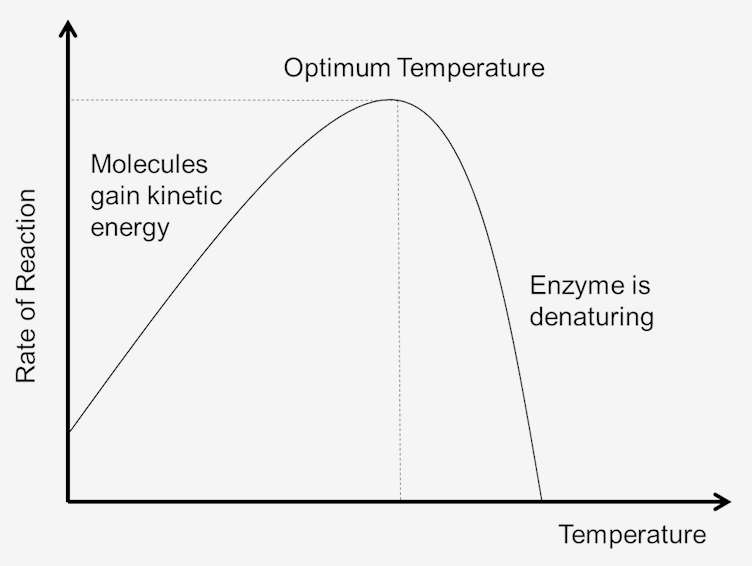
Figure 13.27 – Effect of Temperature on Enzymes Caption: Enzyme activity increases up to the optimum temperature and then decreases rapidly due to denaturation. Attribution: Creative Enzymes / educational resources.
🔵 Effect of Low Temperature
When body temperature falls below the optimum level: ❄️ Enzyme activity decreases. ❄️ Enzyme-substrate collisions become less frequent. ❄️ Metabolic reactions slow down. ❄️ Less energy is produced. ❄️ Body functions become slower.
🔴 Effect of High Temperature
When body temperature rises above the optimum level: 🔥 Enzymes begin to denature. 🔥 Cell membranes lose their selective permeability. 🔥 Cells may become damaged. 🔥 Body organs cannot function normally.
📊 Summary Table
| Temperature Condition | Effect on the Body |
|---|---|
| Too Low | Slow metabolism, reduced enzyme activity |
| Optimum | Maximum enzyme activity, normal metabolism |
| Too High | Enzyme denaturation, membrane damage |
📦 Did You Know?
The average normal body temperature of a healthy human is approximately 37°C, but slight variations throughout the day are normal.
🧠 Memory Trick
Remember: HOT = Harmful Over Temperature COLD = Chemical reactions Occur Less Daily
This helps you remember the effects of extreme temperatures.
📌 Key Points
✔ Thermoregulation is a part of homeostasis. ✔ Enzymes require an optimum temperature. ✔ Low temperatures slow metabolism. ✔ High temperatures can permanently damage enzymes. ✔ Humans maintain an internal body temperature close to 37°C.
⭐ Board Exam Tip
Frequently Asked Short Questions ✅ Define Thermoregulation. ✅ Why is thermoregulation important? ✅ What happens to enzymes at very high temperatures?
30 MCQs – Thermoregulation (Class 12)
1. Thermoregulation is the process of maintaining: A) Water balance B) Body temperature C) Blood sugar D) Blood pressure Answer: B
2. Normal human body temperature is approximately: A) 35°C B) 36°C C) 37°C D) 39°C Answer: C
3. Enzymes work best at: A) Very high temperature B) Very low temperature C) Optimum temperature D) Any temperature Answer: C
4. Permanent damage to enzyme shape due to high temperature is called: A) Activation B) Denaturation C) Inhibition D) Saturation Answer: B
5. At low temperature, enzyme activity: A) Increases B) Decreases C) Remains same D) Becomes maximum Answer: B
6. High temperature causes: A) Increase in enzyme activity B) Enzyme denaturation C) Faster metabolism D) No effect Answer: B
7. Thermoregulation is a part of: A) Digestion B) Respiration C) Homeostasis D) Excretion Answer: C
8. Which of the following is affected by extreme temperature? A) Enzyme activity B) Cell membrane C) Metabolic rate D) All of these Answer: D
9. Optimum temperature means: A) Lowest temperature B) Highest temperature C) Temperature of maximum enzyme activity D) Room temperature Answer: C
10. When body temperature falls, metabolic rate: A) Increases B) Decreases C) Remains constant D) Becomes zero Answer: B
11. Selective permeability of cell membrane is lost at: A) Low temperature B) Optimum temperature C) High temperature D) 0°C Answer: C
12. The main reason for thermoregulation is to: A) Produce more heat B) Keep enzymes working properly C) Increase body size D) Reduce water loss Answer: B
13. Shivering occurs when body temperature: A) Rises B) Falls C) Remains normal D) Fluctuates rapidly Answer: B
14. Sweating occurs when body temperature: A) Falls B) Rises C) Is normal D) Is below 35°C Answer: B
15. Enzyme-substrate collisions become less frequent at: A) High temperature B) Low temperature C) Optimum temperature D) 40°C Answer: B
16. Which statement is correct? A) High temperature always increases enzyme activity B) Low temperature denatures enzymes C) Enzymes have an optimum temperature D) Temperature has no effect on enzymes Answer: C
17. Metabolic rate means: A) Rate of breathing B) Speed of chemical reactions in the body C) Heart rate D) Rate of excretion Answer: B
18. At very high temperature, cells may: A) Function better B) Become damaged C) Divide faster D) Produce more enzymes Answer: B
19. Thermoregulation helps in: A) Maintaining enzyme efficiency B) Protecting cell membranes C) Proper organ function D) All of these Answer: D
20. Slight daily variation in human body temperature is: A) Abnormal B) Normal C) Dangerous D) Always harmful Answer: B
21. The process that maintains body temperature is called: A) Osmoregulation B) Thermoregulation C) Excretion D) Digestion Answer: B
22. Enzymes are: A) Carbohydrates B) Lipids C) Biological catalysts (proteins) D) Nucleic acids Answer: C
23. Denaturation of enzymes is usually: A) Reversible B) Permanent C) Temporary only D) Beneficial Answer: B
24. Which condition slows down body functions? A) Optimum temperature B) High temperature C) Low temperature D) Both B and C Answer: C
25. The average body temperature of a healthy human is close to: A) 98.6°F or 37°C B) 100°C C) 25°C D) 40°C Answer: A
26. Loss of selective permeability of membrane occurs due to: A) Low temperature B) High temperature C) Optimum temperature D) Cold environment Answer: B
27. Thermoregulation is necessary because: A) Enzymes are temperature sensitive B) Body needs constant temperature C) Both A and B D) None Answer: C
28. Which of the following is true for low temperature? A) Enzyme denaturation B) Increased collisions C) Slowed metabolism D) Maximum activity Answer: C
29. “HOT = Harmful Over Temperature” is a memory trick for: A) Effect of cold B) Effect of high temperature C) Optimum temperature D) Enzyme production Answer: B
30. Thermoregulation keeps the internal environment: A) Changing continuously B) Stable C) Very high D) Very low Answer: B
FAQ (Compact)
Q1. Define Thermoregulation. Thermoregulation is the process by which living organisms maintain their internal body temperature within a tolerable range despite changes in the external environment.
Q2. Why is thermoregulation important? It keeps enzymes working efficiently, maintains normal metabolic rate, protects cell membranes and allows proper functioning of organs.
Q3. What is the normal body temperature of humans? Approximately 37°C (98.6°F).
Q4. What happens to enzymes at very high temperature? Enzymes get denatured (their shape is permanently damaged) and lose their function.
Q5. What happens at low temperature? Enzyme activity decreases, metabolic reactions slow down and less energy is produced.
Q6. What is optimum temperature? The temperature at which an enzyme works most efficiently.
Q7. What is enzyme denaturation? Permanent change in the shape of an enzyme due to high temperature, resulting in loss of its catalytic activity.
Q8. Why do we sweat in summer and shiver in winter? These are thermoregulatory responses to maintain body temperature near 37°C.
Fully Arranged Notes
🔵 13.3.1 Types of Animals on the Basis of Heat Source
🟢 Introduction
Different animals obtain body heat in different ways. Some animals depend mainly on the heat present in their surroundings, while others produce most of their body heat through internal metabolic activities (chemical reactions occurring inside the body).
Based on the source of body heat, animals are divided into two major groups: 🐊 1. Ectotherms (External Heat Animals) 🦅 2. Endotherms (Internal Heat Animals)
🔴 1. ECTOTHERMS
📖 Definition
Ectotherms (Ecto = outside, Therm = heat) are animals that obtain most of their body heat from external sources, such as the Sun, warm rocks, or the surrounding air.
Their body temperature changes with the temperature of the environment. They cannot maintain a constant body temperature using internal metabolism alone.
🧠 Easy Explanation
Think of a lizard sitting on a rock in the morning. It feels cold after the night, so it moves into the sunlight to warm its body. The lizard is not producing enough heat itself — it is borrowing heat from the environment. This is why reptiles are called “cold-blooded” in everyday language, although the scientific term is ectotherm.
🟠 Characteristics of Ectotherms
✅ Depend on external heat sources. ✅ Body temperature changes with the environment. ✅ Low metabolic rate (slow rate of chemical reactions in the body). ✅ Need less food because they use less energy. ✅ Use behavioral thermoregulation (changing behavior to control body temperature).
🌞 Behavioral Thermoregulation
Instead of producing heat internally, ectotherms change their behavior.
When they feel cold: ☀️ They bask in sunlight. 🪨 They sit on warm rocks (heat transfer by conduction).
When they feel hot: 🌳 They move into the shade. 🕳️ They burrow into the cool soil.
During very cold weather: Many ectotherms become dormant (inactive for a period to conserve energy) until temperatures rise again.
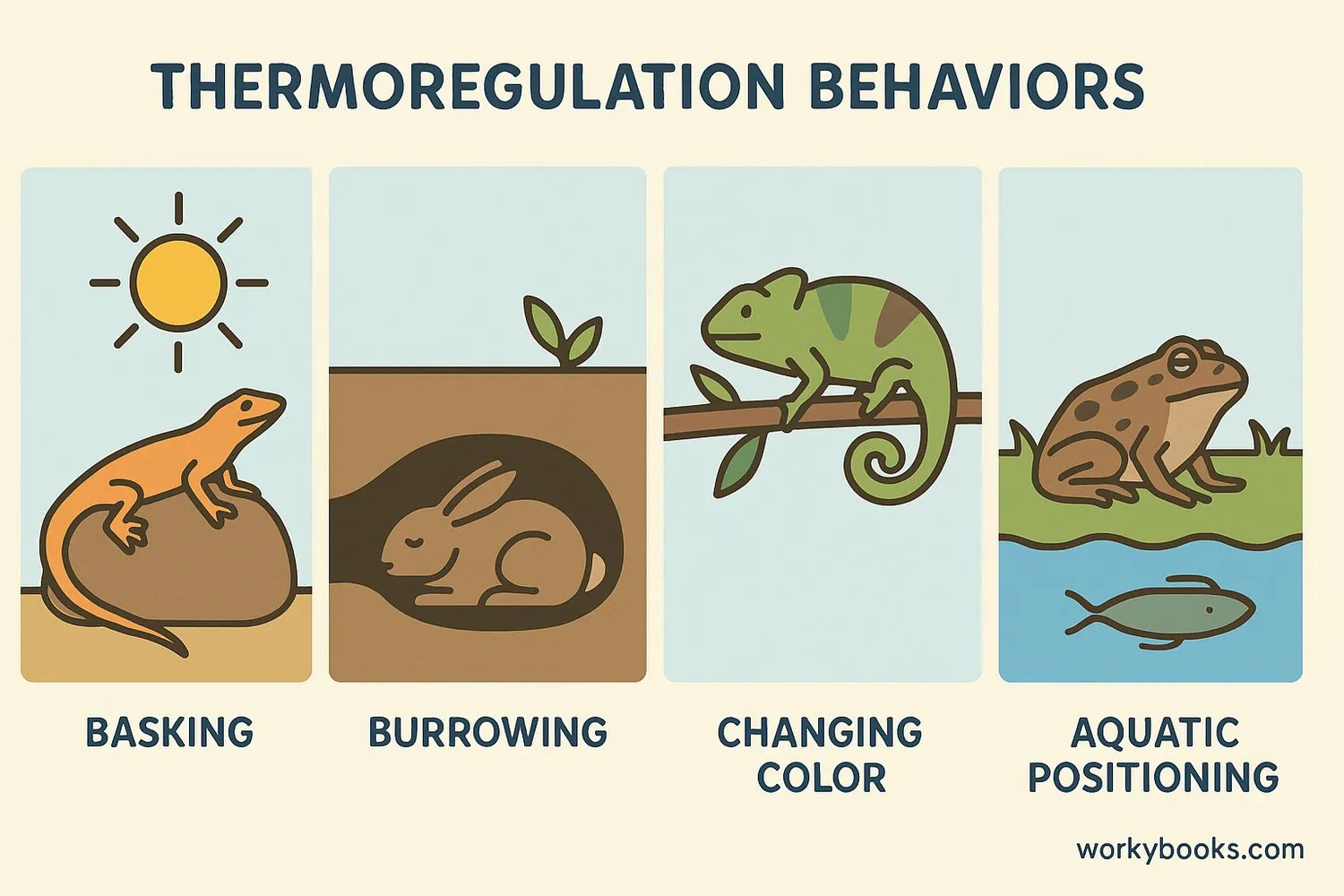
Figure 13.29 – Behavioral Thermoregulation in Ectotherms Caption: Ectotherms control body temperature by changing behavior such as basking, burrowing and changing position. Attribution: Workybooks / educational resources.
Examples of Ectotherms 🐟 Fishes 🐸 Amphibians 🐍 Reptiles 🦋 Most Invertebrates
🟢 Did You Know?
Ectotherms can survive long periods without food because their metabolism is slow. This allows them to live in environments where food is scarce.
🔵 2. ENDOTHERMS
📖 Definition
Endotherms (Endo = inside, Therm = heat) are animals that generate most of their body heat through internal metabolism. They maintain a relatively constant body temperature, even when the surrounding environment changes.
🧠 Easy Explanation
Imagine a human standing outside on a cold winter morning. Although the surrounding temperature is very low, the body continues producing heat by muscle activity, metabolism and burning stored fat. As a result, body temperature remains close to 37°C.
🟠 Characteristics of Endotherms
✅ Produce heat internally. ✅ Maintain a nearly constant body temperature. ✅ High metabolic rate. ✅ Require more food because they use more energy. ✅ Can remain active in cold environments.

Figure 13.30 – Polar Bear (Endotherm) Caption: Endotherms remain active in cold environments because they generate heat internally and have insulation (fur + blubber). Attribution: Ecology Blog / educational resources.
🔥 How Endotherms Produce Heat
When the weather becomes cold, endotherms use several mechanisms:
🫨 Shivering Shivering (rapid, involuntary contraction of skeletal muscles) produces heat.
🟤 Brown Adipose Tissue (Brown Fat) Brown adipose tissue (a special type of fat that produces heat instead of storing energy) helps maintain body temperature, especially in infants and some mammals.
🧥 Insulation Most endotherms reduce heat loss using: 🐻 Thick fur 🪶 Feathers 🧈 A layer of body fat (blubber in whales and seals)
Examples of Endotherms 🦅 Birds 🐄 Mammals 👨 Humans 🐬 Dolphins 🐋 Whales
📊 Comparison Table
| Feature | Ectotherms | Endotherms |
|---|---|---|
| Main Heat Source | Environment | Internal metabolism |
| Body Temperature | Changes with surroundings | Nearly constant |
| Metabolic Rate | Low | High |
| Food Requirement | Less | More |
| Examples | Fish, Amphibians, Reptiles | Birds, Mammals |
Comparison Flowchart
Animals
                      │
          ┌───────────┴───────────┐
          │                       │
          ▼                       ▼
     Ectotherms              Endotherms
 (External Heat)          (Internal Heat)
          │                       │
  Sun • Warm Rocks         Metabolism
          │                       │
 Variable Temperature     Constant Temperature
🧠Memory Trick
🌞 ECTOtherm ECTO = EXTERNAL → Gets heat from outside.
🔥 ENDOtherm ENDO = INTERNAL → Produces heat inside the body.
📦 Did You Know?
A crocodile may spend hours lying in the sun to warm its body, while a sparrow can remain active on a cold morning because it continuously produces heat through its metabolism.
⭐ Board Exam Tips
Frequently Asked Short Questions ✅ Define Ectotherms. ✅ Define Endotherms. ✅ Give two examples of each. ✅ Why do ectotherms bask in the sun?
Frequently Asked MCQs ✔ Which animals obtain heat mainly from the environment? → Ectotherms ✔ Which animals maintain a constant body temperature? → Endotherms ✔ Birds are → Endotherms ✔ Reptiles are → Ectotherms
📌 Quick Revision
✔ Ectotherms depend on external heat. ✔ Endotherms generate heat internally. ✔ Reptiles and fishes are ectotherms. ✔ Birds and mammals are endotherms. ✔ Endotherms have a high metabolic rate. ✔ Ectotherms regulate temperature mainly through behavior.
30 MCQs – Ectotherms & Endotherms
1. Animals that obtain most body heat from the environment are called: A) Endotherms B) Ectotherms C) Homeotherms D) Poikilotherms Ans: B 2. Animals that generate most body heat internally are called: A) Ectotherms B) Endotherms C) Cold-blooded D) Poikilotherms Ans: B 3. Reptiles are examples of: A) Endotherms B) Ectotherms C) Both D) None Ans: B 4. Birds and mammals are: A) Ectotherms B) Endotherms C) Cold-blooded D) Both Ans: B 5. Body temperature of ectotherms: A) Remains constant B) Changes with environment C) Is always high D) Is always low Ans: B 6. Body temperature of endotherms is: A) Variable B) Nearly constant C) Always 20°C D) Always changing Ans: B 7. Which animals have low metabolic rate? A) Endotherms B) Ectotherms C) Birds D) Mammals Ans: B 8. Which animals require more food? A) Ectotherms B) Endotherms C) Fishes D) Amphibians Ans: B 9. Behavioral thermoregulation is mainly used by: A) Endotherms B) Ectotherms C) Humans D) Birds Ans: B 10. Basking in the sun is an example of: A) Endothermy B) Behavioral thermoregulation C) Shivering D) Insulation Ans: B 11. Shivering produces heat in: A) Ectotherms B) Endotherms C) Both D) None Ans: B 12. Brown fat is found in: A) Ectotherms B) Endotherms C) Reptiles D) Fishes Ans: B 13. Thick fur and feathers help in: A) Heat production B) Reducing heat loss C) Increasing metabolism D) Cooling the body Ans: B 14. Fishes are generally: A) Endotherms B) Ectotherms C) Homeotherms D) Both Ans: B 15. Humans are: A) Ectotherms B) Endotherms C) Poikilotherms D) Cold-blooded Ans: B 16. Which animals can remain active in cold weather? A) Ectotherms B) Endotherms C) Lizards D) Snakes Ans: B 17. Ectotherms need less food because: A) They have high metabolism B) They have low metabolism C) They produce more heat D) They are large in size Ans: B 18. Moving into shade when hot is an example of: A) Endothermy B) Behavioral thermoregulation C) Shivering D) Insulation Ans: B 19. Polar bears are: A) Ectotherms B) Endotherms C) Cold-blooded D) Poikilotherms Ans: B 20. Blubber is an example of: A) Heat production B) Insulation C) Behavioral regulation D) Shivering Ans: B 21. The term “Ecto” means: A) Inside B) Outside C) Constant D) Variable Ans: B 22. The term “Endo” means: A) Outside B) Inside C) Heat D) Cold Ans: B 23. Most invertebrates are: A) Endotherms B) Ectotherms C) Homeotherms D) Both Ans: B 24. Which group has high metabolic rate? A) Ectotherms B) Endotherms C) Amphibians D) Reptiles Ans: B 25. Lizards warm their body mainly by: A) Shivering B) Basking in sun C) Brown fat D) Sweating Ans: B 26. Which is NOT a characteristic of ectotherms? A) Low metabolic rate B) Variable body temperature C) High food requirement D) Depend on external heat Ans: C 27. Which is NOT a characteristic of endotherms? A) Constant body temperature B) High metabolic rate C) Low food requirement D) Internal heat production Ans: C 28. Whales and dolphins are: A) Ectotherms B) Endotherms C) Cold-blooded D) Poikilotherms Ans: B 29. Dormancy in cold weather is common in: A) Endotherms B) Ectotherms C) Birds D) Mammals Ans: B 30. Main difference between ectotherms and endotherms is: A) Size B) Source of body heat C) Habitat only D) Color Ans: B
FAQ (Compact)
Q1. Define Ectotherms. Animals that obtain most of their body heat from external sources (environment). Their body temperature changes with surroundings.
Q2. Define Endotherms. Animals that generate most of their body heat through internal metabolism and maintain nearly constant body temperature.
Q3. Give two examples of each. Ectotherms: Fishes, Reptiles Endotherms: Birds, Mammals
Q4. Why do ectotherms bask in the sun? To absorb heat from the environment and raise their body temperature.
Q5. Why do endotherms need more food? Because they have high metabolic rate and continuously produce heat, which requires more energy.
Q6. What is behavioral thermoregulation? Changing behavior (basking, moving to shade, burrowing) to control body temperature, mainly used by ectotherms.
Q7. How do endotherms reduce heat loss? By insulation such as thick fur, feathers and body fat (blubber).
Q8. What is the advantage of being an ectotherm? They need less food and can survive longer periods without eating due to low metabolic rate.
Temperature qualification: Around 37 °C is a useful average teaching value for human core temperature. Normal values vary with measurement site and time. Piloerection provides little thermal insulation in humans compared with densely furred mammals.


0 Comments