Human Nervous System – Nervous Coordination and Neurons
To survive, every animal must stay connected to the world around it. They need to sense and respond to changes in the environment. The activities of their organs and systems are also coordinated. For example, heart rate, breathing rate, digestion and many other functions are coordinated. Due to such coordination, every function is regulated according to the needs of the body.

- Nervous coordination – controlled by the nervous system
- Chemical coordination – controlled by the endocrine system
This chapter deals with the details of the human nervous system.
Tidbit: Think of your body as a large, complex city. For the city to run smoothly, the traffic lights, emergency services and power plants must all talk to each other. This “talking” is what we call coordination.
15.1 – Nervous Coordination
In nervous coordination, the nervous system controls coordination with the external environment and among different parts of the body. Nervous coordination is done by means of electrical signals (nerve impulses).
15.1.1 – Basic Elements of Nervous Coordination
For homeostasis (maintenance of a relatively constant internal environment), the nervous system is the most important because it regulates other systems and also maintains homeostasis by itself.
The basic elements of nervous coordination are:
1. Receptors
These are organs, tissues or cells (such as eyes, ears or skin) that detect stimuli (changes in the external and internal environment). They act as transducers (they convert one form of energy into another).
When receptors receive stimuli, they generate nerve impulses in sensory neurons. Sensory neurons then carry these impulses to the central nervous system for processing.
Tidbit: Receptors act as transducers because they convert one form of energy into another. Example: Rod and cone cells in the retina convert light energy into nerve impulse (electrochemical energy).
2. Central Nervous System (CNS)
It is the control centre of nervous coordination. It consists of the brain and spinal cord. These parts are made of associative neurons (also called inter-neurons).
They receive nerve impulses from sensory neurons, process them, and then send impulses to effectors via motor neurons.
3. Effectors
These are the parts which produce responses after receiving nerve impulses from the CNS via motor neurons. Muscles and glands act as effectors.
- Muscles produce response by contracting
- Glands produce response by secretion
Complete path of nerve impulse: Receptors → Sensory neurons → CNS (Inter-neurons) → Motor neurons → Effectors
In this pathway, neurons act as the functional units.

Figure: Simple pathway of nervous coordination (Reflex Arc style) Source: Simply Psychology
15.2 – Neurons
The function of the nervous system is carried out by specialized cells called neurons (nerve cells). A neuron is the structural and functional unit of the nervous system.
15.2.1 – Structure of a Neuron
All neurons have three basic components:
1. Cell Body (Soma)
Enlarged region of the neuron. Contains the nucleus and most organelles. Cytoplasm has Nissl’s granules (groups of ribosomes + rough endoplasmic reticulum).
2. Dendrites
Membrane-bound extensions of the cell body. They receive information from other neurons or cells, convert it into nerve impulses, and carry it toward the cell body. Motor and inter-neurons have highly branched dendrites because they receive impulses from many sources.
3. Axon
Long membrane-bound extension of the cell body. It transmits impulses away from the cell body. The end of the axon is called the axon terminal. It contacts a muscle cell, gland cell or another neuron.

Figure: Structure of a model neuron (cell body, dendrites, axon, myelin sheath, node of Ranvier) Source: Lumen Learning
Supporting Cells – Neuroglia (Glial Cells)
Neuroglia (glial cells) support neurons. They supply nutrients, remove wastes and provide immunity.
Two important types:
- Schwann cells → produce myelin sheath in the Peripheral Nervous System (PNS)
- Oligodendrocytes → produce myelin sheath in the Central Nervous System (CNS)
Myelin sheath is an insulating covering of multiple membrane layers. It helps in fast transmission of nerve impulses.
- Neurons with myelin sheath = myelinated
- Neurons without myelin sheath = non-myelinated
In the CNS:
- Myelinated axons form white matter
- Non-myelinated dendrites + cell bodies form grey matter
In the PNS, both myelinated and non-myelinated axons are bundled together to form nerves.
In myelinated neurons, the myelin sheath is interrupted every 1–2 mm by small gaps called Nodes of Ranvier.
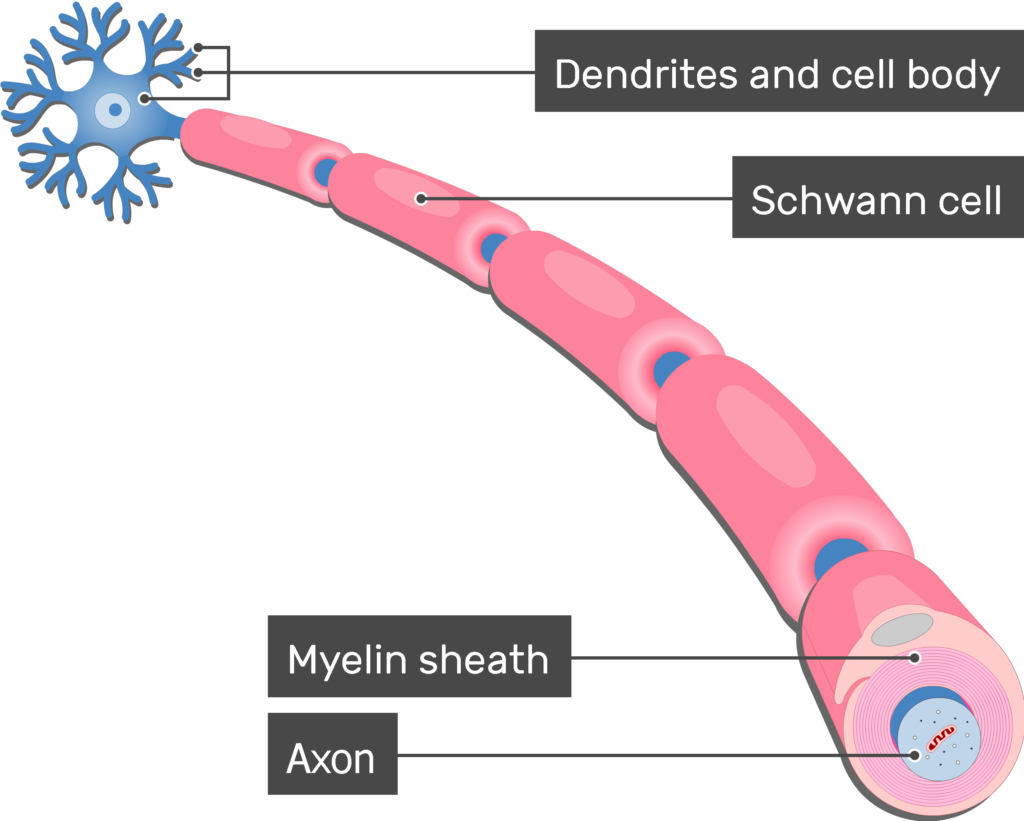
Figure: Myelin sheath formed by Schwann cell Source: GetBodySmart
Figure: Neuron with oligodendrocyte, myelin sheath and nodes of Ranvier Source: OpenStax
15.2.2 – Types of Neurons
1. Sensory Neurons
Conduct impulses from receptors to the CNS. Cell bodies located outside CNS in clusters called ganglia. Unipolar (one long process that divides into dendrite and axon). Terminal branches of dendrite connected to receptors.
2. Motor Neurons
Conduct impulses away from the CNS to effectors. Cell bodies located inside the CNS. Multipolar (many branched dendrites). Dendrites make contact with other neurons in brain and spinal cord.
3. Inter-neurons (Associative Neurons)
Occur entirely within the CNS. Receive impulses from sensory neurons or other inter-neurons and transmit impulses to motor neurons or other inter-neurons. Some have short axons (local circuits), others have long axons (connect different regions).
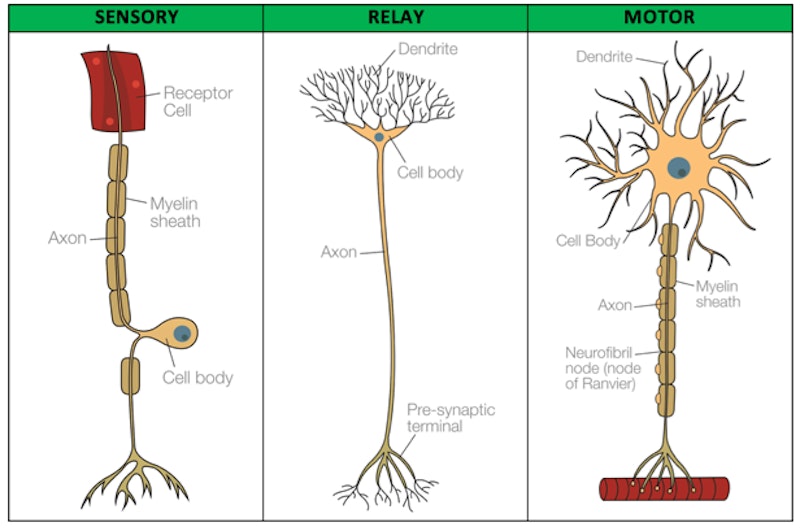
Figure: Sensory, Relay (Inter) and Motor neurons Source: Tutor2u
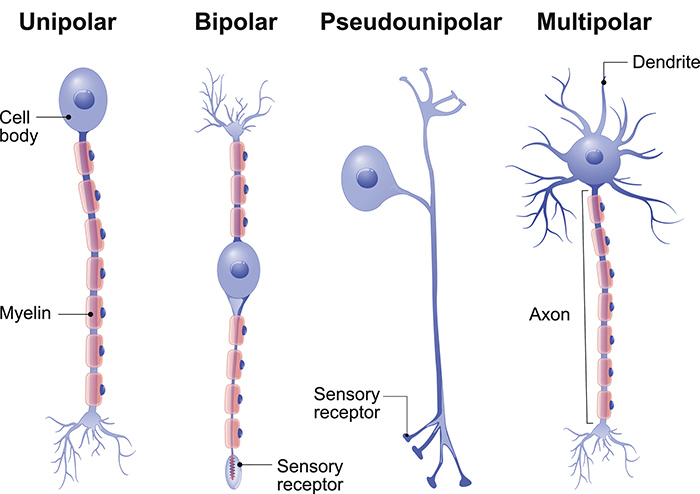
Figure: Structural types of neurons (Unipolar, Bipolar, Pseudounipolar, Multipolar) Source: Queensland Brain Institute
Quick Exam Summary
- Path of impulse: Receptor → Sensory neuron → CNS → Motor neuron → Effector
- Neuron = Cell body + Dendrites + Axon
- Myelin sheath → faster conduction + Nodes of Ranvier
- Many somatic sensory neurons are pseudounipolar; sensory cell forms vary. | Motor = Multipolar | Inter-neuron = inside CNS only
MCQs and FAQs – Human Nervous System (Nervous Coordination & Neurons)
Multiple Choice Questions (MCQs)
1. Nervous coordination is carried out by means of: a) Chemical signals only b) Electrical signals (nerve impulses) c) Hormones d) Blood circulation
2. Which of the following acts as transducers in the nervous system? a) Effectors b) Inter-neurons c) Receptors d) Motor neurons
3. The control centre of nervous coordination is: a) Muscles and glands b) Sensory neurons c) Central Nervous System (brain and spinal cord) d) Peripheral nerves
4. Which of the following is NOT a basic component of a neuron? a) Cell body b) Dendrites c) Axon d) Nephron
5. Nissl’s granules are found in the: a) Axon terminal b) Cell body of neuron c) Myelin sheath d) Nodes of Ranvier
6. Myelin sheath is produced in the Peripheral Nervous System by: a) Oligodendrocytes b) Schwann cells c) Astrocytes d) Microglia
7. The gaps in the myelin sheath are called: a) Synapses b) Nodes of Ranvier c) Ganglia d) Dendrites
8. Sensory neurons are mostly: a) Multipolar b) Bipolar c) Unipolar d) Non-polar
9. Motor neurons conduct impulses: a) From receptors to CNS b) Away from CNS to effectors c) Only within the CNS d) From one inter-neuron to another
10. Inter-neurons (associative neurons) are found: a) Outside the CNS b) Entirely within the CNS c) Only in the peripheral nerves d) Only in sensory organs
FAQs (Frequently Asked Questions)
Q1. What is nervous coordination? Nervous coordination is the process by which the nervous system controls and coordinates the activities of the body and its response to the external environment using electrical signals (nerve impulses).
Q2. What are the three basic elements of nervous coordination?
- Receptors (detect stimuli)
- Central Nervous System (processes information)
- Effectors (produce response)
Q3. Why are receptors called transducers? Because they convert one form of energy (stimulus) into another form (nerve impulse/electrochemical energy). Example: light energy into nerve impulse by rod and cone cells.
Q4. What is the complete pathway of a nerve impulse? Receptors → Sensory neurons → CNS (Inter-neurons) → Motor neurons → Effectors
Q5. What is a neuron? A neuron (nerve cell) is the structural and functional unit of the nervous system. It consists of cell body, dendrites and axon.
Q6. What is the function of myelin sheath? Myelin sheath is an insulating covering around the axon that helps in the fast transmission of nerve impulses. It is produced by Schwann cells (PNS) and oligodendrocytes (CNS).
Q7. What are Nodes of Ranvier? Nodes of Ranvier are the small non-myelinated gaps present at regular intervals (1–2 mm) in the myelin sheath of myelinated neurons.
Q8. Differentiate between sensory, motor and inter-neurons.
- Sensory neurons: Carry impulses from receptors to CNS (mostly unipolar).
- Motor neurons: Carry impulses from CNS to effectors (multipolar).
- Inter-neurons: Found entirely within CNS; connect sensory and motor neurons.
Q9. What is the difference between white matter and grey matter?
- White matter → consists of myelinated axons
- Grey matter → consists of non-myelinated dendrites and cell bodies
Q10. Why do motor and inter-neurons have highly branched dendrites? Because they receive nerve impulses from many different sources simultaneously, so highly branched dendrites help collect information from multiple neurons.
Study qualifications: Neural communication uses electrical membrane changes and, at many synapses, chemical neurotransmitters. Grey matter includes neuronal bodies, dendrites, synapses and glia; white matter consists largely of myelinated axons and glia. These are predominant features, not absolute exclusions.


0 Comments