Disorders of Urinary Tract – UTI, Kidney Stones, Kidney Failure, Dialysis & Transplant
🔵 14.3 Disorders of the Urinary Tract
A variety of disorders can affect the structure and function of the kidneys and urinary tract. Common disorders include urinary tract infections, kidney stones, kidney failure and polycystic kidney disease.
🟢 14.3.1 Urinary Tract Infections (UTIs)
Urinary tract infections are usually caused by bacteria, most commonly Escherichia coli (E. coli).
These bacteria enter the urinary system through the urethra and can infect the bladder, ureters or kidneys.
Common Symptoms:
- Frequent and urgent need to urinate
- Pain or burning sensation during urination
- Cloudy or strong-smelling urine
- Lower abdominal pain
- Fever or chills (in severe cases)
Educational overview: bacterial urinary infections may require clinician-prescribed antibiotics. Appropriate treatment depends on the diagnosis and patient; increased water intake alone is not a reliable treatment and fluid needs can differ in kidney disease.
🟢 14.3.2 Kidney Stones
Kidney stones are hard, crystalline mineral materials that form small “pebbles” inside the kidney or urinary tract.
Types of Kidney Stones:
- 70% are calcium oxalate stones (due to high calcium and oxalate in urine)
- 10% are uric acid stones (due to high uric acid in blood)
- Some stones are formed due to high cysteine or phosphate levels
Main Cause: Continuous dehydration increases the risk of stone formation.
Treatment – Lithotripsy (Breaking of Stones)
1. Extracorporeal Shockwave Lithotripsy (ESWL) Shock waves are generated from outside the body. These waves break the stone into small pieces which then pass out through urine.

Figure: Extracorporeal Shockwave Lithotripsy (ESWL)
2. Percutaneous Nephrolithotripsy (PNL) Used for larger stones. A tube is inserted from the back into the kidney. A camera (nephroscope) and ultrasound equipment are used to break and remove the stone pieces.
🟢 14.3.3 Kidney Failure
Kidney failure is a condition in which the kidneys lose their ability to filter wastes from the blood and regulate fluid and salt balance.
Types:
- Chronic Kidney Failure: Develops slowly over a long period and is irreversible. Common causes include diabetes, high blood pressure and chronic kidney diseases.
- Acute Kidney Failure: Occurs suddenly and can often be reversed with proper treatment. Causes include infection, blockage, certain medicines or blood clots.
🔴 Renal Dialysis
Dialysis is an artificial method of filtering metabolic wastes from the blood when kidneys fail.
There are two main types:
1. Haemodialysis
- Blood is taken out of the body through a catheter.
- It is passed through a machine called dialyzer which contains a semi-permeable membrane.
- Wastes, excess water and salts move into the dialysate fluid.
- Clean blood is returned to the body.
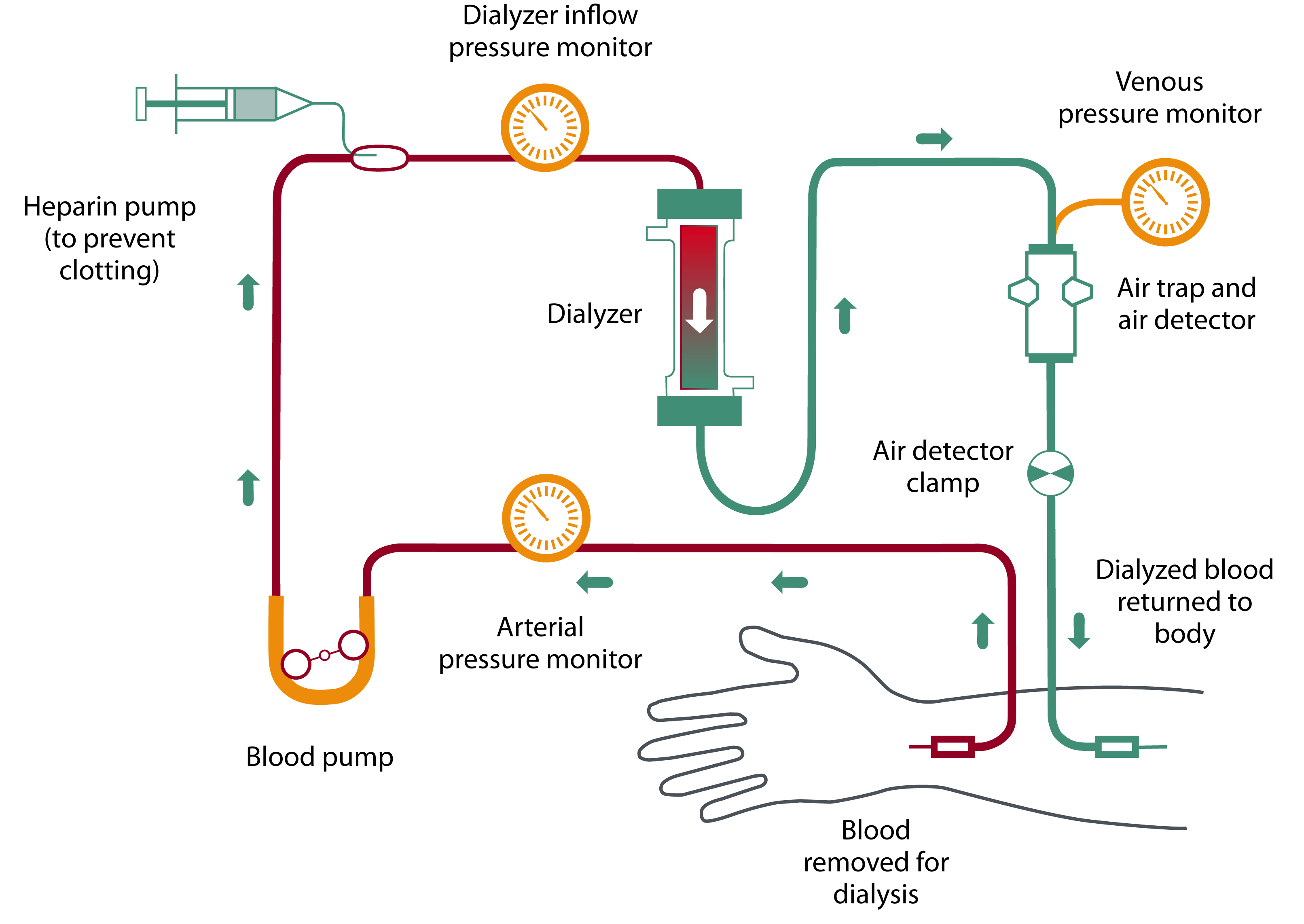
Figure: Haemodialysis process
2. Peritoneal Dialysis
- Dialysate fluid (1.5–2 litres) is introduced into the abdominal cavity through a catheter.
- The peritoneal membrane acts as a natural filter.
- After 4–6 hours, the fluid (now containing wastes) is drained out.
- This process is repeated several times a day.
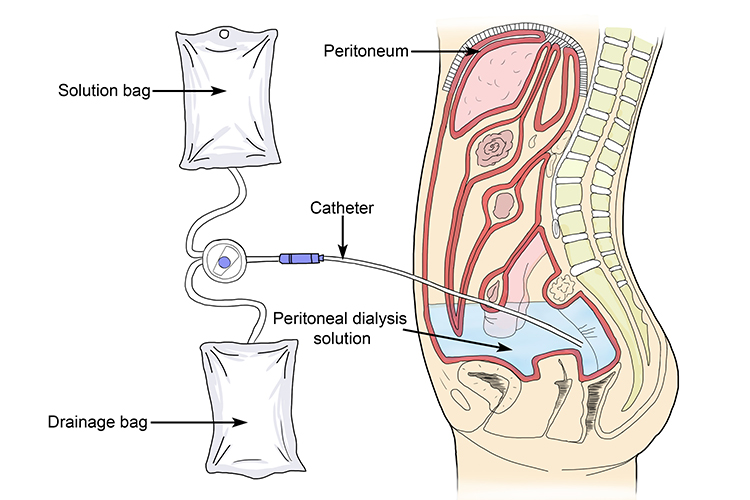
Figure: Peritoneal Dialysis
Problems associated with Dialysis:
- Risk of infection
- Low blood pressure (hypotension)
- Muscle cramps
- Anaemia and fatigue
- Emotional stress and depression
🟢 14.3.4 Kidney Transplant
A kidney transplant places a healthy donor kidney into the recipient. The original kidneys usually remain unless there is a reason to remove them. Transplantation treats kidney failure but is not a permanent cure; follow-up and anti-rejection treatment remain necessary.
Treatment choice depends on medical suitability, donor availability and patient circumstances; transplantation is an option, not a universal best treatment.
Types of Donors:
- Related donor (parent, sibling, child)
- Unrelated living donor (spouse, friend)
- Deceased donor (organs donated after death)
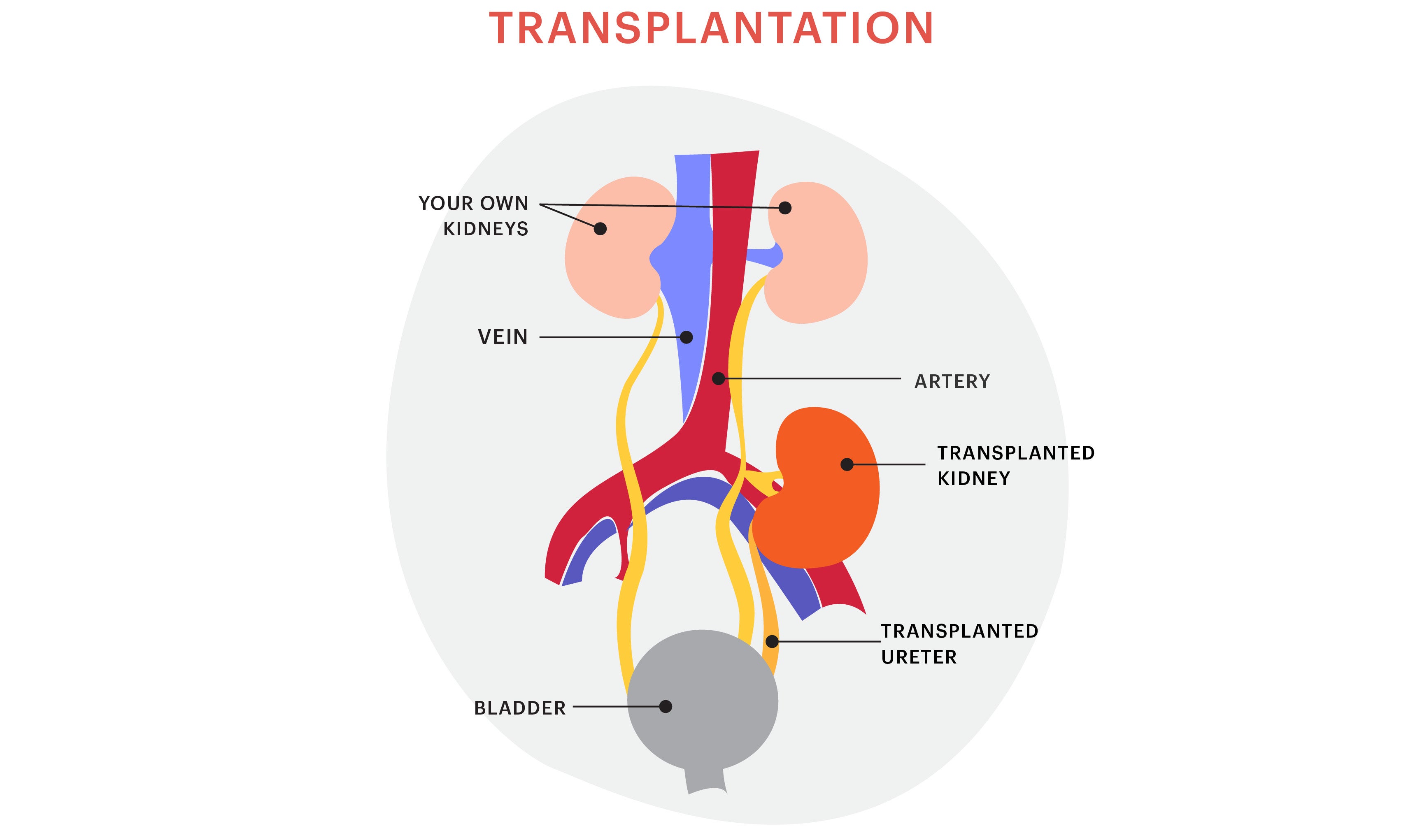
Figure: Kidney Transplant
Problems associated with Kidney Transplant:
- Risk of organ rejection by the immune system
- Increased risk of infections due to immunosuppressant medicines
- Side effects of immunosuppressant drugs (high blood pressure, weight gain, increased risk of infections and cancers)
📌 Quick Revision Points
- Most common cause of UTI → Escherichia coli
- Most common kidney stones → Calcium oxalate (70%)
- ESWL → Shock waves from outside the body
- Haemodialysis → Blood cleaned outside the body
- Peritoneal dialysis → Uses peritoneal membrane inside abdomen
- A functioning transplant can improve kidney replacement for eligible recipients; treatment is individualized and ongoing follow-up remains necessary.
(Past Board style )
Multiple Choice Questions
1. Most common cause of urinary tract infection is: A) Staphylococcus B) Escherichia coli C) Streptococcus D) Salmonella Ans: B 2. The most common type of kidney stone is: A) Uric acid B) Calcium oxalate C) Cysteine D) Phosphate Ans: B 3. About 70% of kidney stones are of: A) Uric acid B) Calcium oxalate C) Calcium phosphate D) Cysteine Ans: B 4. Breaking of kidney stones by shock waves from outside the body is called: A) PNL B) ESWL C) Dialysis D) Transplant Ans: B 5. Percutaneous Nephrolithotripsy is used for: A) Small stones B) Large stones C) Infection D) Dialysis Ans: B 6. Chronic kidney failure is usually: A) Reversible B) Irreversible C) Temporary D) Mild Ans: B 7. In haemodialysis, blood is cleaned by: A) Peritoneal membrane B) Dialyzer C) Kidney itself D) Liver Ans: B 8. In peritoneal dialysis, which membrane acts as filter? A) Pleural membrane B) Peritoneal membrane C) Synovial membrane D) Meninges Ans: B 9. Which treatment can restore many kidney functions in a medically eligible recipient? A) Haemodialysis B) Peritoneal dialysis C) Kidney transplant D) Lithotripsy Ans: C 10. The major risk after kidney transplant is: A) High blood pressure B) Organ rejection C) Stone formation D) Infection only Ans: B 11. ADH increases: A) Urine volume B) Blood volume and pressure C) Sodium excretion D) Potassium reabsorption Ans: B 12. Continuous dehydration increases the risk of: A) UTI B) Kidney stones C) Diabetes D) Hypertension Ans: B 13. Uric acid stones are formed due to: A) Hypercalciuria B) Hyperuricemia C) Hyperoxaluria D) High phosphate Ans: B 14. Which of the following is a problem of dialysis? A) Infection B) Low blood pressure C) Muscle cramps D) All of these Ans: D 15. Related donor of kidney means: A) Friend B) Spouse C) Parent or sibling D) Deceased person Ans: C
Short Questions
1. What is the most common bacterium that causes UTI? Escherichia coli (E. coli).
2. Name the two methods of lithotripsy.
- Extracorporeal Shockwave Lithotripsy (ESWL)
- Percutaneous Nephrolithotripsy (PNL)
3. What is the difference between acute and chronic kidney failure? Acute kidney failure occurs suddenly and is often reversible. Chronic kidney failure develops slowly and is irreversible.
4. What is haemodialysis? It is a process in which blood is taken out of the body, cleaned by a dialyzer (artificial kidney), and then returned to the body.
5. What is peritoneal dialysis? In this method, dialysate fluid is introduced into the abdomen. The peritoneal membrane acts as a natural filter to remove wastes.
6. Write any three problems associated with dialysis.
- Risk of infection
- Low blood pressure
- Muscle cramps
7. What is a potential advantage of a functioning transplant? It can replace many kidney functions more effectively than dialysis, but requires ongoing care and is not appropriate for every patient.
8. Name three types of kidney donors.
- Related living donor
- Unrelated living donor
- Deceased donor
9. Why do patients take immunosuppressant medicines after kidney transplant? To prevent the immune system from rejecting the transplanted kidney.
10. What is the main cause of calcium oxalate stones? High levels of calcium and oxalate in urine (hypercalciuria and hyperoxaluria)
Reference for corrected concepts: NIDDK: kidney transplant.


0 Comments