Blood Supply of Kidney, Urine Formation & Hormonal Control | Class Biology Chapter 14
🔵 14.1.2 Blood Supply of the Kidney
The pathway of blood inside the kidney begins with the renal artery, which enters the kidney at the hilum.
Pathway of Blood:
- Renal artery enters at hilum
- Divides into smaller branches
- Gives rise to afferent arterioles
- Each afferent arteriole leads into the glomerulus (a capillary network)
- Blood leaves the glomerulus through the efferent arteriole
- Efferent arteriole branches into peritubular capillaries (around proximal and distal tubules)
- In juxtamedullary nephrons, efferent arterioles also form vasa recta (long straight capillaries parallel to loops of Henle)
- Capillaries join to form venules → larger veins → renal vein
- Renal vein exits at the hilum and joins the inferior vena cava
Important Point: Kidneys are highly vascular organs. They receive 20–25% of total cardiac output.
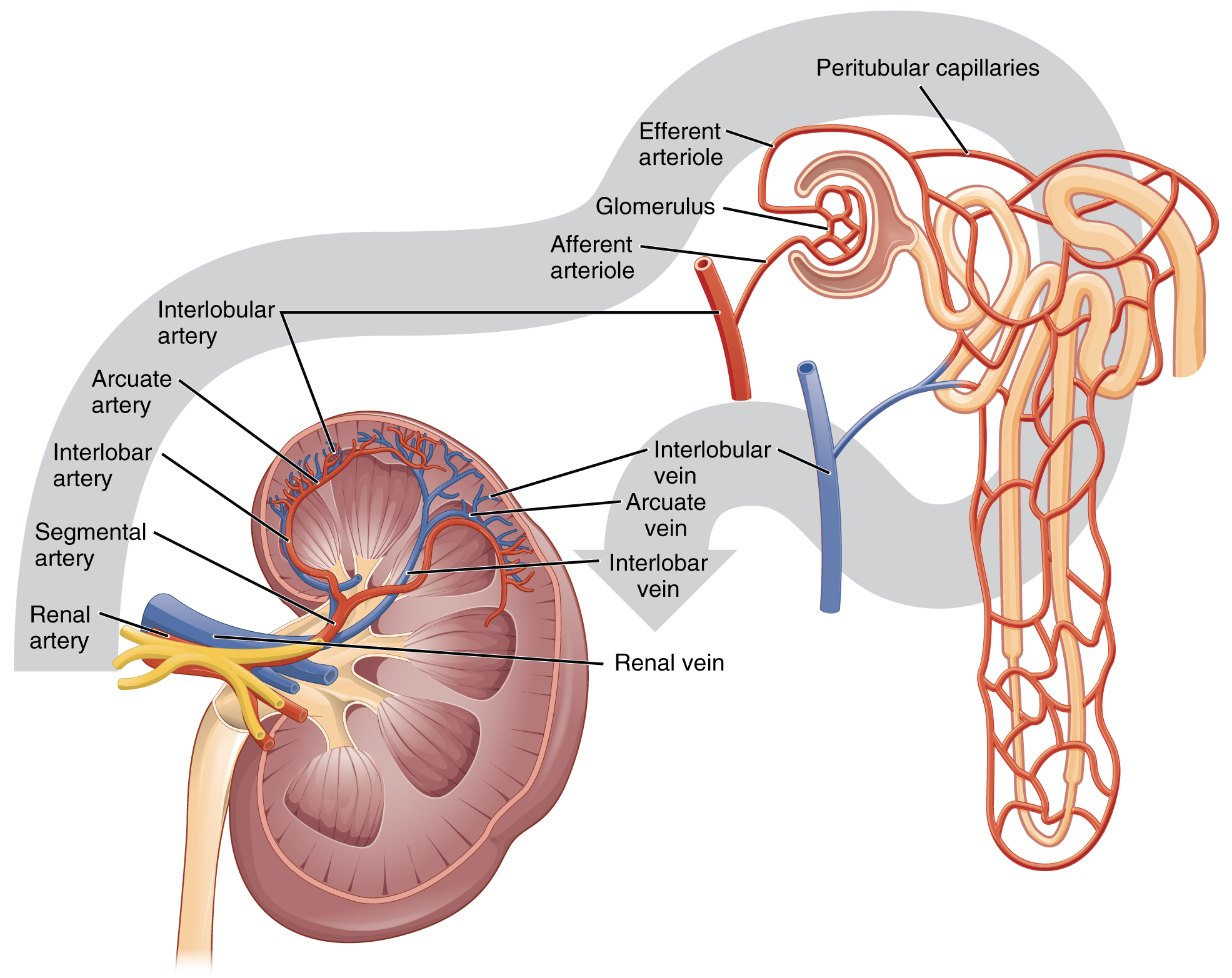
Figure: Blood supply of the kidney showing afferent arteriole, glomerulus, efferent arteriole, peritubular capillaries and vasa recta.
🔵 14.1.3 Functioning of the Kidney (Urine Formation)
Urine formation takes place in three main steps:
🟢 1. Glomerular Filtration (Ultrafiltration)
This is the first step of urine formation.
- The efferent arteriole is narrower than the afferent arteriole.
- This creates high blood pressure in the glomerular capillaries.
- Due to this high pressure, water, urea, glucose, amino acids, vitamins and salts (Na⁺, K⁺, Cl⁻) are forced out of the blood into the Bowman’s capsule.
- This fluid is called glomerular filtrate.
Important: About 20% of the blood plasma is filtered. Plasma proteins and blood cells are too large to pass, so they remain in the blood.
🟢 2. Selective Reabsorption
The glomerular filtrate contains many useful substances. The body cannot afford to lose them.
Selective reabsorption is the process by which useful materials are taken back from the renal tubule into the blood (peritubular capillaries).
Where it occurs:
- The proximal convoluted tubule reabsorbs roughly two-thirds of filtered water and sodium, and normally nearly all filtered glucose and amino acids when transport capacity is not exceeded. Reabsorption and secretion occur at several nephron segments.
- More water is reabsorbed in the descending limb of the loop of Henle.
- The ascending limb is impermeable to water but actively pumps out salts.
- Some reabsorption also occurs in the distal convoluted tubule and collecting duct.
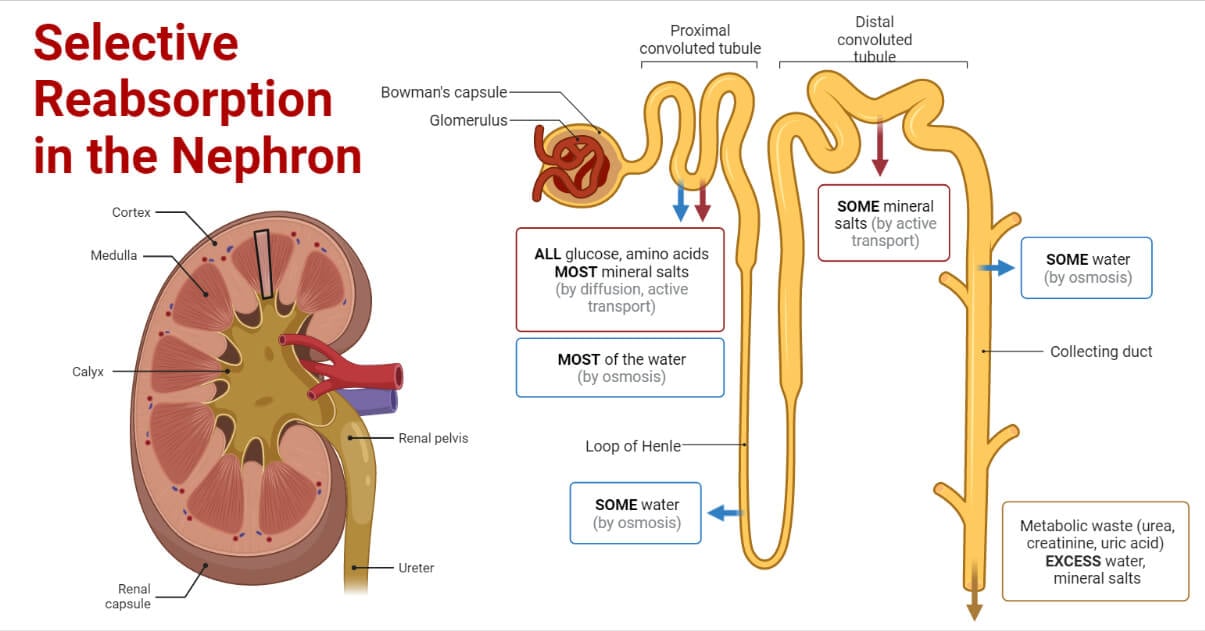
Figure: Selective reabsorption in different parts of the nephron.
🟢 3. Tubular Secretion
This is the opposite of reabsorption.
Tubular secretion transfers selected substances from blood into tubular fluid. It occurs in the proximal tubule as well as later segments; it is not confined to the distal convoluted tubule.
Substances secreted:
- Hydrogen ions (H⁺)
- Ammonium ions (NH₄⁺)
- Potassium ions (K⁺)
- Some drugs and toxins (e.g., penicillin)
Importance: By secreting H⁺ ions, kidneys help maintain the acid-base balance (pH) of the blood.
🔴 Elimination of Urine
From collecting ducts → renal pelvis → ureter → urinary bladder → urethra → outside the body.
A normal adult produces 1 to 2 litres of urine per day. This amount varies according to water intake, salt intake, exercise and weather.
🔵 14.2 Regulation of Urine Concentration
🟢 14.2.1 Counter-Current Mechanism
This is a very important mechanism that allows the kidney to produce concentrated urine.
How it works:
- Descending limb of loop of Henle → permeable to water, impermeable to salts.
- Ascending limb → impermeable to water, actively pumps out NaCl.
As a result, the interstitial fluid in the medulla becomes highly concentrated (hypertonic). When urine passes through the collecting duct, water is reabsorbed by osmosis into this hypertonic fluid and then into the blood via vasa recta.
This mechanism is called the counter-current mechanism.

Figure: Counter-current mechanism showing concentration gradient in the medulla.
🟢 Hormonal Control of Kidney Functions
1. Antidiuretic Hormone (ADH)
- Produced by hypothalamus and released by posterior pituitary.
- Released when body is dehydrated or blood is too concentrated.
- Makes the walls of collecting ducts more permeable to water.
- Result → more water is reabsorbed → concentrated urine is produced.
When ADH is not released: Collecting ducts become less permeable → large amount of dilute urine is produced.
Disorder: Deficiency of ADH causes Diabetes Insipidus (person produces large volume of dilute urine and becomes dehydrated).
2. Aldosterone
- Produced by adrenal cortex.
- Released when blood pressure falls or sodium level is low.
- Acts on distal convoluted tubule and collecting duct.
- Increases reabsorption of sodium (and water follows sodium).
- Also promotes excretion of potassium.
🔴 Two Capillary Beds in Kidney
| Capillary Bed | Location | Function | Blood Pressure |
|---|---|---|---|
| Glomerular capillaries | Inside Bowman’s capsule | Filtration of blood | High |
| Peritubular capillaries | Around renal tubules | Reabsorption and secretion | Low |
📌 Quick Revision for Board Exam
- High pressure in glomerulus is due to narrower efferent arteriole.
- About one-fifth of renal plasma flow becomes filtrate; this is not one-fifth of whole blood.
- Most reabsorption occurs in proximal convoluted tubule.
- Counter-current mechanism creates hypertonic medulla.
- ADH controls water reabsorption.
- Aldosterone controls sodium reabsorption.
- Deficiency of ADH → Diabetes Insipidus.
Multiple Choice Questions
1. Blood enters the kidney through: A) Renal vein B) Renal artery C) Ureter D) Afferent arteriole Ans: B 2. Afferent arteriole leads into: A) Efferent arteriole B) Glomerulus C) Peritubular capillaries D) Vasa recta Ans: B 3. Efferent arteriole is narrower than afferent arteriole. This helps in: A) Decreasing pressure B) Increasing pressure in glomerulus C) Stopping filtration D) Reabsorption Ans: B 4. About how much blood plasma is filtered in glomerulus? A) 10% B) 20% C) 50% D) 80% Ans: B 5. Which of the following is not filtered in glomerulus? A) Glucose B) Urea C) Plasma proteins D) Amino acids Ans: C 6. Most of the selective reabsorption occurs in: A) Distal convoluted tubule B) Loop of Henle C) Proximal convoluted tubule D) Collecting duct Ans: C 7. Ascending limb of loop of Henle is impermeable to: A) Salts B) Water C) Urea D) Glucose Ans: B 8. The process opposite to reabsorption is called: A) Filtration B) Secretion C) Osmosis D) Diffusion Ans: B 9. Hydrogen ions are secreted in the tubule to maintain: A) Blood pressure B) Blood pH C) Blood volume D) Body temperature Ans: B 10. Counter-current mechanism is mainly concerned with: A) Filtration B) Concentration of urine C) Secretion of toxins D) Blood pressure Ans: B 11. ADH is released from: A) Anterior pituitary B) Posterior pituitary C) Adrenal cortex D) Hypothalamus only Ans: B 12. ADH makes the collecting duct walls: A) Less permeable to water B) More permeable to water C) Impermeable to salts D) More permeable to urea Ans: B 13. Deficiency of ADH causes: A) Diabetes mellitus B) Diabetes insipidus C) High blood pressure D) Kidney stones Ans: B 14. Aldosterone is secreted by: A) Adrenal medulla B) Adrenal cortex C) Pituitary D) Kidney Ans: B 15. Main function of aldosterone is: A) Water reabsorption only B) Sodium reabsorption C) Glucose reabsorption D) Urea secretion Ans: B 16. Vasa recta are associated with: A) Cortical nephrons B) Juxtamedullary nephrons C) Both D) None Ans: B 17. Kidneys receive approximately how much of cardiac output? A) 5-10% B) 20-25% C) 40% D) 50% Ans: B 18. Glomerular filtrate is also called: A) Urine B) Plasma C) Ultrafiltrate D) Lymph Ans: C 19. Which part actively transports salts out? A) Descending limb B) Ascending limb C) Proximal tubule only D) Glomerulus Ans: B 20. Normal daily urine output in adult is: A) 0.5 – 1 litre B) 1 – 2 litres C) 3 – 4 litres D) 5 litres Ans: B
Short Questions
1. Why is pressure high in the glomerulus? Because the efferent arteriole is narrower than the afferent arteriole.
2. What is glomerular filtrate? The fluid that is filtered from blood into Bowman’s capsule is called glomerular filtrate.
3. Name the three steps of urine formation.
- Glomerular filtration
- Selective reabsorption
- Tubular secretion
4. Where does maximum reabsorption take place? In the proximal convoluted tubule.
5. What is the function of counter-current mechanism? It helps in creating a concentration gradient in the medulla so that concentrated urine can be produced.
6. What is the role of ADH? ADH increases the permeability of collecting ducts to water, resulting in reabsorption of more water and production of concentrated urine.
7. What happens if ADH is deficient? A large volume of dilute urine is produced. This condition is called diabetes insipidus.
8. What is the main function of aldosterone? It increases reabsorption of sodium ions (and water) from the distal convoluted tubule and collecting duct.
9. Differentiate between glomerular capillaries and peritubular capillaries. Glomerular capillaries – high pressure, used for filtration. Peritubular capillaries – low pressure, used for reabsorption and secretion.
10. Why are plasma proteins not filtered? Because they are too large to pass through the capillary walls of the glomerulus.
Reference for corrected concepts: OpenStax: tubular reabsorption.


0 Comments