Osmoregulation – Definition, Importance, Osmoconformers & Osmoregulators | Class 11 Biology
🔵 13.2 OSMOREGULATION
🟢 Introduction
Have you ever wondered why drinking too little water makes you thirsty, or why drinking too much water makes you urinate more? The answer lies in osmoregulation.
Every living cell needs the right amount of water and dissolved salts (solutes) to function properly. If body fluids become too diluted or too concentrated, cells may swell, shrink, or stop functioning normally.
To prevent this, living organisms continuously regulate the balance of water and solutes through a process called osmoregulation.
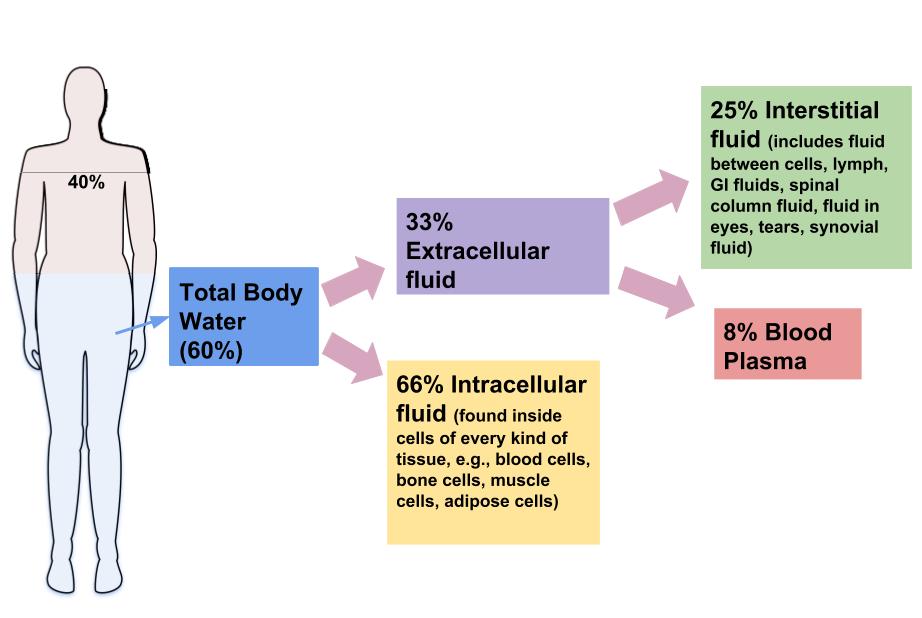
Figure 13.11 – Osmoregulation in the Human Body Caption: Osmoregulation maintains the proper balance of water and dissolved salts in body fluids (intracellular and extracellular fluid). Attribution: Human Nutrition Pressbooks / educational resources.
🟣 Definition
Osmoregulation (Osmo = water, Regulation = maintaining balance) is the process by which living organisms maintain the correct balance of water and dissolved salts (solutes) in their body fluids.
This ensures that body fluids do not become: ❌ Too dilute (too much water) ❌ Too concentrated (too little water)
💡 Important Terms
- Solutes (Substances dissolved in water) Examples: Sodium (Na⁺), Potassium (K⁺), Chloride (Cl⁻), Glucose
- Body Fluids Fluids found inside the body, such as blood, tissue fluid, cytoplasm and lymph.
- Osmosis Osmosis (movement of water through a selectively permeable membrane from a dilute solution to a concentrated solution) is the main process involved in osmoregulation.

Figure 13.12 – Osmosis Caption: Water moves from a dilute solution (high water concentration) to a concentrated solution (low water concentration) through a selectively permeable membrane. Attribution: Lumen Learning / educational chemistry resources.
🔴 Why is Osmoregulation Important?
Without osmoregulation, cells cannot maintain their normal shape or function.
Osmoregulation is important because it: ✅ Maintains blood pressure ✅ Keeps cells healthy ✅ Helps organs function properly ✅ Regulates metabolism ✅ Prevents dehydration ✅ Prevents excessive water accumulation
🟠 Real-Life Example
Imagine preparing lemonade. If you add too much water, the taste becomes weak. If you add too much sugar, it becomes overly sweet. Only the correct balance gives the best taste.
Similarly, our body also requires the correct balance of water and dissolved substances.
🔵 13.2.1 Osmoconformers and Osmoregulators
Animals are divided into two groups according to their ability to regulate water and salt balance.
Animals
      │
      ▼
────────────────────────
Osmoconformers     Osmoregulators
🟢 OSMOCONFORMERS
📖 Definition
Osmoconformers (animals whose body fluid concentration changes with the surrounding environment) do not actively regulate the concentration of water and salts in their body fluids.
Instead, their internal fluid concentration becomes almost the same as the surrounding environment. They remain Isotonic (having the same solute concentration as the surrounding medium).
💡 Easy Explanation
Think of an osmoconformer as a person who simply adjusts to whatever weather they experience without changing anything. If the environment changes, their body fluids also change.
Examples ✔ Most marine invertebrates ✔ Hagfish ✔ Sharks ✔ Rays
📦 Characteristics of Osmoconformers ✅ Internal concentration changes with surroundings ✅ Usually live in stable marine environments ✅ Spend less energy on osmoregulation ✅ Mostly marine animals
🔴 OSMOREGULATORS
📖 Definition
Osmoregulators (animals that actively maintain a constant internal water and salt concentration regardless of the surrounding environment) can regulate their body fluids even when external conditions change.
💡 Easy Explanation
Unlike osmoconformers, osmoregulators constantly work to keep their internal environment stable. Even if the environment changes, their body fluids remain almost constant.
How do they regulate? They use several mechanisms: ✔ Active transport (movement of substances using cellular energy called ATP) ✔ Salt absorption ✔ Salt excretion ✔ Water conservation
Examples ✔ Humans ✔ Birds ✔ Mammals ✔ Amphibians ✔ Most freshwater fishes ✔ Most terrestrial vertebrates

Figure 13.14 – Human Kidneys (Major Osmoregulatory Organs) Caption: Human kidneys continuously regulate water and salt balance. Attribution: Concepts of Biology (Open Textbook) / educational resources.
📊 Comparison Table
| Feature | Osmoconformers | Osmoregulators |
|---|---|---|
| Internal Concentration | Changes with environment | Remains nearly constant |
| Energy Required | Very little | High |
| Water Balance | Not actively regulated | Actively regulated |
| Habitat | Mostly marine | Freshwater, marine & terrestrial |
| Examples | Sharks, Rays, Hagfish | Humans, Birds, Mammals |
🧠 Memory Trick
OSMOCONFORMERS CONFORM ↓ They conform to the environment.
OSMOREGULATORS REGULATE ↓ They regulate themselves.
📦 Did You Know?
A shark is an osmoconformer, while a human is an osmoregulator. Even though sharks live in salty seawater, their internal body fluid concentration closely matches the surrounding water, whereas humans constantly regulate their internal water and salt balance.
⭐ Board Exam Tips
Frequently Asked Short Questions ✅ Define Osmoregulation. ✅ Define Osmoconformers. ✅ Define Osmoregulators. ✅ Differentiate between Osmoconformers and Osmoregulators.
Frequently Asked MCQs ✔ Water balance in the body is called → Osmoregulation ✔ Humans are → Osmoregulators ✔ Sharks are → Osmoconformers
📌 Quick Revision
✔ Osmoregulation maintains water and salt balance. ✔ Osmosis is the movement of water through a selectively permeable membrane. ✔ Osmoconformers match the surrounding environment. ✔ Osmoregulators maintain a constant internal environment. ✔ Humans are osmoregulators. ✔ Most marine invertebrates are osmoconformers.
30 MCQs – Osmoregulation
(Based on Past Paper Patterns of Punjab Boards)
1. The process of maintaining water and salt balance in the body is called: A) Thermoregulation B) Osmoregulation C) Excretion D) Homeostasis
Answer: B) Osmoregulation
2. Osmoregulation is the regulation of: A) Body temperature only B) Water and dissolved salts C) Blood pressure only D) Hormones
Answer: B) Water and dissolved salts
3. Animals whose body fluid concentration changes with the surrounding environment are called: A) Osmoregulators B) Osmoconformers C) Homeotherms D) Poikilotherms
Answer: B) Osmoconformers
4. Animals that maintain a constant internal water and salt concentration are called: A) Osmoconformers B) Osmoregulators C) Ectotherms D) Endotherms
Answer: B) Osmoregulators
5. Humans are: A) Osmoconformers B) Osmoregulators C) Both D) None
Answer: B) Osmoregulators
6. Most marine invertebrates are: A) Osmoregulators B) Osmoconformers C) Homeotherms D) Endotherms
Answer: B) Osmoconformers
7. Sharks are examples of: A) Osmoregulators B) Osmoconformers C) Poikilotherms only D) Endotherms
Answer: B) Osmoconformers
8. Which of the following is an example of an osmoregulator? A) Hagfish B) Shark C) Human D) Ray
Answer: C) Human
9. Osmoconformers remain: A) Hypertonic to environment B) Hypotonic to environment C) Isotonic to environment D) None of these
Answer: C) Isotonic to environment
10. Osmoregulators require: A) Very little energy B) High amount of energy C) No energy D) Energy only in freshwater
Answer: B) High amount of energy
11. The main process involved in osmoregulation is: A) Diffusion B) Osmosis C) Active transport only D) Filtration
Answer: B) Osmosis
12. Osmosis is the movement of water from: A) Concentrated to dilute solution B) Dilute to concentrated solution C) Higher solute to lower solute D) None of these
Answer: B) Dilute to concentrated solution
13. Which of the following is NOT a body fluid? A) Blood B) Lymph C) Tissue fluid D) Sweat outside the body
Answer: D) Sweat outside the body
14. Solutes in body fluids include: A) Na⁺, K⁺, Cl⁻ B) Only glucose C) Only proteins D) Only water
Answer: A) Na⁺, K⁺, Cl⁻
15. Which animal spends less energy on osmoregulation? A) Human B) Freshwater fish C) Shark D) Bird
Answer: C) Shark
16. Osmoconformers are mostly found in: A) Freshwater B) Terrestrial habitats C) Marine environments D) Deserts
Answer: C) Marine environments
17. The major osmoregulatory organs in humans are: A) Lungs B) Liver C) Kidneys D) Skin
Answer: C) Kidneys
18. Which statement is correct about osmoconformers? A) They actively regulate salt balance B) Their internal concentration changes with environment C) They live only in freshwater D) They require high energy
Answer: B) Their internal concentration changes with environment
19. Which of the following is a characteristic of osmoregulators? A) Internal concentration matches environment B) Spend very little energy C) Maintain constant internal environment D) Mostly marine invertebrates
Answer: C) Maintain constant internal environment
20. Hagfish is an example of: A) Osmoregulator B) Osmoconformer C) Homeotherm D) Endotherm
Answer: B) Osmoconformer
21. Freshwater fishes are generally: A) Osmoconformers B) Osmoregulators C) Both D) None
Answer: B) Osmoregulators
22. Why is osmoregulation important? A) It maintains blood pressure B) It keeps cells healthy C) It prevents dehydration D) All of the above
Answer: D) All of the above
23. In osmoconformers, the body fluids are: A) Always hypertonic B) Always hypotonic C) Almost same as surrounding medium D) Completely independent
Answer: C) Almost same as surrounding medium
24. Which of the following animals is an osmoregulator? A) Most marine invertebrates B) Rays C) Mammals D) Hagfish
Answer: C) Mammals
25. Active transport in osmoregulation requires: A) No energy B) ATP C) Only diffusion D) Light energy
Answer: B) ATP
26. The term “isotonic” means: A) Higher solute concentration B) Lower solute concentration C) Same solute concentration D) No solute
Answer: C) Same solute concentration
27. Which group of animals actively maintains constant internal concentration? A) Osmoconformers B) Osmoregulators C) Both equally D) Neither
Answer: B) Osmoregulators
28. A person who drinks too much water will: A) Produce less urine B) Produce more urine C) Stop urination D) Have no change
Answer: B) Produce more urine
29. Which of the following is correct? A) Sharks are osmoregulators B) Humans are osmoconformers C) Most marine invertebrates are osmoconformers D) Birds are osmoconformers
Answer: C) Most marine invertebrates are osmoconformers
30. The main difference between osmoconformers and osmoregulators is: A) Habitat only B) Ability to regulate internal concentration C) Body size D) Type of blood
Answer: B) Ability to regulate internal concentration
Quick Answer Key
1-B, 2-B, 3-B, 4-B, 5-B, 6-B, 7-B, 8-C, 9-C, 10-B, 11-B, 12-B, 13-D, 14-A, 15-C, 16-C, 17-C, 18-B, 19-C, 20-B, 21-B, 22-D, 23-C, 24-C, 25-B, 26-C, 27-B, 28-B, 29-C, 30-B
Sources / Pattern Mention: These MCQs are prepared according to the pattern of Punjab Board past papers (especially BISE Lahore, Faisalabad, Gujranwala, Multan) and standard FSc Biology resources. Definitions of osmoregulation, difference between osmoconformers and osmoregulators, and examples (sharks, humans, marine invertebrates) are among the most frequently asked objective questions in Chapter 13.
Osmotic versus ionic regulation: Osmoconformity describes total osmotic concentration. A shark can broadly match seawater osmolarity using organic solutes while regulating individual ions. “Conformer” does not mean that every salt concentration passively matches seawater.


0 Comments