Homeostasis – Definition, Importance & Major Processes | Class 11 Biology Chapter 13
🟢 Chapter Introduction
Homeostasis is one of the most important characteristics of living organisms. It is the process by which organisms maintain a stable internal environment even when the external environment changes continuously. For example, during summer the weather becomes hot and during winter it becomes cold, but the human body keeps its internal temperature close to 37°C. Likewise, the body continuously regulates water, salts, blood glucose and many other conditions to ensure that cells function properly. These regulatory processes together are called homeostasis (maintenance of a stable internal environment).
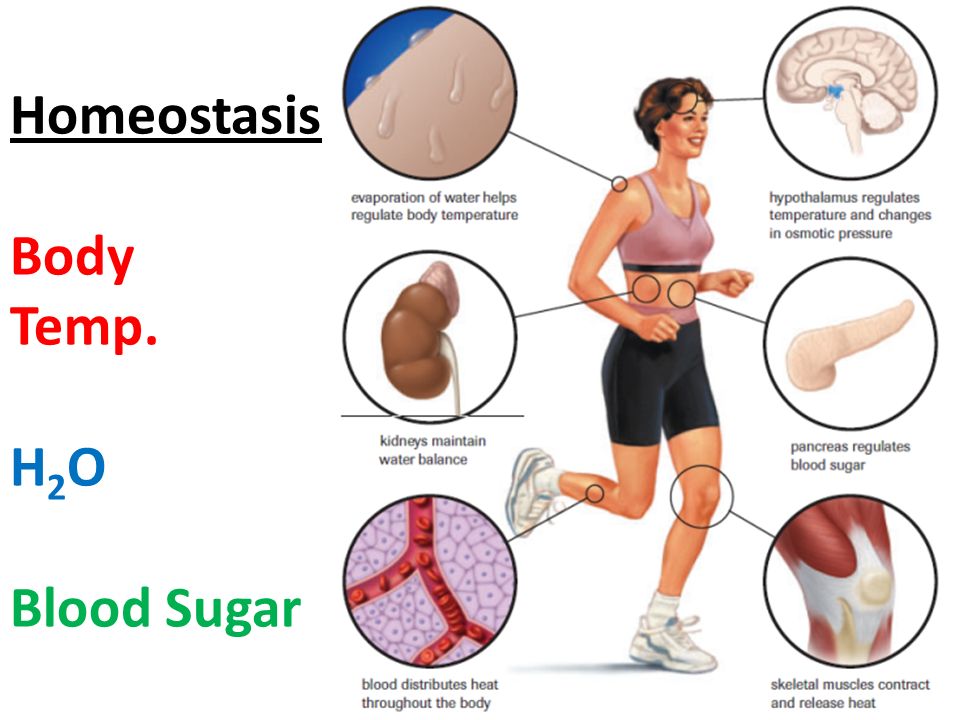
Figure 13.1 – Homeostasis in the Human Body Caption: Homeostasis helps maintain body temperature, water balance, blood glucose, blood pressure and pH within normal limits. Attribution: Educational diagram from Thomas Tallis Science / open educational resources.
🟠 What Does Homeostasis Mean?
📖 Definition
Homeostasis (Homeo = same, Stasis = standing still) is the process by which living organisms maintain a stable internal environment despite changes in the external environment.
💡 Important Terms
- Internal Environment (conditions inside the body) – Includes body temperature, blood pressure, blood sugar, water content and pH.
- External Environment (conditions outside the body) – Includes weather, humidity, sunlight and surrounding temperature.
- Stable (remaining nearly constant) – Does not mean completely unchanging, but kept within a safe range.
🔴 Why is Homeostasis Important?
Without homeostasis, cells cannot survive because enzymes, membranes and organs work efficiently only under suitable internal conditions.
Homeostasis helps to maintain:
- 🌡️ Body temperature
- 💧 Water balance
- 🧂 Salt concentration
- ❤️ Blood pressure
- 🍬 Blood glucose level
- ⚗️ Blood pH
- 🔥 Normal metabolism
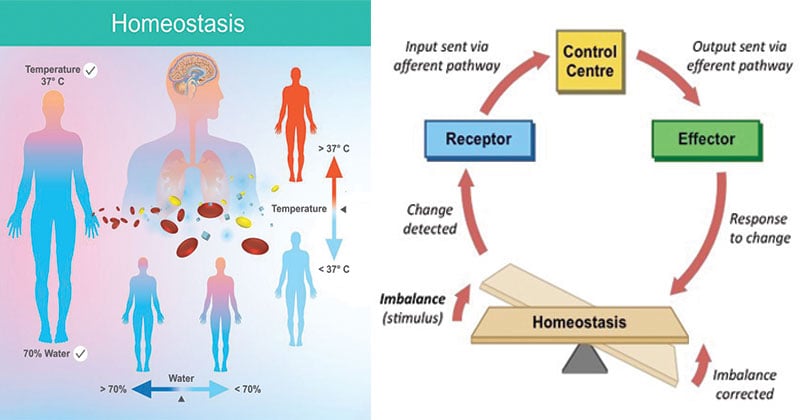
Figure 13.2 – Examples of Homeostasis
Caption: Examples of homeostasis include regulating body temperature, blood sugar and water balance. Attribution: Microbe Notes / educational biology resources.🟣 Major Processes of Homeostasis
The three major processes of homeostasis are:
1️⃣ Thermoregulation (Regulation of body temperature)
Maintains body temperature close to 37°C in humans so that enzymes function efficiently.
2️⃣ Osmoregulation (Regulation of water and dissolved salts)
Maintains the correct balance of water and minerals inside body fluids.
3️⃣ Excretion (Removal of metabolic waste products)
Removes harmful nitrogenous wastes such as ammonia, urea and uric acid from the body.
📊 Summary Table
| Process | Function | Example |
|---|---|---|
| Thermoregulation | Controls body temperature | Sweating and shivering |
| Osmoregulation | Maintains water and salt balance | Kidneys producing urine |
| Excretion | Removes metabolic waste | Elimination of urea in urine |
HOMEOSTASIS
                       │
      ┌────────────────┼────────────────┐
      │                │                │
      ▼                ▼                ▼
 Thermoregulation  Osmoregulation   Excretion
 (Body Heat)      (Water & Salts)  (Waste Removal)
Figure 13.3 – Three Major Processes of Homeostasis
📦 Did You Know?
Even while you are sleeping:
- Your brain monitors body temperature.
- Your kidneys continuously regulate water and salts.
- Your pancreas controls blood glucose.
- Your lungs regulate oxygen and carbon dioxide.
These are all examples of homeostasis working automatically.
🧠 Memory Trick
Remember HOME:
- H – Heat (Thermoregulation)
- O – Osmoregulation
- M – Metabolism
- E – Excretion
⭐ Board Exam Tip
Definition of Homeostasis is one of the most frequently asked short questions in Punjab Board Biology examinations. Learn the definition accurately and be able to explain it with one or two everyday examples (e.g., body temperature remaining 37°C in summer and winter).
Temperature qualification: Around 37 °C is a useful average teaching value for human core temperature. Normal values vary with measurement site and time. Piloerection provides little thermal insulation in humans compared with densely furred mammals.


0 Comments