🌱 Reproductive Efforts in
Population Ecology
Life History Strategies, Trade-offs & Ecological Implications
🔍 Introduction: The Balance of Life
Population ecology examines how populations interact with their environment and how these interactions influence population size, structure, and dynamics. One critical aspect is understanding reproductive efforts—the allocation of energy, time, and resources toward reproduction.
This concept is integral to comprehending life-history strategies, population growth, and species survival. Every organism faces a fundamental trade-off: invest in current reproduction or future survival. The solutions different species have evolved represent millions of years of natural selection.
📖 Definition of Reproductive Efforts
📖 Definition
Reproductive effort is the proportion of an organism's energy and resources devoted to the production and care of offspring. This includes processes such as mating, gestation, egg production, parental care, and mechanisms that ensure offspring survival.
Reproductive efforts vary widely among species and are influenced by environmental conditions, life-history traits, and evolutionary strategies. The fundamental question every organism faces is: How much should I invest in reproduction now versus saving resources for future reproduction or survival?
🔬 Components of Reproductive Efforts
1. Energy Allocation
📖 Energy Allocation
Organisms must balance energy between reproduction, growth, and maintenance. Reproductive effort involves energy directed toward gamete production, mating behaviors, and parental care.
🌿 In Plants
Energy allocation includes producing flowers, seeds, and fruits. Plants invest carbon, nitrogen, and phosphorus in reproductive structures.
Examples: Annual plants allocate 50-80% of energy to seeds; perennial plants allocate less per season but reproduce repeatedly.
🐾 In Animals
Energy allocation includes gamete production, courtship displays, and creating nesting sites. Males often invest in mating displays; females in gametes and care.
Examples: Bird courtship displays, fish spawning, mammalian gestation and lactation.
2. Parental Investment
📖 Parental Investment
Parental care varies significantly among species, ranging from none (many fish, amphibians) to extensive care (birds, mammals). Investment increases offspring survival but reduces parent's future reproductive capacity.
🐾 Animal Examples
Feeding: Providing food to offspring (birds feeding chicks, mammals nursing)
Defending: Protecting offspring from predators (guarding nests, defending territory)
Teaching: Offspring survival strategies (hunting skills, foraging techniques)
🌿 Plant Examples
Seed dispersal: Mechanisms ensuring seeds reach suitable sites (wind, water, animals)
Seed dormancy: Delaying germination until favorable conditions
Endosperm: Nutrient reserves in seeds supporting early seedling growth
3. Timing of Reproduction
📖 Timing of Reproduction
The timing and frequency of reproduction influence reproductive success and population dynamics. Species are classified as semelparous (reproduce once) or iteroparous (reproduce multiple times).
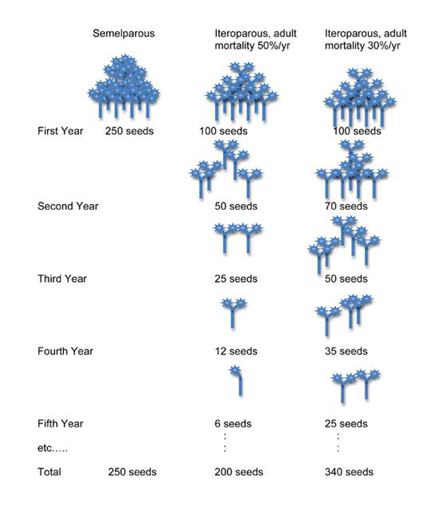
🌸 Semelparous Species
Reproduce once in their lifetime, investing all energy in a single reproductive event, then die.
Examples: Pacific salmon, annual plants, bamboo (after decades), agave
Strategy: "Big bang" reproduction—massive effort, then death
🌳 Iteroparous Species
Reproduce multiple times throughout their lifetime, spreading reproductive effort across years.
Examples: Perennial plants, most mammals, birds, trees
Strategy: Repeated reproduction—lower effort per event, but sustained over time
4. Reproductive Output
📖 Reproductive Output
The number of offspring produced varies with species and environment. High output is common in unstable environments; low output with high investment per offspring is typical of stable environments.
📈 High Output
Many offspring, low investment each
Examples: Plankton (millions of eggs), many insects (thousands of eggs), annual plants (thousands of seeds)
Environment: Unstable, unpredictable
Strategy: Quantity over quality—bet-hedging
📉 Low Output
Few offspring, high investment each
Examples: Large mammals (1-2 offspring), birds (few eggs), perennial plants (few large seeds)
Environment: Stable, predictable
Strategy: Quality over quantity—high survival per offspring
🌍 Reproductive Strategies: r vs. K Selection
Species have evolved different reproductive strategies to maximize fitness in varying environmental conditions. These strategies are typically classified into two extremes: r-selected and K-selected species.
1. r-Selected Species
📖 r-Selected Species
r-selected species have high reproductive rates, short generation times, and minimal parental care. They thrive in unstable, unpredictable environments.
✅ Characteristics
- High reproductive rates (many offspring)
- Short generation times (rapid maturity)
- Minimal parental care (offspring left to fend for themselves)
- Small body size (less energy per individual)
- Short lifespan (die after one or few reproductive events)
✅ Examples
- Insects: Aphids, fruit flies, mosquitoes
- Small rodents: Mice, rats
- Annual plants: Dandelions, weeds, grasses
- Marine invertebrates: Plankton, sea urchins
✅ Advantages & Trade-offs
Advantages: High reproductive output enables rapid population growth, particularly in unstable or unpredictable environments. These species often colonize new or disturbed habitats effectively.
Trade-offs: High mortality rates among offspring due to limited parental investment. Most offspring die before reaching maturity, but enough survive to maintain population.
2. K-Selected Species
📖 K-Selected Species
K-selected species have lower reproductive rates, longer lifespans, and significant parental care. They thrive in stable, competitive environments.
✅ Characteristics
- Lower reproductive rates (few offspring)
- Longer lifespans (years to decades)
- Significant parental care (extensive investment per offspring)
- Large body size (more energy per individual)
- Delayed reproduction (invest in growth first)
✅ Examples
- Large mammals: Elephants, whales, primates
- Birds: Eagles, albatrosses, parrots
- Perennial plants: Oak trees, redwoods, long-lived shrubs
- Reptiles: Tortoises, crocodiles
✅ Advantages & Trade-offs
Advantages: High survival rates of offspring due to extensive parental care and stable environmental conditions. These species are more competitive in stable environments.
Trade-offs: Slower population growth makes these species vulnerable to environmental changes and habitat loss. Slow recovery from population declines.
🌍 Factors Influencing Reproductive Efforts
1. Environmental Conditions
📖 Environmental Conditions
Resource availability, predation risk, and climate directly influence reproductive strategies.
💡 Effects
- Resource scarcity: May lead to fewer offspring with higher parental care (invest quality over quantity)
- Favorable conditions: Often lead to increased reproductive rates (more offspring, faster reproduction)
- High predation: May favor early reproduction (reproduce before being eaten)
- Climate variability: May favor flexible timing (reproduce when conditions are right)
2. Life-History Traits
📖 Life-History Traits
Traits such as age at first reproduction, lifespan, and growth rates shape reproductive efforts.
💡 Effects
- Fast-growing species: Often reproduce earlier and more frequently
- Long-lived species: May delay reproduction to invest in growth and survival
- Age at maturity: Earlier maturity → more reproductive events; later maturity → fewer events but larger offspring
3. Population Density
📖 Population Density
High population density can lead to competition for resources, influencing reproductive output and timing.
💡 Effects
- Density-dependent factors: Can result in smaller brood sizes or delayed reproduction
- Competition: High density → less resources per individual → reduced reproduction
- Stress: Crowding increases stress hormones, reducing reproductive output
4. Evolutionary Pressures
📖 Evolutionary Pressures
Natural selection favors reproductive strategies that enhance survival and fitness in specific environments.
💡 Effects
- Trade-offs: Between quantity and quality of offspring often depend on environmental stability
- Selection pressure: Environments with high mortality favor early, frequent reproduction; stable environments favor delayed, quality-focused reproduction
- Adaptation: Species evolve strategies matching their ecological niche
🌿 Ecological Implications
1. Population Dynamics
📖 Population Dynamics
The balance between birth and death rates, influenced by reproductive efforts, determines population size and growth.
📈 r-Selected Species
May show boom-and-bust cycles in population size. Rapid growth when conditions favorable, rapid decline when conditions deteriorate.
Example: Insect outbreaks, algal blooms
⚖️ K-Selected Species
Often maintain stable population levels. Slow growth, slow decline, more resilient to short-term fluctuations.
Example: Elephant populations, old-growth forests
2. Species Interactions
📖 Species Interactions
Reproductive strategies can influence predator-prey relationships, competition, and mutualism.
💡 Effects
- Predator-prey: Predator populations may fluctuate based on reproductive success of prey species
- Competition: High reproductive output → more competitors → intense competition
- Mutualism: Reproductive timing may synchronize with mutualist partners (e.g., flowering and pollinators)
3. Conservation Biology
📖 Conservation Biology
Understanding reproductive efforts is essential for species conservation and management, particularly for endangered species with low reproductive rates.
💡 Conservation Strategies
- Habitat protection: Preserving breeding grounds and resources
- Captive breeding programs: Assisting reproduction of endangered species
- Minimizing stressors: Reducing human-induced pressures (pollution, disturbance)
- Population monitoring: Tracking reproductive success to assess conservation status
4. Adaptation and Resilience
📖 Adaptation & Resilience
Species with flexible reproductive strategies can adapt better to environmental changes, enhancing their resilience to habitat destruction and climate change.
💡 Examples
- Phenotypic plasticity: Adjusting reproduction timing and output based on conditions
- Flexible strategies: Some species switch between r and K strategies depending on environment
- Resilience: Species with diverse reproductive strategies more likely to survive environmental change
📋 Case Studies
1. Pacific Salmon
🐟 Semelparity Example
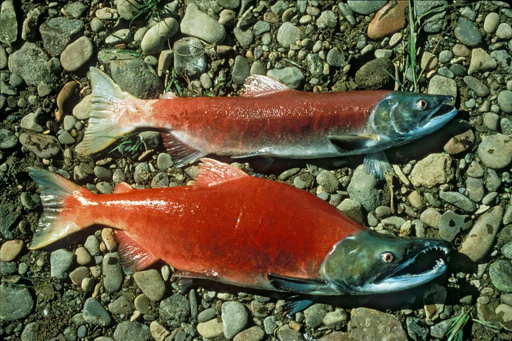
Pacific salmon are a classic example of semelparity. These fish invest all their energy into a single reproductive event, laying thousands of eggs before dying.
Life cycle: Born in freshwater → migrate to ocean → grow for years → return to freshwater → spawn once → die
Strategy: Massive reproductive effort in one event ensures some offspring survive despite high mortality
2. Elephants
🐘 K-Selected Example
Elephants exemplify K-selected strategy. They reproduce slowly, with extended parental care ensuring high offspring survival rates.
Life cycle: Gestation ~22 months → single calf → nursing 2+ years → parental care for years → next reproduction after 4-5 years
Strategy: Low reproductive rate but high offspring survival through extensive care
3. Desert Annual Plants
🌵 r-Selected Plant Example
Desert annual plants reproduce quickly during short wet seasons, producing seeds capable of dormancy until favorable conditions return.
Life cycle: Rain triggers germination → rapid growth → flowering → seed production → seeds dormant until next rain
Strategy: Rapid reproduction during brief favorable periods; seed dormancy ensures survival through unfavorable times
🔑 Key Takeaways
📌 Essential Points
- Reproductive effort is proportion of energy/resources devoted to producing and caring for offspring
- Four components: Energy allocation, parental investment, timing, and reproductive output
- Semelparity: Reproduce once, then die (salmon, annual plants)
- Iteroparity: Reproduce multiple times (perennials, mammals)
- r-selected: High reproduction, short lifespan, minimal care, unstable environments
- K-selected: Low reproduction, long lifespan, extensive care, stable environments
- Factors: Environment, life-history traits, density, evolutionary pressures
- Implications: Population dynamics, species interactions, conservation, adaptation
- Trade-off: Quantity vs. quality of offspring; current vs. future reproduction
- Case studies: Salmon (semelparous), elephants (K-selected), desert annuals (r-selected)
❓ FAQs
🔍 Frequently Asked Questions
A: Reproductive effort is the proportion of an organism's energy and resources devoted to production and care of offspring.
A: Four components: (1) Energy allocation, (2) Parental investment, (3) Timing of reproduction, (4) Reproductive output.
A: Semelparity is reproducing once in lifetime, then dying. Examples: Pacific salmon, annual plants, bamboo.
A: Iteroparity is reproducing multiple times throughout lifetime. Examples: perennial plants, most mammals, birds.
A: r-selected species have high reproductive rates, short generation times, minimal parental care. Examples: insects, annual plants, small rodents.
A: K-selected species have lower reproductive rates, longer lifespans, significant parental care. Examples: large mammals, birds, perennial plants.
A: Environmental conditions, life-history traits, population density, and evolutionary pressures.
A: r-selected species show boom-bust cycles; K-selected species maintain stable populations.
A: Essential for managing endangered species with low reproductive rates. Conservation includes habitat protection, captive breeding, reducing stressors.
A: Trade-off between quantity (many offspring, low investment) and quality (few offspring, high investment). Also between current and future reproduction.
📝 Exam Questions
Short Questions (5 marks each)
- Define reproductive effort in population ecology.
- List four components of reproductive efforts.
- Define semelparity with an example.
- Define iteroparity with an example.
- Compare r-selected and K-selected species (two differences).
- What factors influence reproductive efforts?
- How do reproductive efforts affect population dynamics?
- Why is understanding reproduction important for conservation?
Long Answer Questions (10 marks each)
- Define reproductive effort. Discuss four components with examples from plants and animals.
- Compare and contrast r-selected and K-selected species. Include characteristics, examples, advantages, and trade-offs.
- Discuss factors influencing reproductive efforts. How do environmental conditions and life-history traits shape strategies?
- Explain ecological implications of reproductive efforts. Include population dynamics, species interactions, conservation, and adaptation.
- Describe three case studies of reproductive strategies: Pacific salmon, elephants, and desert annual plants.


0 Comments