💧 Hydrological Dynamics in
Plants
Water Absorption Pathways & Driving Forces
🔍 Introduction: The Journey of Water in Plants
Water absorption is a cornerstone process in plant physiology, fueling growth, development, and environmental resilience. This comprehensive guide explores the hydrological dynamics governing water movement from soil through roots to the entire plant system. We'll examine three distinct absorption pathways (symplast, apoplast, transmembrane) and four major driving forces (osmosis, root pressure, capillarity, transpiration pull) that orchestrate this vital process.
🌿 Plant Water Absorption Pathways
Water absorption in plants is a complex, finely regulated process involving three distinct pathways. Each pathway facilitates water movement through different cellular compartments, collectively ensuring efficient uptake from soil and distribution throughout the plant.

1. Symplast Pathway
📖 Definition: Symplast Pathway
The symplast pathway involves water movement through the living components of plant cells—specifically through interconnected protoplasts (living cell contents) linked by plasmodesmata (cytoplasmic channels).
🔬 Key Characteristics
- Route: Through cytoplasm, endoplasmic reticulum, and organelles via plasmodesmata
- Regulation: Highly controlled and selective—allows plants to coordinate responses to environmental changes
- Speed: Slower than apoplast but more regulated
- Importance: Critical for water uptake from soil into root hairs and transport through root cortex
- Selectivity: Enables selective uptake of water and solutes, maintaining cellular homeostasis
💡 Key Point
The symplast pathway allows water to bypass cell walls, moving directly through living cells. This provides regulatory control but requires crossing multiple membranes via plasmodesmata.
2. Apoplast Pathway
📖 Definition: Apoplast Pathway
The apoplast pathway involves water movement through non-living components—specifically cell walls and intercellular spaces—without entering the protoplasts (living cell contents).
🔬 Key Characteristics
- Route: Through cell walls and extracellular spaces
- Regulation: Less regulated, rapid movement
- Speed: Faster than symplast due to lower resistance
- Checkpoint: Water must transition from apoplast to symplast at the endodermis due to the Casparian strip
- Function: Critical for rapid initial water uptake from soil into root cell walls
⚠️ Important Correction
Original article states: "Water must transition from apoplast to symplast at the endodermis."
Clarification: This is correct! The Casparian strip (waxy band in endodermal cell walls) blocks apoplastic flow, forcing water and solutes to cross cell membranes and enter the symplast. This ensures selective uptake and prevents harmful substances from entering the xylem.
3. Transmembrane (Vacuolar) Pathway
📖 Definition: Transmembrane Pathway
The transmembrane (or vacuolar) pathway involves water movement across cell membranes, specifically into and out of the central vacuole through osmosis.
🔬 Key Characteristics
- Route: Across plasma membrane and tonoplast (vacuolar membrane) into central vacuole
- Mechanism: Driven by osmosis—water moves down water potential gradient
- Function: Regulates cell turgor pressure, essential for cell rigidity and structural integrity
- Storage: Vacuole serves as water reservoir, enabling plants to withstand water fluctuations
- Contribution: Works alongside symplast and apoplast pathways
💡 Integrated Network
All three pathways—symplast, apoplast, and transmembrane—collectively form an intricate network for water absorption and transport. Plants use all three simultaneously, with relative contributions varying by species, environmental conditions, and root zone.
⚙️ Driving Forces Behind Water Absorption
Water absorption is facilitated by four coordinated driving forces that ensure efficient uptake from soil and long-distance transport through the plant.
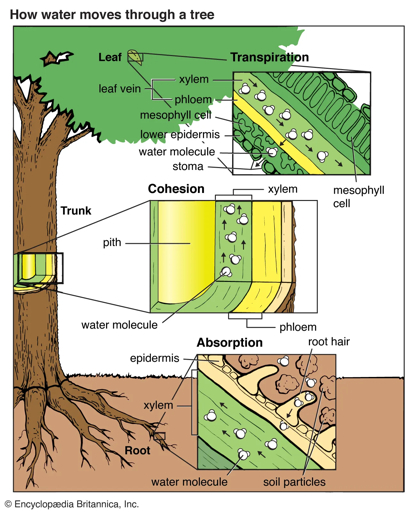
1. Osmosis
📖 Definition: Osmosis
Osmosis is the movement of water molecules across a selectively permeable membrane from an area of lower solute concentration (higher water potential) to an area of higher solute concentration (lower water potential).
🔬 Role in Water Absorption
- Mechanism: Root cells actively pump mineral ions (K⁺, NO₃⁻, etc.) into cytoplasm, creating higher solute concentration inside roots than in soil
- Gradient: Establishes osmotic (water potential) gradient, driving water influx into roots
- Location: Primary mechanism at root hair level and across endodermis
- Energy: Requires ATP for active ion transport, but water movement itself is passive
💡 Water Potential
Water moves from high Ψ (less negative) to low Ψ (more negative). Typical values: Soil (-0.1 to -0.3 MPa) → Root (-0.5 to -1.0 MPa) → Stem (-1.0 to -2.0 MPa) → Leaf (-2.0 to -3.0 MPa) → Atmosphere (-10 to -100 MPa).
2. Root Pressure
📖 Definition: Root Pressure
Root pressure is a positive hydrostatic pressure generated in roots by active uptake of mineral ions, causing water to follow via osmosis and increasing pressure within root cells.
🔬 Key Characteristics
- Mechanism: Active ion transport into xylem → water follows osmotically → positive pressure builds
- Magnitude: Typically 0.1-0.5 MPa (1-5 atmospheres)
- Function: Can push water upward in xylem, especially at night or in spring
- Evidence: Guttation (water droplets on leaf margins) and bleeding from cut stems
- Limitation: NOT the primary force for long-distance transport—insufficient to push water to tree tops
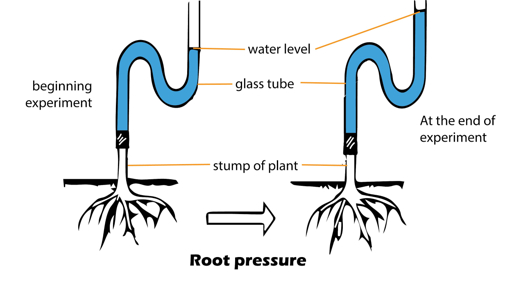
⚠️ Important Clarification
Original article states: "Root pressure is not the primary driving force for long-distance water transport."
Correction: This is correct! Root pressure can push water only a few meters at most. Transpiration pull (cohesion-tension theory) is the primary force for long-distance transport, especially in tall trees.
3. Capillarity (Capillary Action)
📖 Definition: Capillarity
Capillarity is the ability of water to move in narrow spaces (like soil pores and root hair surfaces) against gravity, due to cohesive (water-water) and adhesive (water-surface) forces.
🔬 Key Characteristics
- Mechanism: Adhesion to soil/root surfaces + cohesion between water molecules
- Height: Can raise water only a few centimeters to meters (depending on tube diameter)
- Function: Aids initial absorption from soil into root hairs
- Limitation: NOT sufficient for long-distance transport in tall plants
- Contribution: Minor compared to transpiration pull
💡 Capillarity vs. Transpiration Pull
Capillarity can raise water only short distances (capillary rise formula: h = 2γcosθ/ρgr). In contrast, transpiration pull can lift water 100+ meters in tall trees. Capillarity aids initial uptake; transpiration drives long-distance transport.
4. Transpiration Pull (Cohesion-Tension Theory)
📖 Definition: Transpiration Pull
Transpiration pull is the negative pressure (tension) generated in leaves by water evaporation from stomata, which pulls water upward through the xylem from roots to leaves via the cohesion-tension mechanism.
🔬 Cohesion-Tension Theory
- Transpiration: Water evaporates from leaf mesophyll cells → exits via stomata
- Tension: Evaporation creates negative pressure (tension) in leaf cells
- Cohesion: Water molecules stick together via hydrogen bonds, forming continuous columns
- Adhesion: Water molecules adhere to xylem vessel walls, preventing column collapse
- Pull: Tension transmitted down xylem → pulls water from roots upward
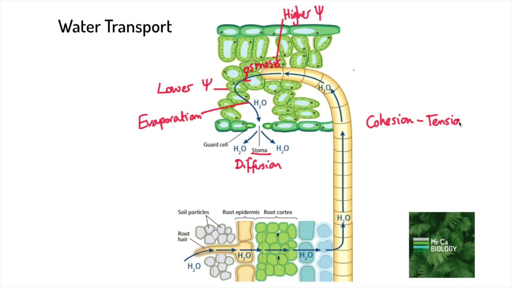
💡 Primary Driving Force
Transpiration pull is the primary driving force for long-distance water transport in plants, especially tall trees. It can generate tensions of -1 to -3 MPa (or more), sufficient to lift water 100+ meters. Root pressure and capillarity are secondary forces.
📊 Comparison of Driving Forces
🔗 Integrated Water Transport System
Water absorption and transport in plants is an integrated system where pathways and driving forces work together:
💡 Complete Pathway
- Soil → Root hairs: Water enters via osmosis, aided by capillarity
- Root hairs → Cortex: Moves through symplast, apoplast, or transmembrane pathways
- Cortex → Endodermis: Casparian strip forces water into symplast (selective uptake)
- Endodermis → Xylem: Water enters xylem vessels
- Roots → Stem → Leaves: Transpiration pull (cohesion-tension) drives long-distance transport
- Leaves → Atmosphere: Water evaporates via stomata (transpiration)

❌ Common Misconceptions (Corrections)
🔍 Misconception 1: Root Pressure Is Primary Force
Correction: Root pressure is NOT the primary force for long-distance transport. It can push water only a few meters. Transpiration pull (cohesion-tension) is the primary force, capable of lifting water 100+ meters.
🔍 Misconception 2: Capillarity Lifts Water to Tree Tops
Correction: Capillarity can raise water only short distances (cm to few meters). It aids initial absorption but is insufficient for tall trees. Transpiration pull does the heavy lifting.
🔍 Misconception 3: Water Moves Only Through Symplast
Correction: Water moves through all three pathways (symplast, apoplast, transmembrane) simultaneously. Relative contributions vary by species and conditions. Apoplast is faster; symplast is more regulated.
🔍 Misconception 4: Casparian Strip Is Optional
Correction: The Casparian strip is essential. It blocks apoplastic flow at the endodermis, forcing water and solutes to cross cell membranes. This ensures selective uptake and prevents harmful substances from entering the xylem.
🔑 Key Takeaways
📌 Essential Points
- Three pathways: Symplast (living cells), apoplast (cell walls), transmembrane (across membranes/vacuoles)
- Symplast: Regulated, slower, through plasmodesmata
- Apoplast: Faster, less regulated, blocked by Casparian strip at endodermis
- Transmembrane: Regulates turgor pressure via vacuolar water storage
- Four driving forces: Osmosis, root pressure, capillarity, transpiration pull
- Osmosis: Primary at root hair level; driven by water potential gradient
- Root pressure: Minor force (0.1-0.5 MPa); causes guttation
- Capillarity: Aids initial absorption; insufficient for tall plants
- Transpiration pull: PRIMARY force for long-distance transport via cohesion-tension
- Casparian strip: Essential checkpoint ensuring selective uptake into xylem
- Water potential gradient: Soil → Root → Stem → Leaf → Atmosphere (increasingly negative)
- Integrated system: Pathways and forces work together for efficient water transport
❓ FAQs
🔍 Frequently Asked Questions
A: (1) Symplast—through living cells via plasmodesmata; (2) Apoplast—through cell walls and extracellular spaces; (3) Transmembrane—across membranes into vacuoles.
A: Symplast moves through living cytoplasm (regulated, slower); apoplast moves through non-living cell walls (faster, less regulated). Apoplast is blocked at endodermis by Casparian strip.
A: The Casparian strip (waxy band in endodermal cell walls) blocks apoplastic flow, forcing water and solutes to cross cell membranes. This ensures selective uptake into the xylem.
A: (1) Osmosis (water potential gradient); (2) Root pressure (positive hydrostatic pressure); (3) Capillarity (adhesion + cohesion); (4) Transpiration pull (cohesion-tension).
A: Transpiration pull (cohesion-tension theory) is the primary force, capable of lifting water 100+ meters. Root pressure and capillarity are minor forces.
A: Root cells actively pump ions into cytoplasm, creating higher solute concentration inside roots than soil. This establishes water potential gradient, driving water influx via osmosis.
A: Root pressure is positive hydrostatic pressure from active ion uptake. It's significant at night, in spring, or in small plants, causing guttation. It's insufficient for tall trees.
A: Transpiration from leaves creates tension (negative pressure). Cohesion between water molecules maintains continuous columns in xylem. Adhesion to vessel walls prevents collapse. Tension pulls water upward from roots.
A: Capillary rise is limited by tube diameter (h = 2γcosθ/ρgr). Even in narrow xylem vessels, capillarity can raise water only a few meters at most. Transpiration pull is needed for tall trees.
A: Soil (-0.1 to -0.3 MPa) → Roots (-0.5 to -1.0 MPa) → Stem (-1.0 to -2.0 MPa) → Leaves (-2.0 to -3.0 MPa) → Atmosphere (-10 to -100 MPa). Water flows down this gradient.
📝 Exam Questions
Short Questions (5 marks each)
- Define symplast pathway and explain its characteristics.
- What is the apoplast pathway? Where is it blocked?
- Describe the transmembrane pathway and its function.
- What is the Casparian strip and why is it important?
- Define osmosis and explain its role in water absorption.
- What is root pressure? Is it the primary force for water transport?
- Explain capillarity and its contribution to water absorption.
- What is transpiration pull? Why is it the primary driving force?
- Describe the cohesion-tension theory of water transport.
- What is the water potential gradient from soil to atmosphere?
Long Questions (10 marks each)
- Describe the three water absorption pathways in plants. Compare their characteristics, routes, and relative contributions.
- What is the Casparian strip? Explain its location, structure, and physiological significance in water and solute uptake.
- Discuss the four driving forces for water absorption in plants. Which is primary for long-distance transport and why?
- Explain the cohesion-tension theory of water transport. Include the roles of transpiration, cohesion, adhesion, and tension.
- Compare and contrast root pressure, capillarity, and transpiration pull. Why is transpiration pull the primary force in tall trees?
- Trace the complete pathway of water from soil to atmosphere, including absorption pathways and driving forces at each stage.


0 Comments